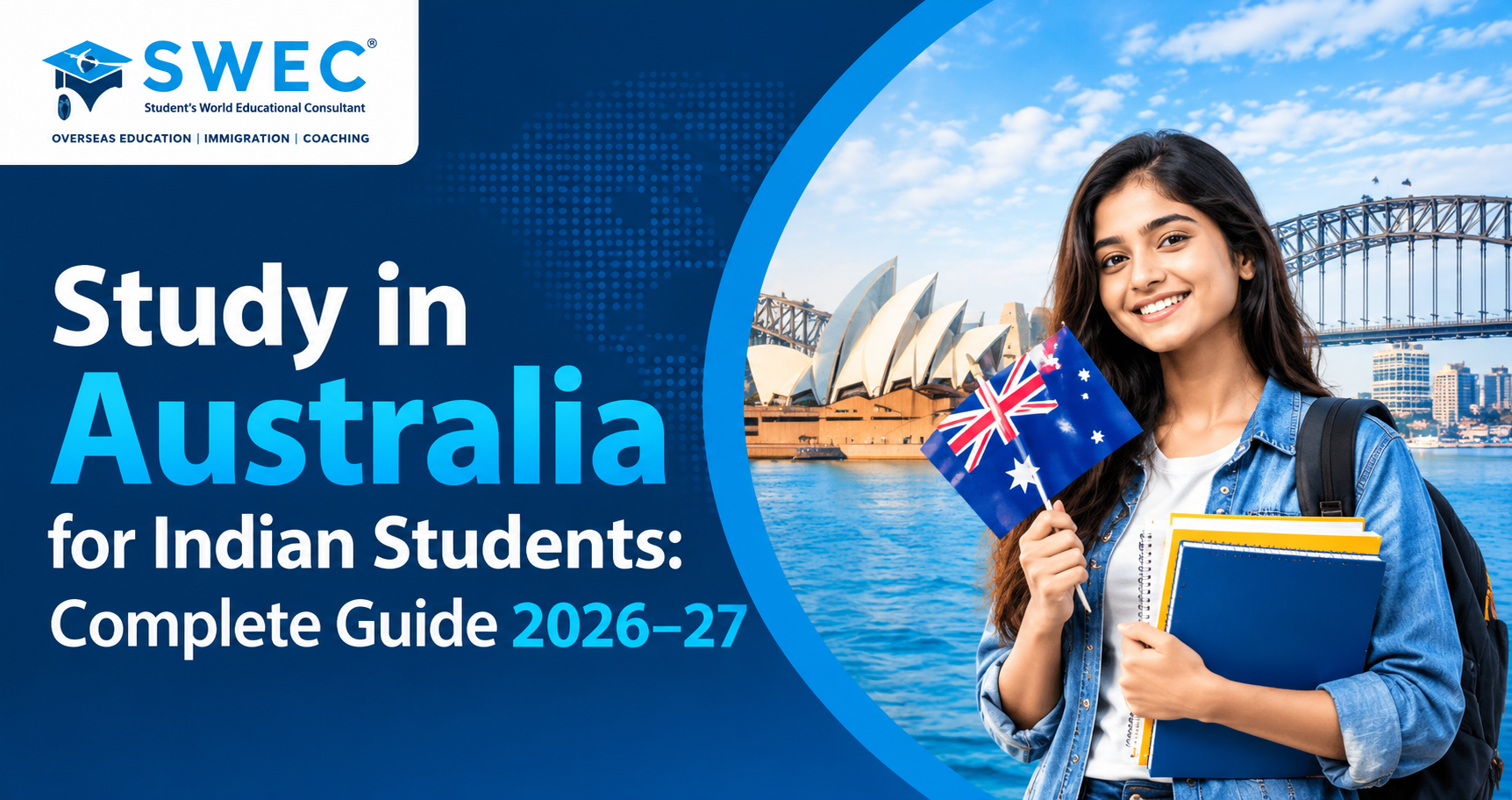
Australia is a popular destination for Indian students seeking internationally recognised qualifications, practical learning opportunities and exposure to a multicultural environment. From undergraduate degrees after Class 12 to postgraduate and research programmes, Australian education providers offer courses across business, engineering, information technology, healthcare, science and many other fields.
However, planning to study in Australia involves more than choosing a university. Students must understand admission requirements, tuition fees, financial evidence, English-language requirements and the Australian Student visa application process.
This guide explains the Australia study visa process for Indian students in 2026–27, including eligibility, the application procedure, current visa fees, proof of funds, work rights, scholarships and post-study options. It also covers practical considerations to help students prepare for life in Australia.
Visa requirements, fees and policies can change. Always verify the latest information through official Australian Government sources before submitting an application.
Why Choose Australia for Higher Education?
Australia offers a range of educational opportunities for international students. The right destination depends on your academic interests, budget, career objectives and preferred learning environment.
Some benefits of studying in Australia include:
Internationally recognised qualifications: Australian education providers offer qualifications that may support career opportunities in Australia and other countries.
A wide choice of courses: Students can explore undergraduate, postgraduate, vocational and research programmes.
Practical learning: Many courses incorporate projects, practical assignments, laboratory work or industry-related learning.
Multicultural communities: International students can meet people from different cultural and educational backgrounds.
Student support services: Many institutions provide academic support, counselling, career services and assistance for international students.
Potential post-study options: Eligible graduates may be able to apply for a temporary graduate visa, subject to the rules in force at the time.
Students should compare course content, tuition fees, location, career relevance and entry requirements before selecting an institution. Studying in Australia does not automatically guarantee employment or permanent residency.
Top Australian Universities for Indian Students
Australia has universities offering programmes across a broad range of disciplines. The following institutions are useful starting points for students researching study options.
| University | What to research |
|---|---|
| The University of Melbourne | Undergraduate, postgraduate and research programmes |
| Monash University | Business, engineering, health and technology programmes |
| The University of Sydney | Business, engineering, health and other disciplines |
| Australian National University (ANU) | Research, science, public policy and other fields |
| UNSW Sydney | Engineering, business, technology and research |
| The University of Queensland (UQ) | Science, engineering, business and health |
| RMIT University | Technology, design, business and applied learning |
| Deakin University | Business, health, IT and professional programmes |
| The University of Western Australia (UWA) | Science, engineering, business and research |
| University of Technology Sydney (UTS) | Technology, business, design and applied disciplines |
| University of Wollongong | Engineering, IT, business and research |
| Macquarie University | Business, IT, health and other disciplines |
This is not a ranking, and course availability varies by institution and intake. Check each university’s official website for current programmes, entry requirements, tuition fees, scholarships and application deadlines.
You can also explore courses and education providers through the official Study Australia website.
Eligibility to Study in Australia for Indian Students
Eligibility depends on the course, institution and visa requirements. Admission to an Australian university and eligibility for a Student visa are related but separate assessments.
Academic requirements
Students must meet the academic entry requirements for their chosen course.
After Class 12: Applicants may consider eligible bachelor’s degrees, diplomas, foundation programmes or vocational courses. Required subjects and marks depend on the institution and course.
After a bachelor’s degree: Applicants may explore relevant postgraduate programmes, subject to the institution’s entry criteria.
For research programmes: Applicants may need relevant academic qualifications, a research proposal, supervisor approval or other evidence.
For vocational courses: Entry requirements vary according to the programme and education provider.
There is no universal percentage requirement that applies to every Australian institution. Some courses may also consider portfolios, relevant work experience, interviews or prerequisite subjects.
Students with academic backlogs or study gaps should check the provider’s requirements and prepare a clear explanation of their academic history where relevant.
English-language requirements
Many courses require evidence of English-language proficiency. Depending on the institution, course and applicable rules, accepted tests may include IELTS, PTE Academic and other approved examinations.
The minimum score is not the same for every course or applicant. A university may require a higher score than the minimum applicable for a visa, and exemptions may apply in certain circumstances.
Before taking an English test, confirm:
Which tests your education provider accepts.
The minimum overall score and any section-score requirements.
Whether the result meets the applicable visa evidence requirements.
How long the test result remains valid for your intended application.
Do not assume that one IELTS or PTE score is suitable for every university and Student visa application.
Australia Study Visa Requirements for Indian Students
Indian students generally need a Student visa (subclass 500) to study an eligible course in Australia. Applicants must meet the applicable visa criteria and provide the evidence requested for their circumstances.
The main requirements may include the following.
1. Confirmation of Enrolment (CoE)
Students will generally need a valid Confirmation of Enrolment from an eligible Australian education provider.
To obtain a CoE, students usually need to complete the institution’s admission and enrolment steps, accept the offer and make any required payments.
Check the course name, enrolment details and dates carefully. Your CoE must remain valid when the Department of Home Affairs decides the visa application.
2. Genuine Student (GS) requirement
The Genuine Student requirement applies to Student visa applications lodged on or after 23 March 2024. It replaced the previous Genuine Temporary Entrant (GTE) requirement for these applications.
The assessment considers whether studying in Australia is the applicant’s primary reason for applying for the visa.
Applicants are asked questions about their circumstances, course choice, understanding of studying and living in Australia, and the potential benefits of completing their course.
When preparing your answers:
Explain why you selected the particular course and institution.
Describe how the course relates to your previous education, experience or future plans.
Demonstrate that you understand the course requirements and expected costs.
Provide accurate information supported by relevant evidence.
Ensure your statements are consistent with your academic history and financial documents.
The online application includes GS questions with a 150-word limit for each response. Follow the current instructions in your application and avoid generic or unsupported statements.
Read the official Genuine Student requirement guidance before applying.
3. Financial capacity
Applicants may need to demonstrate access to sufficient funds for tuition fees, living expenses, travel and other applicable costs.
Evidence requirements depend on the applicant’s circumstances. Documents may include bank statements, eligible education loan records, scholarship documents, financial sponsorship evidence or other accepted records.
The financial evidence should be genuine, consistent and sufficient under the applicable rules.
4. Overseas Student Health Cover (OSHC)
Most international students must maintain Overseas Student Health Cover for the required period of their stay, unless an exemption applies.
Check the required coverage period and make sure your policy meets the relevant conditions. Include the cost of insurance in your overall study budget.
5. Health, character and supporting documents
Applicants may be asked to complete health examinations, provide character-related documents or submit additional evidence. Requirements vary according to individual circumstances.
Use the Australian Government’s document checklist and application instructions to determine what you need to provide.
Australia Study Visa Requirements After 12th
Students who have completed Class 12 in India can explore undergraduate degrees and other eligible study pathways in Australia.
The appropriate pathway depends on your subjects, academic results, English proficiency, budget and career objectives.
Follow these steps before applying:
Identify courses that match your Class 12 subjects and career plans.
Check the academic requirements and prerequisite subjects.
Confirm the English-language requirements for your course.
Compare tuition fees, accommodation costs and living expenses.
Apply to suitable education providers with the required documents.
Accept an offer and complete the institution’s enrolment requirements.
Obtain your valid CoE and arrange OSHC.
Prepare your financial evidence and Genuine Student responses.
Lodge your Student visa application when you meet the applicable requirements.
Students should choose courses based on their educational value and suitability, rather than assuming that a particular course guarantees a visa or permanent residency.
Types of Australian Visas Relevant to Students
Different Australian visas serve different purposes. It is important to distinguish a visa for studying from visas that may be relevant to guardians or eligible graduates.
| Visa | General purpose |
|---|---|
| Student visa (subclass 500) | Allows eligible applicants to study an approved course in Australia, subject to visa conditions |
| Student Guardian visa (subclass 590) | May allow an eligible parent or guardian to accompany a student who meets the relevant age and welfare requirements |
| Temporary Graduate visa (subclass 485) | May allow eligible graduates to stay temporarily after completing qualifying studies, subject to the applicable stream and criteria |
These visas have different eligibility criteria. A Student visa holder should not assume that they automatically qualify for a graduate or guardian visa.
For the latest Student visa information, visit the official Student visa subclass 500 page.
Australia Student Visa Fees in 2026–27
The standard Student visa application charge for the primary applicant increased to AUD 2,500 from 1 July 2026. Certain concessions apply to specified applicants and course categories.
This charge is only one part of the cost of studying in Australia. Your total budget may include:
Tuition fees and any required initial payment.
Student visa application charges.
English-language test fees.
OSHC premiums.
University application or enrolment charges, where applicable.
Document translation or certification costs, where required.
Airfare and initial accommodation.
Living expenses, transport and personal costs.
Visa charges can change, so confirm the amount applicable to your circumstances before paying.
Check the official Student visa application charge update and the Student visa subclass 500 page for current information.
Australia Student Visa Financial Requirements and Proof of Funds
Proof of funds is an important part of the Australia student visa process. Applicants may need to show that they can cover the applicable tuition fees, living expenses, travel costs and expenses for eligible accompanying family members.
The total amount required depends on your course, the tuition already paid, your family circumstances and the financial evidence rules that apply to your application.
Published living-cost figures
The following are published 12-month living-cost figures for relevant applicants:
| Applicant or expense | Published amount |
|---|---|
| Student applicant | AUD 29,710 |
| Partner accompanying the student | AUD 10,394 |
| Each dependent child | AUD 4,449 |
| Schooling costs for each school-age dependent child, where applicable | AUD 13,502 per year |
These figures are not the total cost of studying in Australia. You may also need to account for first-year tuition fees, less eligible tuition already paid, and applicable travel expenses.
Financial-capacity requirements and accepted evidence can change. Check the official Student visa financial-capacity guidance before lodging your application.
What documents may be used as financial evidence?
Depending on your circumstances and the evidence requirements, you may be asked to provide:
Bank statements or other accepted evidence of accessible funds.
An eligible education loan document.
Scholarship or sponsorship documentation.
Evidence of your relationship with a financial sponsor.
Relevant income documents where you rely on a permitted annual-income option.
Other documents requested by the Department of Home Affairs.
A bank balance certificate on its own may not explain the source of the money or prove that you can access it. Prepare consistent supporting documents and follow the evidence requirements for your application.
Who can sponsor an Australian student?
Financial support may come from parents, a spouse or another source accepted under the applicable rules. Scholarships and eligible education loans may also be relevant.
Do not assume that every relative’s funds will automatically be accepted. Confirm which forms of financial evidence are permitted and provide the supporting documentation requested.
How much money is needed in Indian rupees?
The equivalent amount in Indian rupees depends on the AUD–INR exchange rate at the time of calculation.
For budgeting purposes, calculate your tuition fees, living expenses, travel, insurance and other costs separately. Exchange-rate movements and bank charges may affect the amount you ultimately need.
Australia Study Visa Process: Step-by-Step
Understanding the Australia study visa process helps you prepare your admission and visa documents in the correct order.
Step 1: Choose your course and education provider
Research courses that match your academic background and career plans. Compare the course structure, entry requirements, fees, location and student support services.
Confirm that the education provider and course meet the applicable requirements for international students.
Step 2: Apply for admission
Prepare your academic transcripts, certificates, passport details, English-language results and other documents requested by the institution.
Submit your application and respond to any requests for additional information. Some programmes may require interviews, portfolios, prerequisite subjects or relevant work experience.
Step 3: Accept your offer and obtain a CoE
Review your offer carefully and complete the provider’s acceptance and payment requirements.
Once your enrolment is confirmed, obtain your valid Confirmation of Enrolment. Check all course and personal details before proceeding.
Step 4: Arrange your finances and OSHC
Calculate your tuition, living costs, travel expenses and other expected costs. Prepare the financial evidence required for your application.
Arrange the required OSHC and check that the cover meets the conditions applicable to your intended stay.
Step 5: Prepare the visa documents
Depending on your circumstances, the documents may include:
A valid passport and identity information.
Confirmation of Enrolment.
Academic records and certificates.
English-language evidence, where required.
Financial-capacity evidence, where required.
Genuine Student responses and supporting documents.
OSHC details.
Health, character or other documents requested by the authorities.
Use the official document checklist for your application. Not every applicant will have identical requirements.
Step 6: Lodge your online Student visa application
Complete the application through the Australian Government’s designated online system. Answer every question accurately and upload the requested documents.
Pay the applicable visa charge and review your application before submitting it.
Important: Where you can lodge your application depends on your current visa status and circumstances. Rules that took effect on 2 October 2026 changed who can apply for a Student visa while already in Australia. Check the latest requirements before planning an onshore application.
Step 7: Complete any additional requests
You may be asked to provide additional documents, complete health examinations or provide biometrics where applicable.
Monitor your application account and email, and respond within the specified time limits.
Step 8: Wait for the decision
Student visa processing times vary according to application circumstances, completeness and other factors. Consult the official processing-time guide rather than relying on a fixed number of weeks.
Avoid making non-refundable travel plans based on an assumed visa approval date.
Step 9: Prepare for departure
After your visa is granted, review the grant letter and conditions. Arrange accommodation, travel, insurance and any required enrolment steps with your institution.
Keep copies of important documents and follow the provider’s instructions for arriving in Australia.
Maintaining Your Student Visa Validity in Australia
Receiving a Student visa is only one stage of your study journey. You must continue to comply with the conditions attached to your visa while living in Australia.
Important responsibilities may include:
Remain enrolled: Maintain the enrolment required by your visa and follow the rules applicable to your course.
Meet academic requirements: Maintain satisfactory course progress and attendance where required by your provider and visa conditions.
Maintain OSHC: Keep the required health insurance in place unless an exemption applies.
Follow work conditions: Check your individual work rights before accepting employment or increasing your hours.
Keep your contact details updated: Notify your education provider of changes to your residential address and other information when required.
Follow visa conditions: Use your visa grant information and the Visa Entitlement Verification Online (VEVO) system to confirm the conditions that apply to you.
Plan any course changes carefully: Before changing your course, provider or qualification level, check the effect on your enrolment and visa conditions. You may need to meet additional requirements or apply for another visa.
Do not assume that changing courses or extending your studies will automatically extend your visa. Seek accurate advice before making changes that could affect your status.
Work Rights for International Students in Australia
Student visa holders may generally work up to 48 hours per fortnight while their course is in session, subject to the conditions of their visa.
Different rules apply in certain circumstances. Eligible master’s-by-research and doctoral students may have different work-hour arrangements under the applicable rules.
Keep these points in mind:
Confirm your individual work conditions through VEVO or your visa grant letter.
Do not work before your course starts unless your visa permits it.
Follow the work limits and conditions that apply to your visa.
Continue meeting your enrolment and course obligations.
Do not rely on future part-time earnings as a substitute for meeting the financial-capacity requirements.
International students have workplace rights and protections under Australian law. Check official information before starting a job.
Post-Study Work Options in Australia
Some international graduates may qualify for the Temporary Graduate visa (subclass 485), which can allow eligible applicants to stay temporarily in Australia after completing a qualifying course.
Eligibility and visa duration depend on the relevant stream, qualification, age, previous visa status and other criteria. Requirements can change, so graduates should confirm the rules applicable when they intend to apply.
Before selecting a course, consider whether it supports your educational and career objectives. Do not assume that a qualification guarantees a post-study work visa, employment or permanent residency.
For current information, visit the official Temporary Graduate visa page.
Scholarships in Australia for Indian Students
Scholarships may help eligible students reduce their education expenses. Availability depends on the institution, course, academic performance, nationality and the conditions of the scholarship.
Students can research:
Australian university merit scholarships.
Faculty-specific scholarships.
Government-funded opportunities for eligible applicants.
Research scholarships for qualifying postgraduate research students.
Tuition-fee reductions offered by education providers.
Examples of institutions where students can research scholarship opportunities include the University of Sydney, Monash University, Deakin University, Macquarie University and Griffith University.
Scholarship amounts, application deadlines and eligibility conditions vary. Check each institution’s official scholarship page for current details rather than relying on amounts published in older articles.
Before accepting a scholarship, confirm whether it covers full or partial tuition, living costs or other expenses. Receiving a scholarship does not necessarily remove the requirement to meet applicable visa financial-evidence rules.
Adjusting to Life in Australia
Preparing for life in Australia can help you settle into your new environment and focus on your studies.
Accommodation and budgeting
Research university accommodation, shared housing and other suitable options before travelling. Compare rent, transport access, utility costs and the distance from your campus.
Create a monthly budget covering rent, food, transport, phone bills, insurance and personal expenses. Actual costs vary by city and lifestyle.
Culture and communication
Australia has diverse communities and students from many countries. Be open to different cultural practices, communication styles and social settings.
Familiarising yourself with local customs and everyday expressions can make it easier to communicate with classmates, teachers and colleagues.
Student support
Find out what support your university provides, including international student services, academic assistance, counselling and career guidance.
If you face difficulties with housing, study or personal wellbeing, contact the relevant student support service rather than trying to manage every issue alone.
Health and safety
Understand your OSHC arrangements and how to access medical care. Keep emergency contact information available and learn the safety guidance provided by your education provider and local authorities.
Transport and daily essentials
Research public transport, campus facilities, nearby grocery shops and other everyday services. Check local transport costs and any student concessions available to you.
Practical Tips for Indian Students Planning to Study in Australia
A little preparation can help you avoid unnecessary costs and delays.
Start researching early. Course availability, admission deadlines and scholarship dates vary by institution.
Choose a suitable course. Ensure that your course choice aligns with your academic background and realistic career goals.
Compare total costs. Consider tuition, accommodation, insurance, transport, travel and personal expenses.
Prepare financial documents carefully. Ensure that funds are accessible and that supporting records are genuine and consistent.
Plan your English test. Confirm the accepted examination and required scores before booking.
Keep copies of your documents. Store digital copies of your passport, offer letter, CoE, insurance and visa records securely.
Understand visa conditions. Review your grant letter and use official sources to check work and study obligations.
Research accommodation before travelling. Be cautious of rental requests that cannot be independently verified.
Avoid guaranteed-visa promises. No consultant can guarantee a visa outcome; the decision rests with the relevant authorities.
Check official updates. Visa fees, financial requirements and application rules can change.
Important Australian Student Visa Changes in 2026
Students planning to apply in 2026–27 should verify current requirements before making financial or travel commitments.
Student visa application charges
From 1 July 2026, the standard Student visa application charge for the primary applicant increased to AUD 2,500. Concessions apply to certain applicants and course categories.
Rules for applying from within Australia
Changes effective from 2 October 2026 affect who can apply for and be granted a Student visa while in Australia, including some existing Student visa holders applying for another Student visa.
Most applicants need to apply from outside Australia unless they meet an applicable exemption. Students already in Australia should confirm their eligibility before planning an onshore application.
Including family members
The rules for including family members in Student visa applications have also changed. Eligibility depends on the applicant’s circumstances and applicable exemptions. Family members generally cannot simply be added after a Student visa has been granted.
Read the official Student visa application rules and changes before making plans.
How SWEC Can Help You Plan Your Studies in Australia
Planning to study in Australia involves selecting a suitable course, understanding admission requirements, organising supporting documents and preparing for the relevant visa criteria.
At SWEC, we help students understand their study options and prepare for the steps involved in applying to international education providers. Our guidance may include course selection, admission documentation and preparation for the student visa process.
Every student’s academic background, finances and future plans are different. We encourage applicants to review their circumstances carefully and use current official requirements when preparing their applications.
If you are planning to study in Australia, visit our Australia student visa service page to learn more about our services.
Planning to study in Australia in 2026–27? Contact SWEC to discuss your academic background, preferred course and next steps.
Frequently Asked Questions About the Australia Study Visa Process
1. What is the Australia study visa process for Indian students?
The process generally involves selecting a suitable course, applying to an Australian education provider, receiving a valid CoE, arranging OSHC, preparing financial and other supporting documents, meeting the Genuine Student requirement and lodging the Student visa application online. Applicants must meet the requirements that apply to their circumstances.
2. What are the Australia study visa requirements after 12th?
Students who have completed Class 12 should check the academic and subject requirements for their chosen undergraduate or other eligible course. They may also need to meet English-language requirements, obtain a CoE, prepare financial evidence and satisfy the relevant Student visa criteria.
3. How much is the Australia student visa fee in 2026–27?
As of October 2026, the standard Student visa application charge for the primary applicant is AUD 2,500. Certain concessions apply. Check the official fee information before lodging your application because charges may change.
4. How much bank balance is required for an Australia student visa?
There is no single bank-balance figure that represents the total cost for every student. Applicants may need to demonstrate funds for the applicable living costs, tuition fees, travel and other required expenses. The published 12-month living-cost figure for a student is AUD 29,710, but this is only one component of the financial-capacity requirement.
5. Is IELTS compulsory for an Australia student visa?
Not every applicant has the same English-language evidence requirements. The accepted tests and minimum scores depend on the applicable visa rules, any exemptions and the education provider’s admission criteria. Check both sets of requirements before applying.
6. Can Indian students work while studying in Australia?
Student visa holders may generally work up to 48 hours per fortnight while their course is in session, subject to their visa conditions. Different rules may apply to certain research-degree students. Students should confirm their individual work rights before accepting employment.
7. How long does an Australia student visa take to process?
Processing times vary according to individual circumstances, application completeness and other factors. Students should consult the Australian Government’s current processing-time guide and submit all required information accurately. No particular processing period or visa outcome can be guaranteed.
8. Can I get permanent residency after studying in Australia?
Studying in Australia does not automatically lead to permanent residency. Some graduates may qualify for temporary graduate or other visas, while permanent migration depends on separate eligibility criteria and the rules in force at the time. Review your options using official government information.
9. Can I take my spouse or children with me on an Australia student visa?
Eligibility to include family members is subject to the current rules and applicable exemptions. Changes effective from 2 October 2026 restrict the circumstances in which family members can be included in Student visa applications. Check the latest Home Affairs guidance before making plans.
10. Can I apply for an Australia student visa without a CoE?
A valid Confirmation of Enrolment is generally required for a Student visa application to be valid and remain eligible for a decision. Students should confirm their enrolment details and ensure the CoE is valid when required by the Department of Home Affairs.
11. Which intake is best for studying in Australia?
The best intake depends on the institution and course. Many universities have major intakes around the beginning and middle of the year, but availability varies. Check the exact course’s start dates and application deadlines before planning your studies.
12. Is a study gap accepted for an Australia student visa?
A study gap does not automatically mean that an application will be refused. Applicants should explain relevant gaps clearly and provide supporting information where appropriate. The course choice, academic history, circumstances and overall evidence may be considered under the applicable requirements.
13. Who can sponsor my studies in Australia?
The accepted financial evidence depends on the applicable rules and your circumstances. Parents, a spouse, scholarships, eligible education loans or other permitted sources may be relevant. Applicants should confirm which evidence is accepted and provide documents establishing access to the funds.
14. Is there an age limit for an Australia student visa?
There is no universal upper age limit that applies to every Student visa applicant. However, applicants must meet the relevant visa criteria and satisfy the Genuine Student requirement. Age, academic history, previous employment and course choice may be relevant to explaining individual circumstances.
15. Which course is best for permanent residency in Australia?
There is no course that guarantees permanent residency. Migration eligibility depends on the rules in force, the occupation and visa pathway, qualifications and other criteria. Choose a course that fits your interests and career objectives, and research current official migration requirements separately.
16. Can I stay in Australia after completing my studies?
Some graduates may qualify for a Temporary Graduate visa or another visa, subject to the relevant eligibility requirements. Completing an Australian course does not automatically grant permission to stay or work after graduation. Check the applicable visa rules before making plans.
17. How much does it cost to study in Australia in Indian rupees?
The total cost depends on tuition fees, location, accommodation, insurance, travel and personal expenses. Calculate your budget in Australian dollars and convert it using a current AUD–INR exchange rate. Allow for exchange-rate movements and other charges.
18. Can I bring my parents to Australia on a Student visa?
A Student visa does not automatically allow parents to accompany an adult student as dependants. A parent may need to consider a separate visa that matches the purpose of their visit and meet the relevant requirements. Check current Australian Government guidance before making travel plans.
Final Thoughts
The Australia study visa process for Indian students requires careful planning, accurate documentation and a clear understanding of current requirements. Selecting the right course, meeting admission criteria, arranging finances and preparing your Genuine Student responses are important steps towards making an informed application.
Students should also plan for accommodation, living expenses, visa conditions and possible post-study options before travelling.
Visa rules, application charges and financial requirements can change. Always check official Australian Government information before lodging your application, and avoid relying on outdated figures or promises of guaranteed visa approval.
With thorough research and preparation, you can make a more informed decision about studying in Australia in 2026–27.