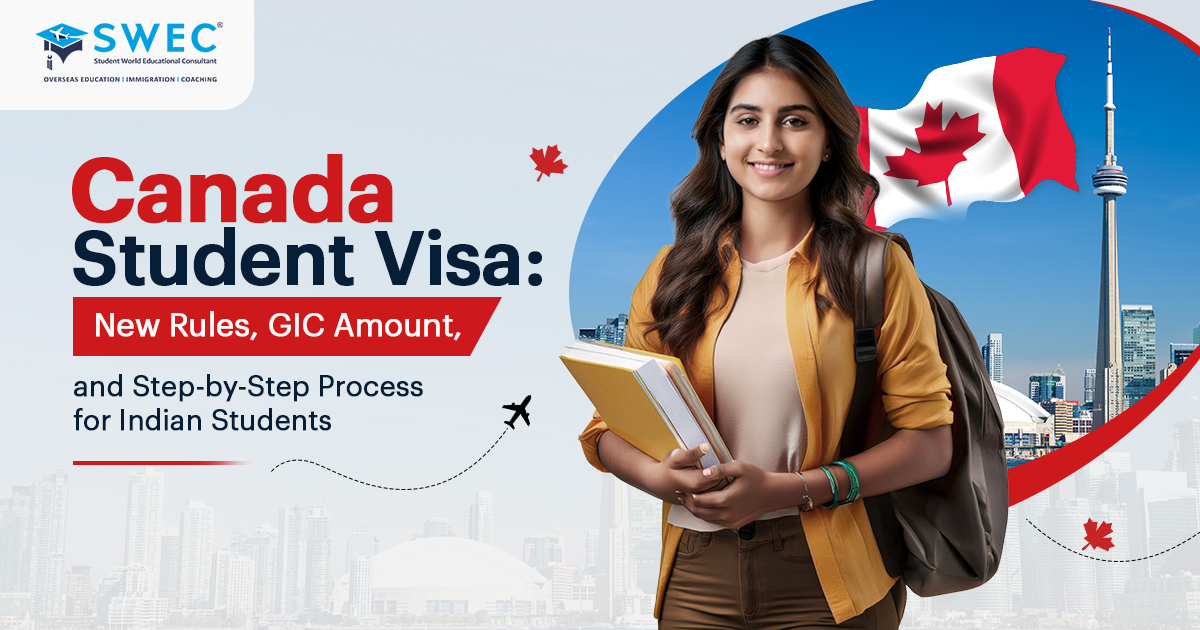
Getting an admission letter from a Canadian college is exciting, but it’s really just the starting point. Before you board a flight, your Canada student visa file has to convince an immigration officer of three things: your course choice makes sense, your money is genuine, and your paperwork holds together without gaps.
Here’s something most applicants don’t realize until they start researching: in Canada, “student visa” is really the everyday name people use for what’s officially a study permit. And because financial thresholds, document rules, and processing timelines shift year to year, treat this guide as a starting point, and always confirm the specifics against IRCC’s official instructions before you submit anything.
Last Updated: August 2026
Key Takeaways
- A study permit is what lets you study in Canada. A visa or eTA is what gets you there in the first place. The two are not the same thing.
- If you’re a single applicant applying from outside Quebec, you’ll need to show CAD 22,895 for living costs, and that figure doesn’t include tuition or travel.
- SDS has been discontinued, so Indian applicants now go through the regular Canada study permit route like everyone else.
- A GIC can support your financial proof, but it isn’t something every applicant is required to have.
- Your course selection, your study plan, and where your funds come from can all tip the scales on approval.
What Is a Canada Student Visa?
When people say “Canada student visa,” they usually mean the Canada study permit, the document that actually authorizes you to study at an approved Canadian institution.
You’ll typically need a study permit if your program runs longer than six months and your school is a Designated Learning Institution (DLI). Some short courses fall outside this requirement, but it’s worth confirming before you make any travel plans.
IRCC may also issue a Temporary Resident Visa (TRV) alongside your approval, and most Indian citizens need one of these to travel to Canada in the first place. If you want the government’s own breakdown before you start assembling your file, their study permit document requirements page is worth bookmarking.
Canada Student Visa vs. Canada Study Permit: What’s the Difference?
| Document | Purpose | When You Receive It | What It Allows |
|---|---|---|---|
| Study permit | Permission to study | Usually issued at the Canadian border after approval | Study at the approved institution |
| TRV or eTA | Travel document | Issued alongside approval when required | Board a flight and request entry to Canada |
| Port-of-entry letter | Approval confirmation | After IRCC approves your application | Proof of approval to show when you travel |
Keep in mind that a study permit doesn’t override every travel or entry requirement on its own. The border officer still has the final say on whether you’re allowed in when you actually arrive.
Canada Student Visa New Rules for Indian Students in 2026
IRCC keeps assessing the same core things: your school, the program you’ve chosen, your study purpose, your academic history, and whether you can genuinely afford it. What they’re really looking for is a file where every piece tells the same story.
If you’re submitting your application on or after September 1, 2025, a single applicant outside Quebec needs to show CAD 22,895 for annual living expenses, and that’s separate from first-year tuition and transportation costs. The older figure of CAD 20,635 only applied through August 31, 2025, so make sure you’re not working off outdated numbers.
The Student Direct Stream shut down on November 8, 2024. That means Indian applicants now go through the same regular Canada study permit process as everyone else. There’s no fast-track shortcut anymore.
Most applicants still need a Provincial Attestation Letter (PAL) or Territorial Attestation Letter (TAL). One exception worth knowing: as of 2026, master’s and doctoral students at public DLIs are exempt from this requirement. Rules like this shift, though, so double-check with IRCC before you pay any tuition or lock in your documents.
Canada Student Visa Requirements for Indian Students
Your application should demonstrate, clearly and not just technically, that you meet the Canadian study permit requirements:
- A valid Letter of Acceptance from a DLI
- A PAL or TAL, where it applies to you
- A valid passport with accurate identity details
- Academic transcripts, certificates, and language scores where relevant
- Proof that you can cover tuition, living costs, and travel
- A study plan that actually explains your reasoning
- Medical or police documents, if IRCC asks for them
Meeting the checklist isn’t the same as getting approved. The officer reviewing your file needs to walk away convinced you’re a genuine temporary student who intends to follow Canada’s immigration rules, not just someone who ticked every box.
How Your Study Plan and Course Choice Affect Approval
A strong study plan connects the dots between your past education, work experience, the course you’ve picked, and where you’re headed afterward. Vague statements like “Canada has better opportunities” don’t do that. An officer has read that line hundreds of times, and it tells them nothing about you specifically.
Instead, explain why this particular program fits where you’ve already been and where you’re trying to go. If there are gaps in your education, an unusual jump between fields, or anything that doesn’t flow logically on paper, address it directly. Leaving it unexplained is what tends to raise questions.
What Is a GIC for a Canada Student Visa?
A Guaranteed Investment Certificate, or GIC for Canada, is a Canadian bank investment that demonstrates you have funds set aside for living costs. Once you arrive, the bank typically releases part of that money upfront and pays out the rest in scheduled installments.
A GIC can genuinely strengthen your financial file, but it’s not automatically the entire proof-of-funds package, and it’s not mandatory for every applicant now that SDS is gone. Whether you need one really depends on your specific application route, your bank’s terms, and what IRCC currently requires, so it’s worth checking rather than assuming.
Current GIC Canada Amount and Proof of Funds

For applications submitted on or after September 1, 2025, from outside Quebec, here’s what IRCC currently lists for living-expense amounts:
| Family Members, Including You | Annual Living Funds Required |
|---|---|
| 1 | CAD 22,895 |
| 2 | CAD 28,502 |
| 3 | CAD 35,040 |
| 4 | CAD 42,543 |
| 5 | CAD 48,252 |
| 6 | CAD 54,420 |
| 7 | CAD 60,589 |
| Each additional person | CAD 6,170 |
These numbers sit separately from tuition and transportation costs. Quebec runs its own financial rules, so don’t assume the table above applies there. And since exchange rates move constantly, don’t treat any rupee conversion you see online as an official figure. Check IRCC’s proof of financial support guidance directly before you transfer anything.
How to Open a GIC Account for Canada
Pick a participating bank and actually read through its fees, refund policy, and payment structure before committing. Complete their identity verification, transfer the required amount, and hold onto your investment certificate, transfer receipt, and source-of-funds records, since you’ll likely need them again later.
One thing worth stressing: avoid unexplained deposits or borrowed money without documentation to back it up. Every bank has its own process, so don’t assume what worked for a friend will work identically for you.
How to Apply for a Canada Student Visa from India
If you’re trying to figure out how to apply for Canada student visa, here’s the general order things go in:
- Choose a DLI and a program that genuinely fits your education and career direction.
- Accept your offer and receive the Letter of Acceptance.
- Obtain a PAL or TAL if your program requires one.
- Arrange tuition payment and pull together your financial evidence.
- Create an online IRCC account and complete your Canada study permit application.
- Upload accurate documents, pay the required fees, and complete biometrics.
- Complete a medical exam if IRCC requests one.
- Respond quickly to any follow-up requests from IRCC, then wait for the decision.

If you’re approved, you’ll usually get a port-of-entry letter first. Your actual study permit is normally issued when you land in Canada, not before.
Canada Student Visa Documents Checklist
| Category | Common Documents |
|---|---|
| Identity | Passport, photographs if requested, biometrics confirmation |
| Admission | Letter of Acceptance, PAL or TAL where required |
| Education | Transcripts, certificates, language test results where relevant |
| Finances | GIC certificate if used, tuition receipt, bank statements, loan or scholarship letters |
| Supporting proof | Sponsor affidavit, income papers, study plan, medical results if requested |
Your personalized document checklist inside your IRCC account should be your primary reference. Treat this table as a general map, not the final word. Anything not written in English or French needs to go through an accepted translation process. IRCC’s own study permit application guide is worth a final read-through before you submit.
Canada Student Visa Cost, Minimum Funds, and Processing Time
Your Canada student visa cost covers more ground than just the government application fee.
| Cost Area | What You Should Budget |
|---|---|
| Study permit and biometrics | Check the IRCC fee page before paying |
| Medical exam and language test | Varies by clinic and test provider |
| Tuition | Depends on your DLI and program |
| Travel and living funds | Based on location, family size, and lifestyle |
| GIC or bank arrangement | Depends on the provider’s terms |
| Professional services | Optional, based on the support you choose |
There’s no single minimum bank balance for Canada student visa applications. IRCC weighs tuition, living funds, travel costs, family size, your intended location, and where your money actually came from, all together rather than against one fixed number.
Canada student visa fees from India also aren’t fixed in the sense of a flat total. Application volume, biometrics scheduling, medical checks, background review, and missing documents can all push your Canada student visa processing time in either direction, so build in buffer time rather than planning around a best-case estimate.
Why Canada Student Visa Applications Get Refused
More often than not, refusals come down to a file that doesn’t answer the basic questions convincingly. Weak funds, sudden large deposits with no explanation, unclear sponsor income, inconsistent information across documents, missing paperwork, thin academic evidence, and a study plan that doesn’t quite add up. These are the usual suspects.
Your chosen course showing no real connection to your previous education or work history is another common flag. Medical, security, PAL/TAL, or DLI-related issues can also derail an otherwise solid application.
If you do get refused, read the decision letter carefully rather than skimming it. Fix the actual problem it points to before you reapply. Resubmitting the same documents with nothing changed rarely leads anywhere different.
How to Avoid Common Canada Student Visa Mistakes
Double-check every name, date, and passport number across your entire file. These details need to match exactly across your forms, bank records, and academic documents, since small inconsistencies cause disproportionate problems.
Explain any study gaps directly instead of hoping they go unnoticed. Document your sponsor’s income and how funds were transferred, steer clear of last-minute deposits, and keep a full copy of everything you submit. Running your file against the official checklist one more time before submission is worth the extra hour.
How SWEC Visa Consultant Can Help With Your Application
If you’re looking for guidance from a Canada student visa consultant, SWEC Visa Consultant can help assess your profile, narrow down a suitable course, prepare your documents, build out your study plan, and review your application before it goes anywhere near IRCC.
If you’re based nearby and searching for Canada student visa consultants in Ahmedabad or Canada study visa consultants in Surat, SWEC also offers pre-departure guidance once your visa comes through. No consultant, SWEC included, can promise approval, so it’s worth comparing any advice you receive against IRCC’s current requirements rather than taking it at face value.
Final Steps Before You Apply
A strong Canada student visa application starts with the right admission offer and a budget that reflects reality, not wishful thinking. Confirm the latest IRCC rules, add tuition to the CAD 22,895 living-fund requirement where it applies to you, and be ready to document exactly where every significant amount of money came from.
Your study plan should hold up both on paper and in real life. If it wouldn’t make sense explained out loud to a stranger, it probably needs another pass. If you’d like personal guidance on your course choice, finances, or documents, reach out to SWEC Visa Consultant to book a Canada student visa consultation, or get in touch if you’re ready to apply for a Canada student visa and want help getting your Canada study visa assistance sorted from the start.
Frequently Asked Questions
What is the current GIC amount for a Canada student visa?
For one applicant outside Quebec, the living-expense figure is CAD 22,895 for applications submitted on or after September 1, 2025. Tuition and transportation sit outside this number.
How much does a Canada student visa cost from India?
Budget for application and biometrics fees, medical exams, tuition, travel, and your financial arrangement (like a GIC). Government charges shift over time, so check IRCC’s official fee page before you pay anything.
Is a GIC mandatory for every Canada student visa applicant?
No. Now that SDS has ended, a GIC isn’t a blanket requirement. You still need to show credible proof that you can cover your studies and living costs, just not necessarily through a GIC specifically.
How long does a Canada student visa take from India?
There’s no fixed timeline. Check IRCC’s online processing-time tool before you apply, and leave room in your schedule for biometrics, medical exams, and any follow-up document requests.
Can SWEC Visa Consultant help me apply for a Canada student visa?
SWEC can guide you through profile review, course selection, documents, and study plan preparation. That said, you’re still the one responsible for making sure everything you submit is truthful and complete.