You’ve received your unconditional offer from a UK university. You’re excited. You’ve paid your deposit. You’ve submitted all your documents. Then your university tells you: “We’ll issue your CAS soon.”
You pause. What is CAS? Why do you need it? When will it arrive? Can you apply for your visa without it?
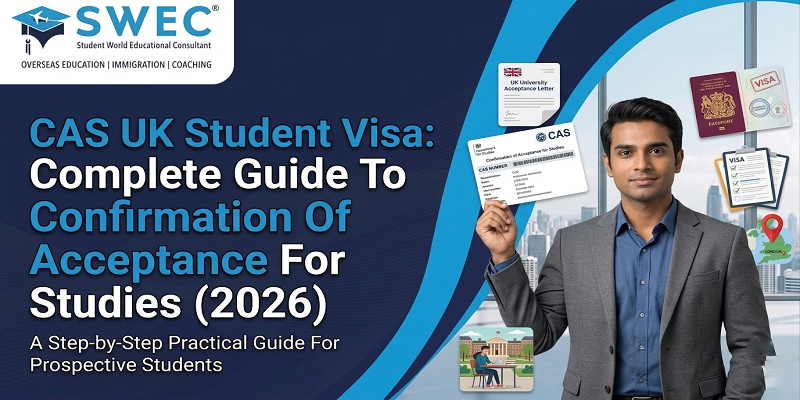
CAS for UK student visa stands for Confirmation of Acceptance for Studies. It’s an electronic reference number your UK university issues to confirm you have a genuine place on their course.
The CAS UK student visa process is something every international student must go through — and getting it wrong can delay your entire application. CAS, or Confirmation of Acceptance for Studies , is the one document that connects your university admission to your UK visa. Without it, your visa application simply cannot move forward.
Many Indian students lose weeks — sometimes their entire intake — because they did not understand when to request their CAS, what documents the university needs, or what to do when something goes wrong. Some do not even realise that a CAS and an offer letter are two completely different things.
This guide covers everything you need to know about the confirmation of acceptance for studies in the UK process in one place. You will learn what a CAS is, how to get it, how long it takes, what the format looks like, and exactly what to do if it is delayed or has an error.
Whether you are applying for the first time or reapplying after a setback, this guide gives you a clear, step-by-step picture of the entire CAS process.
Key Takeaways
CAS is mandatory for UK student visas. Without it, you cannot apply for a student visa.CAS stands for Confirmation of Acceptance for Studies and is an electronic reference number issued by UK universities.You need an unconditional offer to request CAS from your university.CAS is valid for 6 months from the issue date. Apply for your visa within this window.You must provide documents like passport copy, proof of funds, English language test scores, and academic transcripts.Processing time is 2-4 weeks on average, but can take longer during peak seasons.CAS cannot be reused if your visa application is rejected. You must request a new one.Indian students need additional proof like financial credibility interviews, TB tests, and proof of funds.Common errors include incorrect passport details, missing documents, and insufficient funds. These delay CAS issuance.SWEC Visa Consultants help you request, verify, and use your CAS for a successful UK visa application..
What Is CAS? Understanding CAS Meaning, Components & Purpose
CAS for UK student visa stands for Confirmation of Acceptance for Studies. It’s an electronic reference number your UK university issues to confirm you have a place on their course.
Think of CAS as your entry pass to the visa application process. Universities only issue it after they verify your qualifications, funding, and identity. The CAS number links directly to the UKVI (UK Visas and Immigration) database. Immigration officers check it when reviewing your visa application.
What does CAS include? Your CAS contains:
Your personal details (full name, date of birth, passport number)
Your course details (program name, start and end dates, course level)
Tuition fees and total cost
University sponsorship reference number
Your sponsor institution details
CAS is not a physical letter. It’s a digital record that appears on your UKVI account when you apply for your visa online. Your university sends you a reference number via email. You enter this number when filling out your visa application.
Why is CAS so important? Without CAS, your student visa application gets refused automatically. UKVI uses it to verify that you have genuine enrollment at a licensed sponsor institution. It proves you’re a real student with a confirmed place.
CAS Vs Offer Letter: Clear Distinction
Many students mix up the offer letter and CAS. They’re different documents serving different purposes.
Offer Letter:
Your university sends this after your application is reviewed
It confirms your conditional or unconditional admission
It’s a formal letter, usually PDF or paper
You keep it as proof of admission
No visa application is possible with just an offer letter
CAS (Confirmation of Acceptance for Studies):
The university issues this only after you accept the offer and meet all conditions
It’s an electronic reference number in the UKVI system
You cannot apply for a UK student visa without it
It’s linked to the immigration database
Timeline: You get the offer letter first. After accepting it and submitting required documents, you request CAS. Only then can you apply for your visa.
Key difference: An offer letter gets you into the university. CAS gets you into the UK for studies.
Offer Letter
CAS
What it is
University’s written confirmation of your admission
Electronic reference number from UKVI system
When you get it
After accepting your offer
After meeting all conditions (fees, documents)
Used for
Confirming your place
Applying for your student visa
Format
Physical or email letter
Digital — CAS Statement document
Required for visa?
No
Yes — mandatory
You need both , but your CAS is what goes into your visa application.
Eligibility For CAS: Who Can Request It?
Not everyone can request CAS. Your university checks eligibility before issuing it.
To be eligible for CAS, you must:
Hold an unconditional offer from a UKVI-licensed sponsor (university or college)
Be at least 16 years old
Have a valid passport with at least 6 months validity
Meet the university’s English language requirements (typically IELTS B2 level or equivalent)
Provide proof of funds to cover tuition and living expenses
Have completed all conditional requirements from your offer letter
Not have any immigration or criminal history that would disqualify you
Conditional vs Unconditional offers: If your offer is conditional (e.g., “pending final exam results”), you cannot request CAS yet. Wait until all conditions are met and the offer becomes unconditional.
CAS For Conditional Vs Unconditional Offers
Conditional Offers:
If your offer is conditional (e.g., “pending final grade in Maths”), you cannot request CAS until you meet those conditions. Common conditions include:
Final exam results meeting a minimum grade
English language test results
Additional qualifications or certifications
Only after you fulfill these conditions does your offer become unconditional. Then you can request CAS.
Unconditional Offers:
If your offer is unconditional, you can request CAS immediately after accepting the offer and paying the deposit. There are no pending requirements to fulfill.
Why this matters: If you have a conditional offer with a deadline (e.g., exam results due in June), request CAS as soon as conditions are met. Don’t delay. This ensures CAS is issued in time for visa application.
CAS Number Format & Importance: How To Locate It
What Is A CAS Number? A CAS number is a unique 10-14 digit code your UK university gives you to confirm your place, which you must use when applying for your student visa.
CAS Number Format: CAS numbers follow this pattern: 10-14 digits , often formatted as groups.
Example: 1234567890AB or GB12345678CAS
Each university has a unique sponsor reference within the CAS number. The first part is your personal reference.
Why the CAS number matters:
You must enter it exactly when applying for your visa
Even a single digit wrong causes visa application rejection
It’s your proof of enrollment in the UKVI system
Immigration officers use it to verify your university and course details
How to find your CAS number:
Check the email from your university titled “CAS Reference Number” or “Confirmation of Acceptance”
Log into your university’s student portal
Check your UKVI account once you start your visa application
Near the top of the CAS Statement
Contact your university’s international office if you can’t find it
Important: Never share your CAS number with anyone except UKVI during visa application. It’s as sensitive as your passport number.
Processing Time & CAS Validity Period
How long does it take to get CAS?
Average processing time: 2-4 weeks
Factors affecting processing time:
Peak season (July-September): Can take 4-8 weeksDocument completeness: Missing documents add 1-2 weeksFinancial credibility interview: Required for high-risk countries, adds 1-2 weeksUniversity workload: Busy seasons delay processing
CAS Validity Period:
CAS is valid for exactly 6 months from the issue date. You must apply for your visa within this 6-month window. After 6 months, CAS expires and is no longer valid.
What if CAS expires? If your CAS expires before you apply, you must ask your university to issue a new one. This can cause significant delays — so never wait until the last moment to begin your visa application.
Timeline tip: If you receive CAS in January, you have until June to apply for your visa. If you delay and CAS expires before your visa decision, your application gets rejected.
Documents Needed To Request CAS From Your University
Your university requires specific documents before issuing CAS. Have these ready:
Essential Documents:
Valid Passport – Copy of the biographical page. Passport must be valid for the entire course duration.Academic Transcripts – Official documents showing your previous educational qualifications (Class 12, graduation certificates, transcripts).English Language Test Scores – IELTS UKVI, TOEFL, or equivalent test results proving B2 level English or higher.Proof of Funds – Bank statements showing you can afford tuition fees and living costs. Usually 6-9 months of bank statements.Acceptance of Offer – Signed confirmation that you accept the university’s offer.Tuition Deposit – Most universities require a non-refundable deposit (£2,000-£5,000). Proof of payment.CAS Request Form – Completed university form with personal details, passport information, funding sources, and course details.
For Indian Students Specifically:
TB test certificate (if required)
Proof of relationship to sponsor (if parent is funding)
No Objection Certificate from employer (if employer is sponsoring)
Missing any document delays CAS issuance. Double-check with your university about their specific requirements.
Step-by-step: How To Request CAS From Your UK University
Step 1: Receive Your Unconditional Offer After your application is approved, the university sends an unconditional offer letter. This confirms your place on the course.
Step 2: Accept the Offer Reply to the offer letter confirming you accept the place. Most universities have an online portal for this.
Step 3: Pay the Tuition Deposit The university provides bank details or an online payment link. Pay the deposit amount. Keep the payment receipt.
Step 4: Gather All Required Documents Compile your passport copy, academic transcripts, English test scores, proof of funds, and any other documents your university requests.
Step 5: Submit Documents to Your University Upload documents through the university portal or email them to the international office. Some universities require a CAS request form—fill it out completely with accurate information.
Step 6: Complete the CAS application form Many universities use platforms like CAS Shield or their own portal. Fill in your passport details and travel history accurately.
Step 7: University Reviews and Verifies The university’s international office reviews all documents. They may conduct a financial credibility interview (especially for Indian students) to confirm you’re a genuine student with real funds.
Step 8: University submits CAS request to UKVI The university checks your documents and submits the CAS request through the UKVI Sponsor Management System (SMS).
Step 9: Receive Your CAS Number Once everything is approved, the university emails you the CAS reference number. This usually takes 2-4 weeks, but can be longer during peak season (July-September).
Step 10: Apply for your UK student visa Enter your CAS number into the UKVI student visa application at gov.uk/student-visa .
Step 11: Download CAS Documentation Log into your university portal or UKVI account to view full CAS details and print a copy for your records.
Credit: University of South Wales
Sample CAS Letter: What To Expect
While CAS is not a physical letter, your university may send you an email or document showing CAS details. Here’s what you’ll see:
CAS Email from University:
Subject: Your Confirmation of Acceptance for Studies (CAS) Reference Number
Body includes:
Your full name and date of birth
CAS reference number (10-14 digits)
Your course name and level
Course start and end dates
Tuition fees (total and per term)
University name and UKVI sponsor reference
Instructions to use CAS in visa application
Confirmation that CAS is valid for 6 months
Sample format:
“Dear [Student Name],
Congratulations! Your Confirmation of Acceptance for Studies (CAS) has been issued.
Your CAS reference number: GB12345678CAS
Course: MSc Data Science Course start: September 2026 Course end: September 2027 Tuition fee: £16,000 per year
This CAS is valid until [date 6 months from issue]. Use this reference number when applying for your UK student visa.
Best regards, International Office, [University Name]”
You’ll also see detailed CAS information when you log into your UKVI visa application account.
Role Of CAS In Your Visa Application CAS is the foundation of your student visa application. Here’s how it works:
Step 1: Before You Apply for Visa You must have a valid CAS before starting your visa application. UKVI cannot process applications without it.
Step 2: During Visa Application When filling your visa application online, you enter your CAS reference number. UKVI immediately checks it in their database. If the CAS is invalid or doesn’t exist, your application gets rejected instantly.
Step 3: What UKVI Verifies Immigration officers check:
CAS number exists and is valid
Your personal details match the CAS
Your course and university details are genuine
Your tuition fees are reasonable for that course
CAS hasn’t expired
Step 4: After CAS is Verified Only after UKVI confirms your CAS do they review other parts of your application (funds, English, health, criminal history).
Step 5: Visa Decision CAS verification is just the first step. Your visa can still be rejected for other reasons (insufficient funds, failed English test, health issues). But without CAS, you can’t reach this stage.
Why CAS matters more than other documents: Unlike your bank statement or test scores (which you provide), CAS is verified directly with your university through the government database. It’s the most trust-intensive document in your application.
Can I apply for a UK student visa without CAS? No. It is a legal requirement. Your application will be automatically invalid without a valid CAS number.
CAS For Indian Students: Special Considerations
Indian students often face additional requirements when requesting CAS from UK universities. Here’s what you need to know:
Financial Credibility Assessment:
Many universities conduct a financial credibility interview with Indian students. They want to confirm:
Your funds are genuine
Your sponsor (parent/relative) has stable income
The funds aren’t borrowed for the visa application
You can sustain living in the UK
TB (Tuberculosis) Test:
If required, get a TB test at a designated clinic in India. Results must be uploaded to your UKVI account before visa application. This is mandatory for Indian students.
Proof of Funds:
Indian students need stronger proof than others:
6-9 months of bank statements (not just 3 months)
Salary certificates if parent is funding
Tax returns (last 2 years) for self-employed parents
Investment documents (for property/stocks funding)
Sponsor affidavit (if funds come from a relative)
28-Day Rule:
Large sums deposited into your account within 28 days before visa application look suspicious. Try to show funds have been in the account longer. If you must deposit recently, provide explanation letters and proof of source.
ATAS Certificate
If you are studying certain science, engineering, or technology subjects, you need an Academic Technology Approval Scheme (ATAS) clearance certificate before your CAS can be issued.
Sponsored vs Self-Funded:
Parent-sponsored: Provide parent’s income documents, employment letter, tax returnsSelf-funded: Provide your own income documents, job offer letter, or savings proof
No Objection Certificate (NOC):
If your employer is sponsoring, get an NOC confirming they allow you to study abroad.
Language: English language requirements are the same (B2 level), but Indian students must use IELTS UKVI for accuracy.
For detailed guidance on financial documents, read our guide: How to Handle Financial Documents for UK Student Visa
Common CAS Issues & How To Resolve Them
Issue 1: Incorrect Personal Details in CAS
Problem: Your name, date of birth, or passport number is wrong in CAS.
Solution: Contact your university’s international office immediately. They issue a replacement CAS with correct details. This takes 3-5 days.
Issue 2: Missing Documents Delaying CAS
Problem: University says you haven’t submitted all required documents.
Solution: Check the university’s checklist. Upload any missing documents immediately. Follow up with the international office in 2-3 days.
Issue 3: Insufficient Proof of Funds
Problem: University rejected your bank statements as insufficient.
Solution: Provide additional months of statements (up to 9 months). Include salary certificates, parent’s income documents, or investment proofs.
Issue 4: CAS with Errors in Course Details
Problem: Your CAS shows the wrong course code, duration, or fee amount.
Solution: Request a replacement CAS immediately. Don’t use the incorrect one for visa application—it will be rejected.
Issue 5: Financial Credibility Interview Failure
Problem: University’s interview concluded you’re not a genuine student.
Solution: Provide additional proof of genuine funds. Request another interview. If rejected again, contact SWEC for guidance on alternative universities.
Issue 6: CAS Showing Wrong Sponsor Reference
Problem: CAS has another student’s sponsor reference number.
Solution: This is a serious error. Request immediate replacement. Do not use it for visa applications.
What If CAS Is Delayed?
Normal processing time: 2-4 weeks
If CAS is delayed beyond 4 weeks:
Step 1: Contact Your University Email your international office asking for a status update. Provide your CAS request submission date.
Step 2: Check for Missing Documents Ask if they’re waiting for any documents from you. Submit anything missing immediately.
Step 3: Request an Update Timeline Ask when you can expect CAS. If over 4 weeks, ask for expedited processing.
Step 4: Escalate If Needed If over 6 weeks with no CAS, escalate to the Head of International Admissions or Registry Office.
Step 5: Plan Ahead for Visa Remember CAS is valid for 6 months. If CAS is delayed, your 6-month window shrinks. Plan your visa application accordingly.
What if CAS arrives too late?
If CAS arrives after 6 months have passed since your course start date, you cannot use it. You must request a new CAS for a future intake.
What If CAS Has Errors?
Do not apply for a visa with an incorrect CAS. UKVI will reject your application.
Types of CAS Errors:
Personal details wrong (name, DOB, passport number)Course details incorrect (course name, duration, fees)University details wrong (wrong sponsor reference)Sponsor information incorrect
How to fix:
Contact your university immediately and request a replacement CAS. Explain the error clearly. University issues a new CAS with corrections within 3-5 days.
Keep the old CAS as documentation of the error in case UKVI asks questions later.
Updating Or Changing Your CAS
Can you change your course after getting CAS?
If you change your course after receiving CAS, you must request a new CAS. The old one becomes invalid.
Process:
Notify your university of your course change
Get updated offer letter for the new course
Request a new CAS (2-4 weeks processing)
Use the new CAS for visa application
Can you defer your course start date?
If your course start date is postponed, you may need a replacement CAS with the new date. Check with your university.
Can you change your university?
If you change to a different UK university , you need CAS from the new university. You cannot use CAS from your previous university.
After CAS: Next Steps To Visa Application
Once you have a valid CAS, you’re ready for the visa process. Here’s what comes next:
Step 1: Gather Remaining Documents Beyond CAS, prepare:
Valid passport
Proof of funds (bank statements, pay slips)
English language test results
TB test results (if required)
Academic transcripts
Parental consent (if under 18)
Step 2: Create Your UKVI Account Go to gov.uk/apply-uk-visa and create an account if you don’t have one.
Step 3: Fill Out Visa Application Online Complete the visa form. Enter your CAS reference number precisely. Upload all required documents.
Step 4: Pay Visa Fees and Healthcare Surcharge UK student visa fees: £719-£1,000 (depending on visa length) Healthcare Surcharge (IHS): £1,035 per year of study
Pay online during application.
Step 5: Schedule Biometric Appointment Book an appointment at a visa application center in India to provide your fingerprints and photos.
Step 6: Attend Biometric Appointment Go on your scheduled date with your passport. This usually takes 15-20 minutes.
Step 7: Wait for Visa Decision Processing time: 2-4 weeks from biometric appointment (sometimes faster).
You’ll receive an email when your visa is decided. If approved, your passport is returned with a visa stamp or sticker.
For the full step-by-step visa application process, read: Navigating the UK Student Visa Application Portal
Cost Breakdown And Processing Time
Item
Cost (Approx. 2025–26)
UK Student Visa fee
£490
Immigration Health Surcharge
£776/year
Priority Processing (optional)
£500 extra
Super Priority (optional)
£1,000 extra
VFS service charge
~£55
TB test (India)
₹3,000–5,000
Standard processing time: 3 weeks from biometric appointment Priority processing: 5–7 working days Super priority: Next working day decision
Final Checklist: Before You Request CAS
You have an unconditional offer from a UK university
You’ve accepted the offer in writing
You’ve paid the tuition deposit
You have a valid passport with 6+ months validity
You have proof of English language (B2 level or higher)
You have proof of funds (6-9 months of bank statements)
You have academic transcripts and certificates
You have TB test results (if required)
You’ve completed the university’s CAS request form
You’ve gathered all documents your university requests
You’re ready to submit documents to the university
Once all boxes are checked, you’re ready to request CAS. Follow the step-by-step guide above, and you’ll have CAS in hand within 2-4 weeks.
FAQ: CAS UK Student Visa
Q1. What is CAS full form in a UK student visa?
CAS stands for Confirmation of Acceptance for Studies. It is an electronic reference number issued by your UK university confirming your admission for a student visa application.
Q2. Can I apply for a UK student visa without CAS?
No. A valid CAS number is a legal requirement. Your visa application will be rejected without it.
Q3. How long is CAS valid for a UK student visa?
Your CAS is valid for 6 months from the date of issue. You must apply for your visa within this period.
Q4. How long does a UK university take to issue CAS?
Most universities take 5–10 working days after you submit all required documents and pay your deposit. During peak periods (June–August), it can take up to 3–4 weeks.
Q5. What happens if there is an error in my CAS?
Do not apply with an incorrect CAS. Contact your university immediately to correct or reissue it. Errors in passport number or name can lead to visa refusal.
Q6. Does SWEC help with the CAS process? Yes. SWEC Visa Consultants guide students through the entire CAS and UK student visa process — from document preparation to visa application. We have helped hundreds of students from Surat and Ahmedabad successfully obtain their UK student visas.
Q7. What if my CAS is delayed and my visa deadline is approaching?
Contact your university’s international office immediately and ask for a timeline. In parallel, reach out to SWEC — we can help you communicate effectively with universities and explore priority visa processing options.
Q8. Is CAS required for a UK student visa extension?
Yes. A new CAS from your current or new institution is required for any UK student visa extension.
Conclusion
The CAS UK student visa process is straightforward once you know what to expect. Your CAS is not just a formality — it is the foundation of your entire UK visa application. Getting it right means knowing when to request it, what documents to submit, and how to spot errors before they cause bigger problems.
For Indian students especially, small details like the TB test, the 28-day financial rule, and ATAS clearance can affect your CAS timeline more than you expect. Plan ahead, stay in regular contact with your university’s international office, and never wait until the last moment.
A valid, error-free CAS puts you one step closer to your UK university — and that step matters.
Ready To Apply? Let SWEC Handle Your CAS And UK Visa
Getting your CAS UK student visa application right the first time saves weeks of stress and potential refusal. From helping you gather documents for your university to reviewing your CAS for errors before submission — SWEC Visa Consultants are with you every step of the way.
What SWEC Offers:
Expert Guidance: Our consultants review your documents before submission to catch errors earlyCAS Timeline Management: We ensure your CAS is issued in time for visa applicationDocument Checklist: We provide university-specific checklists so you never miss anythingFinancial Documentation Help: We guide you on proper proof of funds presentationVisa Application Support: After CAS, we help you complete and submit your visa application correctlyPost-CAS Planning: We ensure you meet all deadlines and prepare for UK arrival
We have helped students from Surat, Ahmedabad, and across Gujarat secure UK student visas at top universities including the University of Exeter, University of Westminster, and many more.
📞 Schedule a free consultation today swecvisaconsultant.com or call our Surat office. Don’t let paperwork stand between you and your UK university dream.




 Sumit Hisoriya
Trustindex verifies that the original source of the review is Google.
We recently apply for spousal visa for Canada , I would say it was really great experience with SWEC. They have good knowledge of rules and regulations and provide guidance in right direction. We are really thankful to Megha madam and team.Posted on Google Shayan Lakhani
 hejal joshi
 Rajesh Dodia
 Jiya Sanghavi
 Bharat Findoliya