Key Takeaways
- Study comes first on F-1. Work is the bonus, not the main event.
- Start with on-campus jobs if you can. They’re the easiest to get approved.
- CPT needs your school’s stamp before you even show up to the internship.
- OPT is your post-graduation move. USCIS has to sign off, not just your school.
- Off-campus work without approval will tank your visa status. Don’t risk it.
You just got accepted to your dream university in the USA. Congrats. But then reality hits: tuition is expensive, and you’re wondering how you’ll actually pay for it all while keeping up with classes.
Here’s the thing—you’re not alone in asking that question. Thousands of international students land in the U.S. every year feeling confused about what jobs they’re actually allowed to take. Can you work off-campus? Is an internship legal? What about a part-time gig at the library? The rules sound like a maze, and honestly, a lot of bad information floats around online.
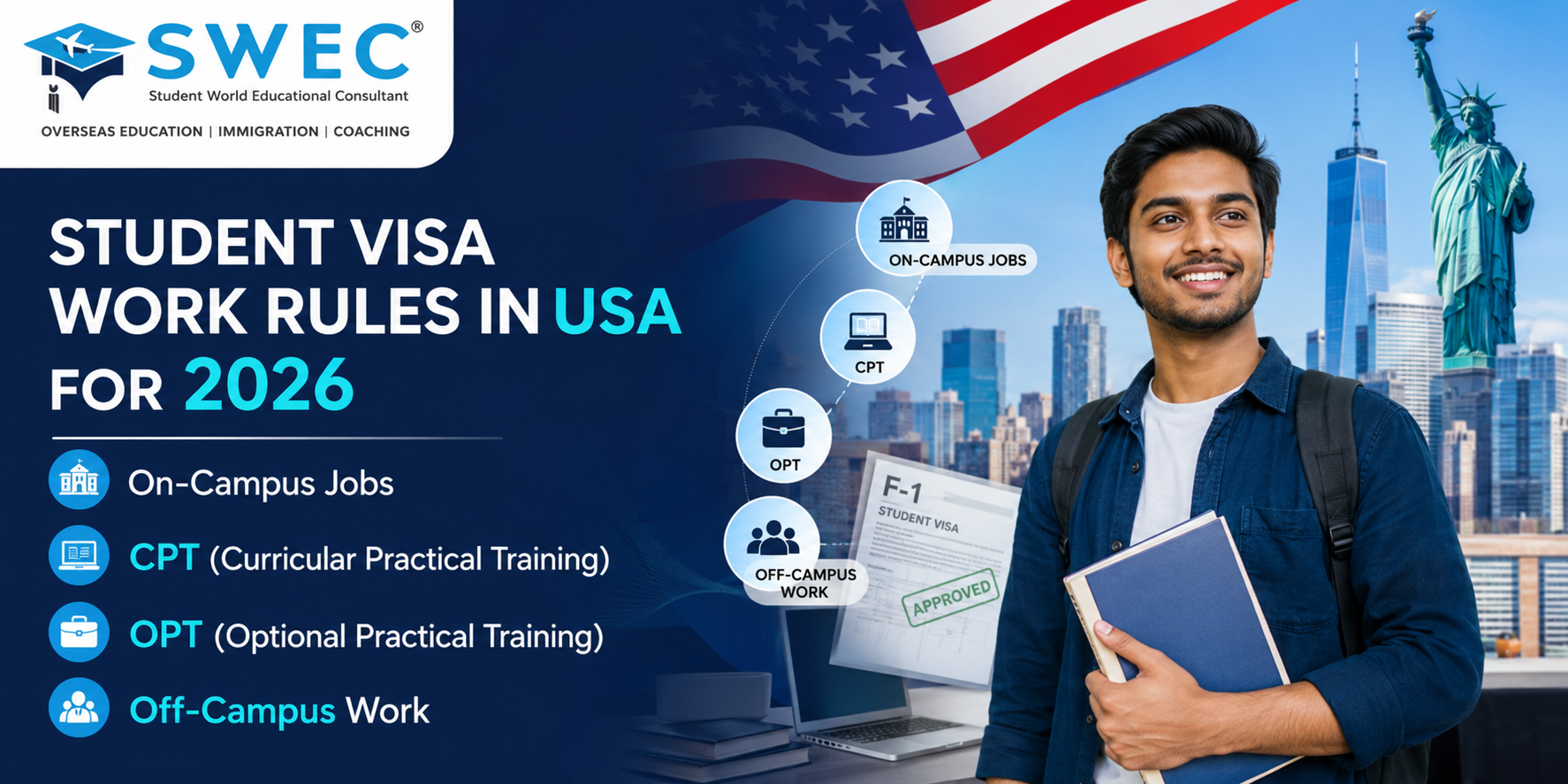
The good news? Student visa work rules aren’t as complicated as they seem once you break them into four actual paths: on-campus jobs, CPT (internships tied to your program), OPT (your post-graduation work window), and limited off-campus employment. Each one has its own rules, but they’re rules you can actually follow.
By the time you finish reading this guide, you’ll know exactly which work option fits your situation, what approvals you need, and how to stay on the right side of your visa status.
What You Need To Know Before You Take Any Job On An F-1 Visa
What exactly IS an F-1 visa?
Your F-1 visa is basically a ticket that says, “This person is here to study full-time at an accredited U.S. school.” That’s it. It’s not a general work visa. It’s not a permission slip to work whenever you want. Work is allowed, but only in ways that fit your student status—and only when your school says it’s okay.
Why does SEVIS care about your job?
SEVIS is the system that tracks every international student in the U.S. It watches where you study, how long you’re here, and what you’re doing. When you take a job, SEVIS cares because work can affect your status. Your school has to report your employment to the government. If you’re working in a way that’s not approved, that’s a red flag in the system, and it can cost you your visa. That’s why even a small paid gig matters—it gets logged.
Want the official details straight from the government? Check out the Department of Homeland Security’s guide to working in the United States. It’s clear and easy to understand.
Quick Fact Box: “F-1 Visa Work Summary”
| What You Need to Know | The Real Deal |
| What is F-1? | Student visa for full-time study at a U.S. school. Work is allowed only in specific ways. |
| Who approves your work? | Your school (DSO) approves on-campus and CPT work. USCIS approves OPT. |
| What happens if you work without permission? | You lose your visa status. Future visa applications get rejected. It’s a big deal. |
| Can you work off-campus? | Not automatically. Only with approved CPT, OPT, or special permission. |
| Does your school track your job? | Yes. SEVIS logs all employment. Your school reports it to the government. |

On-campus Jobs Are The Easiest Way To Start Earning
On-Campus Jobs: What You Need to Know
Let’s be real—if you’re on a student visa, on-campus jobs are your safest first move. You get a paycheck, you learn how work actually feels in the U.S., and the approval process is way simpler than CPT or OPT.
The basic rule is simple: during the school year, you can work up to 20 hours per week on campus. That’s the number you need to remember. During official breaks—winter, spring, summer—many schools let you go full-time if you want. But always check with your school first. Some have stricter policies than others.
How much can you actually make? It depends on the job and where you’re studying, but most on-campus positions pay between $15 to $20 per hour. Do the math: 20 hours a week at $17 per hour adds up to roughly $1,360 a month during the school year. Not life-changing money, but it helps with books, rent, and groceries.
Here’s the key advantage: you don’t need special permission from USCIS or complicated I-20 updates. Your school knows you’re working on campus, they track it, but the approval is straightforward. That’s why it’s the easiest path for student visa holders.
Common On-Campus Positions
You’ll find these jobs all over campus, and they’re all legal on F-1:
- Library assistant — Help at the front desk, shelve books, manage materials
- Dining hall staff — Food service, cashier, kitchen prep
- Teaching assistant — Help professors with grading, tutoring, lab support
- IT help desk — Tech support for students, password resets, equipment checkout
- Front desk receptionist — Answer phones, check in visitors, manage schedules
- Lab helper — Assist professors or graduate students with research or experiments
- Tutor — Help other students with subjects in your major (if your school allows it)
The key? The job has to be on campus or directly tied to your school. A job at a coffee shop inside the student center counts. A job at a coffee shop across the street? That’s off-campus, and it’s a different story.
CPT Can Help You Turn Class Credit Into Real Experience
What Is CPT & When Can You Do It?
CPT stands for Curricular Practical Training. It’s a paid internship or co-op that’s part of your degree program. Unlike a random summer job, CPT connects directly to what you’re studying.
Most schools require you to complete one full academic year before you’re eligible. So if you arrive in fall, you can’t do CPT until fall of year two. Some programs have exceptions, but one year is the standard.
How long can you do CPT? Usually a semester, a summer, or longer—it depends on your school. The catch? If you do 12 months or more of full-time CPT, it eats into your post-graduation work time (OPT). That matters now. Always confirm with your school’s international office. Rules can shift.
CPT Work Rules in 2026
Hour restrictions: Part-time CPT is 20 hours a week or less. Full-time is anything over 20 hours. Full-time CPT adds up against your total eligible work time after graduation.
Timing requirements: Your CPT has to be approved before you start working. Your school updates your I-20, then you show up on day one. If your internship starts Monday and approval hasn’t come through, you wait.
Impact on your I-20: Every CPT gets recorded on your I-20. Keep dates and employer info accurate. Keep a copy for yourself.
When CPT counts toward visa limits: 12 months or more of full-time CPT reduces your OPT eligibility. Part-time CPT doesn’t count the same way.
How to Apply for CPT
- Find the internship – Search job boards or ask professors. It needs to relate to your major.
- Confirm it’s eligible – Email your advisor: “Can this count as CPT?” Get a yes in writing.
- Gather details – Employer name, address, start/end dates, job description.
- Meet with your DSO – Bring your paperwork. They’ll review it.
- Get your I-20 updated – Your DSO adds CPT to your I-20. This is official.
- Start work – Only now can you legally begin.
The whole process usually takes 1-2 weeks. Plan ahead.
CPT vs On-Campus Work Comparison
| What’s Different | On-Campus Job | CPT |
| What is it? | Any job on your school’s campus | Internship or co-op tied to your major |
| Approval needed | School (DSO awareness) | School (DSO approval + I-20 update) |
| When available | Anytime during your student visa status | Usually after year one |
| Hour limits | 20 hours/week during school; full-time during breaks | 20 hours/week (part-time) or full-time |
| Related to major? | No | Yes—must connect to your degree |
| Affects future work? | No impact on OPT | 12+ months full-time = reduced OPT |
| Why pick it? | Easy, quick income, low stress | Real experience, better pay, builds resume |
OPT Gives You A Work Window After Graduation
F-1 OPT: What It Is & Why It Matters
OPT stands for Optional Practical Training. After you graduate, you get a window of time to work in your field without leaving the country or applying for a different visa.
Standard OPT is 12 months. You can work full-time, part-time, or switch jobs. The job has to relate to your field of study.
If you’re in a STEM field, you get an additional 24 months. That’s 36 months total—three years of work authorization.
Timeline: Apply during your final semester. File early so your EAD card (work permit) is ready by graduation. Don’t wait.

F-1 Visa Work Permit Rules for OPT
Job change rules: You can change jobs freely. Quit Monday, start Tuesday. Still authorized.
Geographic limitations: Work anywhere in the U.S. No restrictions.
Remote work: Yes, you can work remotely. Live in one state, work for a company in another.
Gaps in employment: You get about 90 days of unemployment total. Exceed that, and you lose your status. Track the calendar.
OPT vs CPT: The Key Differences
| What Matters | CPT | OPT |
| When you use it | During school | After graduation |
| Who approves it | Your school (DSO) | USCIS |
| Duration | Varies | 12 months standard; 36 months for STEM |
| Job requirement | Must relate to your major | Must relate to your degree |
| Can you change jobs? | Usually no | Yes—freely |
| Do you need an EAD card? | No | Yes |
| Affects future visas? | Yes—reduces OPT | No |
| Why pick it? | Real experience while studying | Explore careers after graduation |
Extending Your OPT
STEM extension eligibility: Engineering, computer science, biology, chemistry, physics qualify. Business, English, social sciences don’t. Check the official USCIS STEM list if unsure.
How to apply: File through USCIS during months 6-12 of your first OPT. Timing matters. File late, lose the extension. File early, might get denied.
Impact on visa status: The extension doesn’t change your status. You’re still on student visa work authorization—you just get more time. After 36 months (or 12 if not STEM), you need a different visa or sponsorship. That’s the hard stop.
Off-campus Employment Is Possible, But Only With The Right Approval
Can Students Work Off-Campus?
Short answer: yes, but with conditions that matter way more than you’d think.
By default, if you’re on a student visa, you can’t work off-campus. Period. But there are specific situations where it becomes legal.
Economic hardship exceptions: If your family faces a serious financial crisis—job loss, medical emergency, currency collapse—you might qualify. You have to prove it to your DSO. Even then, it’s temporary.
Post-completion OPT: Once you graduate and get OPT approval from USCIS, you can work off-campus anywhere in the U.S. This is the legitimate off-campus work window most students use.
Spouse work permissions: If your spouse is on a student visa, they have the same restrictions. If they have other work authorization (like H-1B), that’s different.
USA Student Visa Work Rules for Off-Campus
Permission requirements: You need one of these: approved CPT (off-campus), approved OPT, or special hardship approval. Those are your only three options. If you don’t fit one, off-campus work is not legal.
DSO approval process: For hardship, meet with your DSO with documentation (bank statements, family letters, proof of crisis). They decide yes or no and update your I-20 if approved.
Documentation needed: Keep everything. I-20 updates, approval emails, job offer letters. Official documents count. Screenshots don’t.
Restrictions and monitoring: Your school and the government monitor your work. Your employer reports your employment. Mismatches with your I-20 are red flags.
Is Off-Campus Work Legal for International Students?
No, off-campus work is not automatically legal for international students on a student visa.
But it can be legal if you have the right approval. Simple rule: if your I-20 says you can work off-campus and USCIS or your school approved it, it’s legal. If not, it’s not approved.
Here’s where people mess up: they see a job, need money, and convince themselves the rule doesn’t apply. “It’s just a small gig.” “Nobody will know.” Don’t do that.
Even a small unauthorized off-campus job can:
- Cost you your visa status
- Create a government record (SEVIS)
- Hurt future visa applications (H-1B, green card, anything)
- Block your employment (background checks will find it)
- Get your school in trouble
Get it approved first. If you can’t get approval, it’s probably not allowed.
How To Stay Compliant And Protect Your Future Visa Options
Unauthorized Work: The Risks
Let’s talk about the worst-case scenario. What actually happens if you work without authorization on a student visa?
Visa status consequences: First, you lose your legal status. The moment you start unauthorized work, you’re out of status. That means:
- Your I-20 is no longer valid
- You’re technically in the country illegally
- You can’t travel outside the U.S. and re-enter (you might not be allowed back in)
- You can’t apply for OPT or any other benefit
This isn’t a fine or a warning. It’s immediate.
Deportation possibilities: Can you get deported for unauthorized work? Yes, it’s possible. It depends on how serious the violation is, whether your school reports it, and whether immigration enforcement notices. Not every case ends in deportation, but it’s a real risk. Some students have been removed from the U.S. for work violations. It happens.
Future visa denials: Even if you don’t get deported, the damage follows you. When you apply for an H-1B work visa, a green card, or even visit your home country and try to re-enter the U.S., that unauthorized work gets flagged. Visa officers see it. They remember it. Many applications get denied because of it.
Employment record impacts: Here’s what surprises people: your employer records show up. If you apply for a job years later and they run a background check, sometimes that unauthorized employment gets discovered. It raises red flags. It makes you look like someone who doesn’t follow rules.
How USCIS & Schools Monitor Compliance
You might be wondering: how does anyone even know if I work without permission? The answer is that systems are watching, whether you realize it or not.
SEVIS tracking: SEVIS is the government database that tracks every international student. Your school enters your employment information. USCIS can see it. If your I-20 says you’re working in a library 15 hours a week, but you’re actually working at a restaurant 40 hours a week, that’s a discrepancy. It gets noticed.
Employer verification: When you start a job—even an unauthorized one—your employer usually runs an E-Verify check. That system checks against SEVIS records. If your I-20 doesn’t authorize that job, the system flags it. Some employers ignore small red flags, but many don’t. And the bigger the employer, the more likely they use E-Verify correctly.
Reporting mechanisms: Schools have to report work violations to the government. If your DSO finds out you’re working without authorization, they’re required to report it to USCIS. That’s not optional. It’s their job. And once it’s reported, you’re on the radar.
Work Options Comparison Chart: On-campus, CPT, OPT, And Off-campus Employment
Here’s the thing—you need to see all four options side by side to actually understand which one fits your situation. This table does that.
| What You Need to Know | On-Campus | CPT | OPT | Off-Campus (Other) |
| What is it? | Any job on your school’s campus | Internship or co-op tied to your major | Work authorization after graduation | Authorized off-campus work (hardship, etc.) |
| When available | Anytime during your student visa | Usually after year one of study | After graduation | Limited cases only |
| Hours allowed | 20 hours/week during school; full-time during breaks | 20 hours/week (part-time) or full-time (depends on timing) | Full-time or part-time; 90-day unemployment limit | Depends on specific authorization |
| Who approves it | Your school (DSO) | Your school (DSO + I-20 update) | USCIS (federal government) | Your school + sometimes USCIS |
| Related to your major? | No—any job works | Yes—must connect to your degree | Yes—must relate to your field | Sometimes, depends on category |
| Can you change jobs? | Yes, easily | Usually no—tied to one employer | Yes, freely and often | Depends on authorization type |
| Do you need an EAD card? | No | No | Yes—work permit card required | Sometimes |
| Impact on future work (OPT)? | None | Yes—12+ months full-time reduces OPT | None—doesn’t affect other visas | Depends on the authorization |
| Real-world example | Working at the library, dining hall, or IT help desk | Summer internship at a tech company or engineering firm | First job after graduation, any field-related role | Temporary off-campus work due to family hardship |
| Why pick it? | Easy approval, quick income, low stress, good for studying | Real career experience, better pay, builds resume, connects to your degree | Explore your actual career, time to job hunt, flexibility to change roles | Specific situations where you need off-campus work |
| The catch | Lower pay, limited hours during school, no career advancement | Reduces OPT if you do too much full-time, tied to one employer, approval delays | Needs USCIS processing time, job must match degree, 90-day unemployment limit | Limited eligibility, paperwork heavy, ongoing monitoring |
Breaking Down the Table (What It Actually Means)
On-Campus is your safety net. It’s easy, it’s quick, and it doesn’t require complicated approvals. The trade-off? Lower pay and fewer hours during the school year. But if you need money fast and you’re still adjusting to U.S. college, this is where you start.
CPT is your career move. You get real experience in your field, better pay, and something legit to put on your resume. The catch is that you can only do it once your school approves it, and if you overdo full-time CPT, it comes back to haunt you during OPT. Use it strategically.
OPT is your post-graduation window. This is where you actually explore your career, find the job that fits, and build real work experience. You have flexibility, you can change jobs, and if you’re in STEM, you get three years instead of one. This is the big one for most international students.
Off-campus work (other) is rare. Unless you qualify for hardship-based approval, this isn’t really an option. Don’t count on it. Plan around it not existing.
How To Choose The Right Path For Your Own Situation
How to Choose the Right Work Option
There’s no single “best” work option for everyone. What works for you depends on where you are in school, how badly you need money, and what kind of experience you actually want. Let’s figure out your path.
Timing Timeline: Your 4-Year Work Roadmap
Think of your student visa journey like a four-act play. Each act has different work options available.
Year 1: On-campus only
You just arrived. You’re adjusting to American college, the classes are harder than you expected, and you’re probably homesick. This is not the time to overcommit. On-campus work is your friend here. Pick up 10-15 hours a week at the library, dining hall, or IT desk. You earn some money, you meet people, and you learn how U.S. work culture actually feels. Don’t stress about “real experience” yet. You’re building foundation skills.
Years 2-3: CPT opportunities
Now you’re settled. You understand your major, you’ve done well in classes, and professors know your name. This is when CPT becomes real. Look for internships, co-ops, or practicum positions tied to your degree. Summer is prime time for this. You get paid better than on-campus work, you build a resume that actually matters, and you’re exploring whether your major is the right fit. Don’t do 12+ months of full-time CPT though—you’ll need that OPT time later.
Year 4+: Planning for OPT
By senior year, you should already be thinking about OPT. Are you in a STEM field? If yes, start planning your job search now—STEM OPT gives you 36 months, which is a serious advantage. Not STEM? You have 12 months, so you need to move faster. Start networking with employers. Attend career fairs. Polish your resume. When graduation hits, you want your OPT application filed immediately.
Post-graduation: OPT maximization
You graduated. Your OPT is approved (or processing). Now you have breathing room. Use it. Don’t panic into the first job offer. Interview around. Find something that actually fits your career goals, not just something that looks good on paper. You have time. That’s the whole point of OPT.
Questions to Ask Yourself
Before you pick your work path, answer these honestly:
“Do I need income now?” If yes, on-campus work or CPT pays the bills. If no, you have more flexibility to chase experience over money. Be real about your financial situation.
“Is industry experience important to me?” If you want to actually work in your field after graduation, CPT and OPT matter. Build that resume now. If you’re just trying to pay for school and don’t care about career building yet, on-campus work is fine for now.
“Am I in a STEM field?” This one’s important. STEM gets you 36 months of OPT instead of 12. That’s three years to figure out your career. If you’re not STEM, you need to move faster in your job search. Know which bucket you’re in.
“What’s my visa timeline?” When do you graduate? How much school is left? If you’re graduating in two years, you need to plan CPT differently than if you have four years. Map it out.
“How much do I actually want to work?” Some students go hard on CPT and build serious experience. Others prioritize studying and do light on-campus work. Both are valid. Know yourself.
Student Visa Work Rules In 2026, What To Double-check This Year
Recent Changes to Student Visa Work Rules
Look, rules change. Policy shifts. What was true in 2024 might be different in 2026. So let’s talk about what’s actually happening with student visa work authorization right now.
USCIS policy updates in 2026
As of June 2026, the core F-1 work rules are still the same structure: on-campus work is capped at 20 hours during school, CPT needs school approval first, and OPT needs USCIS approval first. The fundamental lanes haven’t flipped.
But, and this is important – USCIS does update guidance throughout the year. They clarify rules, they release new FAQs, and sometimes they adjust processing times. In 2026, keep an eye on:
- Processing times for OPT applications – How fast is USCIS actually approving EAD cards right now? This changes seasonally. You might file in May and get approved in July, or you might file in September and wait until January. Check current timelines before you plan your graduation timeline.
- E-Verify updates – The employment verification system that employers use gets tweaked occasionally. Nothing major usually, but it affects how employers verify your work authorization.
- SEVIS system changes – Your school’s system for reporting student employment sometimes updates. Sometimes these updates create temporary delays. It’s rare, but worth asking your DSO if anything new is happening.
The point? Don’t rely on old screenshots or Reddit posts from 2023. Things shift.
New OPT extensions or restrictions
In 2026, the STEM OPT extension is still available—that 24-month bonus on top of the standard 12 months. Nothing has changed there as of now. But USCIS has tweaked the requirements slightly over the years, so confirm:
- Your degree qualifies as STEM – Check the official USCIS STEM OPT-eligible degree list before you file. If your school calls it engineering but USCIS doesn’t recognize the specific program, you won’t get the extension.
- Your employer meets STEM OPT requirements – Companies have to be registered in the STEM OPT employer database. Most Fortune 500 companies are. Most startups are too. But some smaller or niche employers aren’t. Check before you accept the job.
- Your job description actually qualifies – The job has to involve STEM work, not just be at a tech company. So if you’re a marketing specialist at Google, that might not qualify for STEM OPT even though Google is obviously a tech company. The work itself has to be STEM.
Bottom line: STEM OPT exists and it’s valuable, but don’t assume you automatically qualify. Verify.
Remote work allowances
This one actually changed in recent years, and it’s still going strong in 2026. You can work remotely on OPT. Your employer doesn’t have to be in the state where you live. You could live in California and work for a company in New York, all remote.
But here’s the catch that some people miss:
- Your employer still has to follow all the rules – Just because you’re remote doesn’t mean your employer gets to ignore work authorization. They still need to verify you’re authorized, pay taxes correctly, and follow employment law.
- You still need to track your location for immigration purposes – If you’re physically in the U.S. on OPT, you’re under U.S. jurisdiction. If you travel outside the U.S. and try to work remotely for that U.S. company, that gets complicated. Talk to an immigration attorney if you’re planning extended international travel while on OPT.
- The job still has to match your degree – Remote work doesn’t change the rule that your job has to relate to your field of study. A remote marketing job at a tech company is still marketing, not STEM work.
What international students need to know
Here’s what you should actually do in 2026 to stay on top of your work authorization:
Check official sources, not social media. USCIS posts updates on their website. Your school’s international office sends emails about changes. UC Davis, like many universities, publishes federal government updates for international students. These are your trusted sources. TikTok threads and group chats are not.
Confirm with your DSO before you commit. When you get a job offer, especially anything that feels like it might be on the edge (remote work, unusual industry, borderline STEM classification), run it by your DSO first. That five-minute conversation saves you months of headaches.
File OPT early if you’re graduating soon. Processing times vary, but filing early gives you a buffer. If you graduate in May, file in February or March. You want your EAD card in hand before graduation, not three months after.
Don’t bet on rules staying the same. Rules can change. New administrations can shift policy. International relations affect immigration rules. You can’t predict everything, but you can stay informed. Check official sources regularly.
FAQ
Can I work 40 hours per week on an F-1 student visa?
No. During the school year, it’s 20 hours max. During breaks, full-time is usually allowed—but check with your school first.
What’s the difference between CPT and OPT?
CPT is an internship during school (school approves it). OPT is work after graduation (USCIS approves it). CPT = while studying. OPT = after you finish.
Is working off-campus illegal on a student visa?
By default, yes. Unless you have approved CPT, OPT, or hardship authorization—then it’s legal. Don’t assume. Get approval first.
How does SWEC help international students navigate work options?
SWEC gives personalized guidance based on your specific situation—your degree, timeline, and goals. They review job offers, help with applications, and ensure compliance.
What happens if I work without proper authorization?
You lose your status immediately. Risk includes deportation, future visa denials, and employment record problems. It’s tracked through SEVIS and employer verification.
Can I do OPT in a different field than my degree?
No. Your OPT job must relate to your degree. Engineering major = engineering job. The rule is strict on this one.
Conclusion
The four paths are pretty clear once you stop lumping them together. On-campus work is the easiest start, CPT is for training tied to your program, OPT is your main post-graduation work path, and off-campus employment only works when you have the right approval.
Student visa work rules don’t have to feel like a maze. They feel that way when you move too fast. Check official guidance, talk to your DSO, and get help when the facts aren’t simple.
If you need more than general advice, whether that’s F-1 visa application help, a work permit application review, or student visa consulting services, get personalized support before you accept the job. One careful check now can save you a big problem later.