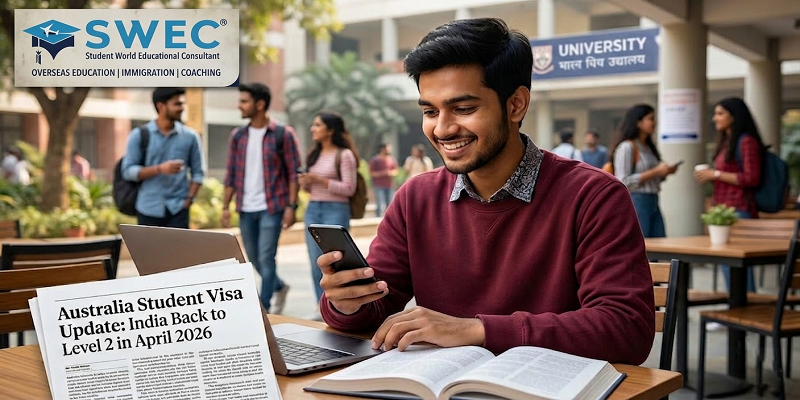
Most students expected 2026 to stay tough after the January shock. But India is back at Level 2 for the Australia student visa. That change matters for students in Gujarat and across India who want to study in Australia in 2026. Level 2 usually means less upfront paperwork, smoother processing, and a better chance to plan your intake with more confidence. Still, this is not a free pass. You still need strong documents, clear financial proof, and a solid GS statement. In this article, we will explain what changed, what Level 2 means for your file, and how to prepare the right way.
By the end of this article, you will know exactly what to do next.
Key Takeaways
- India moved from Level 3 back to Level 2 in April 2026.
- Level 2 usually means less paperwork and faster processing.
- You still need to show AUD 29,710 for living costs.
- The GS statement is still mandatory for every applicant.
- A Level 1 university can improve your approval speed.
- SWEC offers free consultation for Australia student visa guidance.
What Is The SSVF And Why Does India’s Level Matter?
The SSVF, or Simplified Student Visa Framework, helps Australia decide how much evidence you need for your student visa. It groups countries and universities into different evidence levels. These levels affect how many documents you must submit and how closely DHA reviews your file. In simple terms, the system helps decide how much proof your application needs.
Your evidence level comes from two things: your home country rating and your chosen university or provider level. Level 1 usually means the least documents. Level 2 sits in the middle. Level 3 brings the most scrutiny.
| Level | Meaning |
| Level 1 | Least documents and lighter checks |
| Level 2 | Moderate documents and standard checks |
| Level 3 | Most documents and closest review |
Your level directly affects how fast your visa is processed and how many documents you need.
The Full Story — What Happened Between January And April 2026
The first part of 2026 felt stressful for many students. On January 8, 2026, DHA moved India, Nepal, Bangladesh, and Bhutan to Level 3. DHA linked that change to a spike in fake bank certificates and fraudulent academic documents. For students and parents, that news created real fear about an Australia student visa application.
The impact was immediate. Processing times rose from around 33 days to as much as 8 weeks in some cases. Rejection rates also increased, especially for weak or incomplete files. If you want to read the full details of that January decision, the Indian Express covered the Level 3 reclassification in depth when it was first announced.
Then, in April 2026, DHA upgraded India back to Level 2. That decision reflected India’s importance as a source country for 140,000+ students. We should be honest about the back-and-forth. It was unsettling, and many families did not know what to expect next. But Level 2 is a better position than Level 3, and it gives students more room to prepare well. The classification can change again. Always check the DHA Document Checklist Tool before you apply.
Now the facts look better, but students should still treat DHA as the official policy source. The classification can change again, so check the DHA Document Checklist Tool before lodging.
What Evidence Level 2 Means For Your Application Right Now
Evidence Level 2 gives students a better position, but it does not remove the need to prepare properly. For an Australia student visa, the main change is that some files face less upfront pressure than they did under Level 3. That can make the process feel calmer, especially for students from India who are planning UG, PG, or MBA study in 2026.
What gets easier
- Financial proof may not need to be submitted upfront for some Level 2 providers, but prepare it anyway.
- IELTS or PTE may not be required upfront at some Level 1 universities, but always check your course rules.
- Processing times are shorter, with a current median of around 33 days, according to DHA.
- Compliance pressure is lower than it was under Level 3.
What stays the same
- You still need a valid CoE from a CRICOS-registered institution.
- You still need OSHC for your full stay.
- You still need to complete the GS assessment answers.
- You still need proof for the AUD 29,710 living cost benchmark.
- You still pay the AUD 1,600 visa fee.
- Your university provider level still affects your full document list.
Level 2 helps, but your file still needs to be clean, complete, and consistent.
Provider level still matters. That part does not change.
What This Change Will Bring For Students
This update creates a better opening for students planning their Australia student visa journey. With less upfront document pressure, many universities can move faster on offer letters and CoEs. That helps students plan earlier and avoid last-minute stress before their intake.
It also gives students a wider choice. Many students paused their plans during Level 3 because they worried about heavy scrutiny. Now, they can consider a broader range of CRICOS providers with more confidence, as long as they still choose carefully.

The timing also looks better for September and January 2026 intakes. Processing is back to a more manageable pace, so students who act now can plan with greater clarity. But more students will apply now, especially from India. That means strong GS answers, clean financial records, and the right university choice matter even more.
For many parents in Gujarat, this change also brings relief. The January news created fear and confusion. Level 2 does not remove the rules, but it does restore confidence in Australia as a study destination. This is a genuine opportunity, but only for students who prepare properly.
Challenges That Indian Students Still Face At Evidence Level 2
- Financial documentation pressure remains high
Even at Level 2, the AUD 29,710 living cost benchmark still applies. Students from smaller cities or families without formal income records often struggle to show clean, traceable funds. - The GS statement is harder than it looks
Most students underestimate this part of the Australia student visa process. A generic answer about wanting quality education is not enough. DHA case officers read thousands of these applications every month. - The classification can change again
India was at Level 2 before September 2025, then dropped to Level 3 in January 2026. It is back at Level 2 now, but that does not guarantee stability. This shift creates real planning stress for students and parents. - University provider level confusion
Many students choose a university based only on fees or rankings. They do not check the provider evidence level, which can change their final document burden. A poor university choice can reduce the benefit of India’s Level 2 status. - Counterfeit document history still affects trust
DHA knows why India moved to Level 3 in the first place. That history means officers may inspect Indian files more closely. Even small inconsistencies can create problems. - Fake consultants and misinformation
Every policy change brings bad advice online. Some agents promise guaranteed approval or claim you do not need financial proof. That advice can lead to refusals and wasted money.
Level 2 helps, but weak files still get refused.
Tips To Overcome These Challenges
Here is the way, to reduce risk and build a stronger visa file
- Start building your financial paper trail now, not later
Keep your bank funds stable and traceable for at least 3 months before you apply. If you plan to use an education loan, get the sanction letter from a recognised bank early. Avoid sudden large deposits, because they raise questions.
- Write your GS statement like a specific plan, not a dream
Connect your course to a clear career goal. Explain why Australia fits that plan, and why you will return to India after your study. Mention family ties, job prospects, or property where relevant. SWEC’s counsellors can help you shape this correctly.
- Check your evidence level the week you plan to lodge
Do not rely on old research. India’s classification changed twice in a short period, so your file can shift fast. Use the DHA Document Checklist Tool right before you apply and confirm your current requirements.
- Choose your university based on provider level, not just fees
Ask, “What is this university’s SSVF provider level?” Prioritise Level 1 providers when possible. Nearly all Group of Eight universities hold Level 1 status. That choice can reduce your document load and save time.
- Prepare your documents as if you are at Level 3
Even with India at Level 2, gather everything a stricter case might ask for. If DHA requests extra proof, you will already be ready. Over-preparation is safer than last-minute panic.
- Work with a registered, experienced consultant
Choose a consultant who follows DHA changes closely and gives real advice. Our student visa consultant team at SWEC has tracked Australian visa rules for over 20 years from Ahmedabad and Surat. That experience helps you avoid common mistakes and weak file planning.
Is This The Right Time To Apply For An Australia Student Visa?
Yes. Right now is one of the better times to apply for an Australia student visa from India in 2026. India is at Level 2, so the classification is currently more favourable than it was in January. That gives students a better chance to prepare a cleaner file with less upfront pressure.
The timing also works well. Australia’s 2026 international student cap is set at 295,000 commencements, so there is room for new applicants. September 2026 intake applications are open now, and most universities close CoE issuance 10 to 12 weeks before the intake starts. According to DHA, processing is currently around 33 days, which makes the timeline more manageable.
But timing is not the only factor. Waiting carries risk because the evidence level can change again without warning. Students who apply now can lock in their application under current Level 2 conditions. Still, applying now only makes sense if your documents are truly ready. A rushed file with weak funds or a vague GS statement can still get rejected.
If you are not sure whether your profile is ready, book a free consultation with SWEC. We will give you an honest answer.
Australia Student Visa Documents Checklist For Indian Students In 2026

Use this checklist before you lodge your Australia student visa application:
- Keep a valid passport with at least 6 months validity beyond your course end date.
- Secure your Confirmation of Enrolment (CoE) from a CRICOS-registered institution.
- Show 3 to 6 months of bank statements with at least AUD 29,710.
- Attach an education loan sanction letter if you are using a bank loan.
- Buy OSHC health insurance for your full course duration.
- Meet the English requirement, usually IELTS 6.0 overall with no band below 5.5, or PTE equivalent.
- Upload your academic transcripts and certificates, including Class 10, Class 12, and any degree.
- Complete the GS statement inside your ImmiAccount application.
- Add proof of identity, such as Aadhaar card and PAN card.
- Prepare passport-size photographs that match DHA specifications.
- Complete medical tests and TB X-ray if DHA asks for them.
Always verify your exact document requirements using the DHA Document Checklist Tool at the time you lodge. Your university and course can change the checklist.
For one year, show living costs of AUD 29,710. For many Indian families, total funds often reach about INR 16.5 to 18 lakhs, depending on tuition and travel.
How To Verify Your Own Evidence Level
Many students read about evidence levels but never check their own file. You can do it in under 5 minutes.
- Go to the DHA Document Checklist Tool on the official Department of Home Affairs website.
- Select Student (Subclass 500) as your visa type.
- Enter India as your country of citizenship.
- Enter your chosen education provider. Start typing the name of your university or college.
- Review the combined result for your country and provider. The tool will also generate a personalised document checklist.
- Save or screenshot the result. This is your official requirement at the time you check it.
Keep two things in mind. The checklist results reflect that exact moment, so they can change later. Check again the week you plan to lodge, not just once during research.
If your result shows Level 3, your university’s provider level is higher risk, even if India is at Level 2. In that case, consider switching to a Level 1 university.
What If You Have Already Lodged Your Australia Student Visa?
This is a question many students are asking. Here is the clear answer: evidence level changes are not applied retrospectively. If you lodged a complete application while India was at Level 3, DHA assesses it under the Level 3 rules that applied at that time. The move back to Level 2 does not change your existing file.
What this means for you is simple. If you submitted a complete application under Level 3, DHA will continue processing it, and you do not need to withdraw and reapply. If DHA has asked for more information, reply fully and on time. Your case is still being reviewed individually.
If your application went in with missing documents during the Level 3 rush, speak with a consultant before you respond. Do not withdraw your file unless a consultant clearly advises it. Withdrawal and reapplication can reset your place in the queue and delay your intake.
If you lodged during January to March 2026 and you are unsure about your status, contact SWEC. We can review your ImmiAccount and advise the right next step.
How To Pick The Right University To Maximise Your Approval Chances
Even with India at Level 2, your university’s provider level still shapes your final document list. A Level 1 university plus Level 2 India usually gives you the smoothest path. A Level 3 university plus Level 2 India can still mean more documents and longer processing.
Nearly all Group of Eight universities hold Level 1 provider status. That is why many students start there when they want a cleaner Australia student visa file. But rankings alone are not enough. You should always confirm that your chosen institution is registered and check its provider level before you commit. Use the CRICOS register to verify any university or college before you apply — it is the official government database of all approved providers in Australia.
Ask your consultant the right question before you shortlist: what is this university’s SSVF provider level? SWEC keeps an updated list of Level 1 and Level 2 providers to help students choose better. You can also review our Australia student visa services page for more guidance before you apply.
The Genuine Student (GS) Statement, Do Not Ignore This
The GS statement replaced the old GTE statement in March 2024. It now sits inside your ImmiAccount as short answer questions, and each answer usually has a 150-word limit. DHA uses this section to understand your real study plan.
They want to know why you chose this course, why you chose Australia, why you chose this university, what your career goals are, and what ties you have to India. This is where many Australia student visa files fall short. Not because students lie, but because their answers sound too broad and too generic.
A weak answer says, I want to study in Australia because of the high-quality education system. That line does not show personal planning or career direction. A stronger answer names your field, your target job, and how this course fits your path after your current qualification.
SWEC counsellors help students write GS answers that stay specific, honest, and consistent with the rest of the file.
Struggling with your Genuine Student statement? Our team at SWEC has helped thousands of students get this right. Book a free consultation from Ahmedabad or Surat, call us, or fill in the form on our website.
Common Mistakes Indian Students Make, Even At Level 2
- Waiting too long to apply
Level 2 processing is around 33 days, but the full process takes longer than that. You still need time for your CoE, medicals, and document prep. Start at least 90 days before your intended departure. - Sending inconsistent financial documents
Sudden deposits, gaps in statements, or unclear fund sources can raise red flags. Your money trail should stay stable and traceable for at least 3 months before lodgement. - Writing generic GS answers
Saying, I want quality education is not enough. Your GS answer should connect your exact course to a specific career goal and your return plan. - Choosing the wrong university provider
A Level 3 provider can raise your document burden even when India is at Level 2. That one choice can make your Australia student visa file harder than it needs to be. - Not checking evidence level before lodging
India’s level changed twice in 2026, so old research can mislead you. Check the DHA tool the week you plan to submit, not months earlier.
What Students Should Do Right Now, Action Checklist
- Check your current evidence level today.
Go to the DHA Document Checklist Tool and enter India with your chosen university. Save the result so you know your exact requirements before you apply. - Start your financial preparation immediately.
Make sure your bank account shows at least AUD 29,710 in stable, traceable funds. If you need a loan, start the sanction process now, because banks can take 2 to 4 weeks. - Shortlist only Level 1 universities.
Ask SWEC or your consultant for an updated list of Level 1 providers. This one step can reduce your processing time by weeks. - Prepare your GS statement early.
Do not leave this until the day you apply. Draft your answers, review them, and refine them before you open ImmiAccount. - Book your IELTS or PTE if you have not already.
Test centre slots fill fast, so plan ahead. Book your test at least 6 to 8 weeks before your planned application date. - Book a free consultation with SWEC.
Share your marks, target course, and financial situation. SWEC will tell you what you need, which university to pick, and whether your application is ready.
How SWEC Helps You Get Your Australia Student Visa Approved
SWEC has over 20 years of experience in student visa consulting from Ahmedabad and Surat. We have processed 10,000+ visas successfully, including hundreds of Australia student visa cases. That experience matters when the rules change fast.
We monitor DHA policy updates in real time, so you do not apply with old information. Our support includes university shortlisting by provider level, CoE help, GS statement preparation, financial document review, medical appointment coordination, full application submission, and tracking.
We also work with students from Ahmedabad, C.G. Road, and Surat, Ghod Dod Road.
Quick Answers To The Most Common Australia Student Visa Questions
What is the current evidence level for India for the Australia student visa in 2026?
India is currently at Evidence Level 2 under Australia’s Simplified Student Visa Framework, as of April 2026. That followed a short move to Level 3 from January 8, 2026. Level 2 usually means less upfront documentation than Level 3, but it does not remove the need for a strong file. Always check the DHA Document Checklist Tool before you lodge, because the classification can change again.
How much bank balance is required for the Australia student visa from India in 2026?
You need to show at least AUD 29,710 for one year of living expenses. You must also show funds for tuition, OSHC, and travel. In many cases, total funds range from AUD 55,000 to 80,000, depending on your course and university. Keep your money trail clean, stable, and traceable for at least 3 months before you apply.
How long does Australia student visa processing take for Indian students in 2026?
Under Evidence Level 2, DHA’s February 2026 data shows a median processing time of around 33 days. Your own timeline can be faster or slower, depending on your provider level and the quality of your documents. If DHA asks for more information, processing can take longer. That is why a complete file matters so much.
Can SWEC help me apply for an Australia student visa from Surat or Ahmedabad?
Yes. SWEC helps students from Surat and Ahmedabad with the full Australia student visa process. We support university shortlisting, CoE guidance, GS statement drafting, financial document review, medical planning, and final submission. Our team works from Ahmedabad and Surat, so students and parents can get local support with clear answers. Book a free consultation through our website if you want profile-based guidance.
I already lodged my application during Level 3 in January 2026. What happens to my visa?
Your application will usually stay under the evidence rules that applied when you lodged it. If you submitted during Level 3, DHA will assess it under those requirements, not the new Level 2 rules. If your file was complete, DHA should continue processing it. If you are unsure about your status, SWEC can review your ImmiAccount and help you decide the next step.
Conclusion
India is at Evidence Level 2, and that is good news for students planning their Australia study plans in 2026. But it is not a free pass. The GS statement still matters. Financial proof still matters. Your university choice still matters. And the level can change again.
The students who get approved faster are the ones who prepare properly and apply at the right time. Right now is a good time, but not forever. SWEC has helped students from Ahmedabad and Surat get their Australia student visa approved for over 20 years. We know what DHA looks for in 2026, and we stay updated so our students do not have to guess.
Ready to Apply for Your Australia Student Visa? Let SWEC Guide You.
The rules changed twice in 2026. India is now at Level 2. That means the window is open, but it will not stay this way forever.
Right now is one of the best times to apply for an Australia student visa from India. Processing is faster. Documents are lighter. But a weak application still gets rejected.
At SWEC, we have helped over 10,000 students get their visas approved. We know what DHA looks for in 2026. We know which universities process applications faster. And we know how to prepare a file that is far more likely to move smoothly.
Book your free consultation today. Our counsellors in Ahmedabad and Surat are ready to review your profile and guide your full application from start to finish.