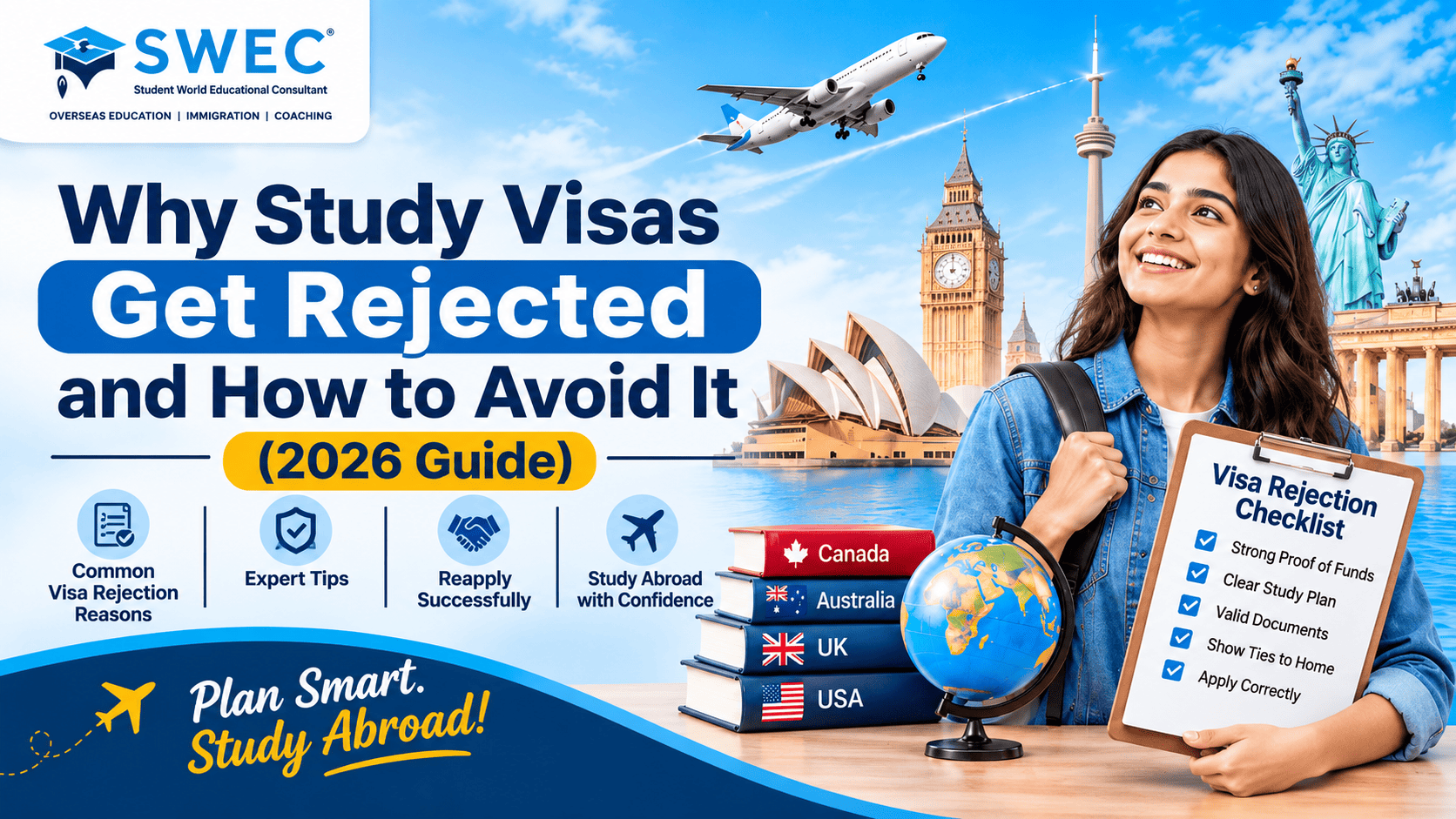
Most study visas are refused for a small set of reasons: weak or unclear proof of funds, a study plan that does not make sense, doubts that you will return home, inconsistent documents and poor interview answers. Most of these problems can be fixed before you apply, and many can be fixed before you reapply.
A refusal feels personal, but it is a decision about one file on one day. The officer decided the file did not meet the rules or did not answer their concerns.
This guide covers the most common visa rejection reasons, country-wise problems for the UK, Canada, Australia, the USA and Germany, and how to check your refusal reason. It also explains how to reapply after a refusal.
Last checked: 17 November 2026. Rules, fees and funds change often. Confirm the current requirement on the official government page before you apply or reapply.

What Is the Visa Rejection Rate for Indian Students?
There is no single official visa rejection rate that applies to every country, university and year. Refusal rates vary by destination, course level, intake and the profile of the applicant.
Be careful with blog posts that quote a neat percentage without naming a government source. A general rate tells you little about your own file. What matters is whether your application meets the current rules and answers the officer’s likely questions.
Top Student Visa Rejection Reasons
Official refusal letters differ by country, but the same themes appear again and again. Here are the student visa rejection reasons to check first.
Reason | What the officer may doubt |
Weak proof of funds | Whether you can really pay for tuition, living and travel |
Unclear study plan | Whether the course makes sense for your background |
Doubts about returning home | Whether your visit is temporary |
Inconsistent or incomplete documents | Whether your claims are true and complete |
Poor interview performance | Whether your answers are genuine and consistent |
Language or eligibility gaps | Whether you meet the entry rules |
Misrepresentation | Whether information or documents are false |
1. Weak or Unclear Proof of Funds
This is the most common file-level problem. Officers look at the amount, the source and whether the money will stay available.
IRCC says it assesses the amount of your funds and their source. It also wants to see that funds remain available for the full length of your studies. For Canada, IRCC lists bank statements for the past six months as one example of proof, and asks you to document the source of income in them.
Typical funding problems include:
- A large deposit just before you apply, with no explanation.
- A sponsor whose income does not match the amount shown.
- Statements that do not agree with tax returns or income proof.
- Funds that do not cover the full first year.
- Missing sponsor relationship proof.
Our guides on financial documents for study abroad and the cost of studying abroad from India help you plan this part early.
2. A Weak SOP or Study Plan
A generic statement is a risk. An officer who reads a copied SOP learns nothing about you.
Your SOP, study plan or form answers should explain:
- Why you chose this course.
- Why this university and country.
- How the course connects to your past studies or work.
- How you will pay.
- What you plan to do after graduation.
A course that has no link to your history needs a clear explanation. Without one, the officer may question your real purpose.
3. Doubts That You Will Return Home
For many destinations, you must show you are a genuine student and not planning an unlawful stay. In the US, this is the legal test behind many refusals. In Australia, it is the Genuine Student requirement.
Officers weigh your overall situation. That can include family, employment, finances, your study plan and your travel history. No single item guarantees approval.
4. Inconsistent or Incomplete Documents
Small mismatches add up. A different spelling of your name, a date that does not match your marksheet or a course title that differs between documents all create doubt.
Check that your passport, admission document, bank papers, sponsor letter and SOP all tell the same story. Our study visa document checklist for Indian students walks through each item.
5. Poor Interview Preparation
Some visas involve an interview, and some apply it only in certain cases. Applicants who memorise answers often sound rehearsed. Applicants who cannot explain their own file often sound unsure.
6. Missing English or Eligibility Requirements
Your English score, course eligibility or admission status must meet the rules for your visa. Check your test score and each section before you book. Our comparison of IELTS vs PTE for study abroad can help you choose a test.
7. Misrepresentation
This is the most serious problem. False or altered documents, or leaving out important facts, can lead to more than a normal refusal.
IRCC says a finding of misrepresentation can make you inadmissible to Canada for at least five years. Never submit a document you cannot prove is real. This holds even if an agent filed the application for you, because you remain responsible for the information.
Country-Wise Student Visa Rejection Reasons
USA F-1 Visa Rejection Reasons and 214(b)
Most USA F-1 visa rejection reasons come back to one section of law: 214(b).
What does a 214(b) rejection mean? The State Department says a 214(b) refusal means the officer decided you did not show you qualify for the visa. It also means you did not overcome the presumption of immigrant intent. In plain terms, the officer was not satisfied that your US stay would be temporary and that you would leave when it ends.
The department describes “ties” as circumstances that bind you to your home country. Examples include a job, a home, and family and friends. Officers look at each case on its own facts.
Points to remember about 214(b) rejection:
- It does not mean the officer found fraud.
- It is not a permanent ban.
- There is no appeal for a 214(b) decision.
- You can reapply if you have additional evidence or changed circumstances.
- A new application needs a new form, a new fee and a new interview slot.
A 214(b) refusal is different from a 221(g) refusal. A 221(g) usually means documents were missing or the application was incomplete, and it follows different steps.
Read the official US State Department page on visa denials before you reapply. For the full process, see our guide to the USA student visa.
Canada Study Permit Rejection Reasons
The most common Canada study permit rejection reasons involve funds, purpose of study and missing or inconsistent documents. IRCC says a refused applicant receives a written explanation, so the letter is your starting point.
Watch for these problems:
- Funds below the required level. For applications from 1 September 2026, IRCC lists a living-expense minimum of C$23,448 for one person outside Quebec. That figure excludes tuition and transport.
- Unexplained deposits in bank statements.
- A study plan that does not match your profile.
- Missing documents, or documents that conflict.
- Doubts about your plan after you finish.
Our guide to the Canada student visa GIC process explains one common way to show funds.
UK Student Visa Rejection Reasons
The common UK student visa rejection reasons are not meeting the funds rule, English requirement or CAS conditions, and the genuine student assessment.
GOV.UK sets out the money rule clearly. You must usually hold the required funds for 28 consecutive days. The end of that period must fall no more than 31 days before your application date. Some loan and sponsorship routes are treated differently.
Caseworker guidance says UKVI must be satisfied you are a genuine student. It also says UKVI must not refuse on genuineness grounds without an interview, unless a previous refusal on the same grounds had no material change or new evidence.
Prepare for this with our UK student visa cost, documents and CAS guide.
Australia Student Visa Rejection Reasons
For Australia student visa rejection reasons, the key test is the Genuine Student (GS) requirement for applications lodged from 23 March 2024.
Home Affairs says the online form asks you to answer in English, with a 150-word limit per response. The questions cover your current circumstances, why you chose the course, Australia and your provider, and how the course benefits you.
Decision-makers consider factors such as:
- Your ties and circumstances at home.
- Why you want to study overseas if a similar course exists at home.
- Your knowledge of the course, provider and living costs.
- Whether the course fits your education or work history.
- Your travel and visa history.
- Inconsistencies in your application.
Funds also matter. Read our guides on the Australia student visa subclass 500 and how to prove financial capacity for an Australian student visa.
Germany Student Visa Rejection Reasons
The German embassy and consulates in India do not publish a ranked list of refusal reasons. Applicants often report problems with the APS certificate, the blocked account and unexplained funds, but treat these as common reports, not official statistics.
Check these points before you apply:
- Your APS documents match your passport and academic records.
- Your blocked account meets the amount currently required.
- Any sponsor documents support the funding claim.
- Your admission and course details are consistent.
German missions in India ended remonstration, the old informal review route, on 1 January 2024. After a refusal, your letter explains the remedy available, which can include a court case or a new application. Read more in our guide to studying in Germany from India.
Student Visa Interview Questions to Prepare For
Not every country interviews every applicant. When an interview happens, officers usually test whether your story is true, clear and consistent.
Common student visa interview questions include:
- Why did you choose this course?
- Why this university?
- Why this country and not India or another country?
- How are you paying for your studies?
- What does your sponsor do?
- What did you study before, and how does this course connect?
- What are your plans after you finish?
- Do you have relatives in the country?
- Why is there a gap in your studies or work?
Tips for Better Answers
- Answer the question that was asked.
- Keep answers short and specific.
- Know your own numbers, such as fees, funds and sponsor income.
- Do not memorise a script.
- Never guess. Say you do not know if you do not.
- Bring a neat file, but do not offer papers unless asked.
How to Check Your Visa Rejection Reasons
Do not guess why you were refused. The facts are in your decision.
How to check visa rejection reasons:
- Read the refusal letter closely. IRCC says refused applicants receive a written explanation. Use the IRCC refusal letter page to understand what each part means.
- Look for the legal section or rule cited. In the US, check whether it cites 214(b) or 221(g).
- Check your options. Your letter or notice states whether review, appeal or a new application is possible.
- Request further notes where allowed. For Canada, IRCC advises you to review any officer decision notes available.
- List each concern separately. Match each one to the evidence you can add or fix.
Visa Reapplication After Refusal: Step by Step
A refusal does not automatically stop you from applying again. However, repeating the same file with the same answers is unlikely to change the result. IRCC says applying again with the same information will usually not change the decision.
Does a Previous Visa Refusal Affect a Future Visa Application?
It can affect how an officer reads your next file, but it is not an automatic bar. Many forms ask whether you have ever been refused a visa, and you must answer truthfully.
For example, Canada’s study permit form asks about refusals in Canada or any other country. UK guidance treats non-disclosure of a previous refusal as a serious issue. A previous refusal is one thing. Hiding it is far worse.
Step-by-Step Plan to Reapply
- Get the facts. Read the refusal letter and note the stated reasons.
- Find the real cause. Check funds, SOP, documents, ties and eligibility against the reasons.
- Fix what you can. Add clear evidence, correct errors and explain gaps honestly.
- Decide whether to review or reapply. In the UK, administrative review is for a possible caseworking error. GOV.UK states a fee and a deadline, and says a new application can withdraw a pending review. See the GOV.UK administrative review page before choosing.
- Answer refusal questions honestly. Declare the refusal and explain what has changed.
- Wait if you need to. If you cannot add real new evidence, give yourself time to build a stronger profile.
- Reapply with a clean, consistent file. Make every document tell the same story.
Australia: A Location Rule to Know
Home Affairs states that from 2 October 2026, most current Student visa holders cannot lodge a further Student visa application in Australia unless an exemption applies. Check the official student visa page if this could affect you. This is a separate rule from the Genuine Student assessment.
How to Avoid Student Visa Rejection Before You Apply
Use this list before you submit.
- Match your course to your story. Make the link between your past and your plan clear.
- Show funds with a clear source. Keep statements steady and explain any large deposit.
- Write your own SOP. Make it specific and consistent with your documents.
- Check every name, date and number. One mismatch can raise a question.
- Read the official rules for your country. Use government pages, not forum posts.
- Prepare for the interview. Practise out loud with someone who will ask follow-up questions.
- Apply early. Rushed files miss details.
- Never use false documents. The consequences can last for years.
Our guide to the student visa application process shows what to do at each stage.
When to Talk to a Visa Refusal Expert
A refusal is easier to fix when someone reads it with you. A visa refusal expert can compare your refusal letter against your file and point out what is missing or inconsistent.
Consider help if:
- You have had one or more refusals.
- Your sponsor setup, loan or funds are complex.
- You have a study gap or a change of course.
- You are unsure whether to reapply or seek review.
- You have a tight intake deadline.
A visa refusal consultant in Ahmedabad and Surat should give you an honest view of your chances. They should never promise approval or ask you to submit false papers. Our guide on how to choose study visa consultants in Surat explains what to compare.
SWEC works with students from Ahmedabad and Surat on every stage of the student visa process. Learn more about our study visa consultant service for Indian students. If you have a refusal letter, book a counselling session with SWEC and bring the letter, your original file and your offer documents.
Frequently Asked Questions
What are the most common study visa rejection reasons?
The most common reasons are weak proof of funds, an unclear study plan, doubts that you will return home, inconsistent documents and poor interview answers. Misrepresentation is less common but more serious.
What does 214(b) rejection mean?
It is a US refusal under section 214(b) of the Immigration and Nationality Act. The officer was not satisfied you qualify for the visa or that you meet the temporary stay requirement. It is not a permanent ban, and you can reapply with new evidence or changed circumstances.
Can I reapply after a student visa refusal?
Usually yes. Review the refusal reasons, fix the gaps and apply again with stronger, consistent evidence. Reapplying with the same file and the same answers rarely helps.
Does a previous visa refusal affect a future visa application?
It can influence how officers assess your next application, but it does not automatically bar you. You must disclose it honestly when the form asks.
How long should I wait before reapplying?
There is no universal waiting period. It depends on the country and your situation. Reapply when you can show meaningful new evidence or fix the stated concerns.
Is a visa refusal the same as a visa rejection?
People use both terms in the same way. Official letters usually say “refused” or “denied,” so use those words when you search government pages.
Can a consultant overturn a visa refusal?
No consultant can guarantee that. A good one can help you understand the decision, choose between review and reapplication, and prepare a stronger file.
Final Takeaway
Most study visa rejection reasons come down to the same few things: unclear funds, a weak story, ties doubts and inconsistent papers. Read the refusal letter first, fix each stated concern with real evidence and answer every question honestly.
If you want a second opinion before you apply or reapply, talk to SWEC.