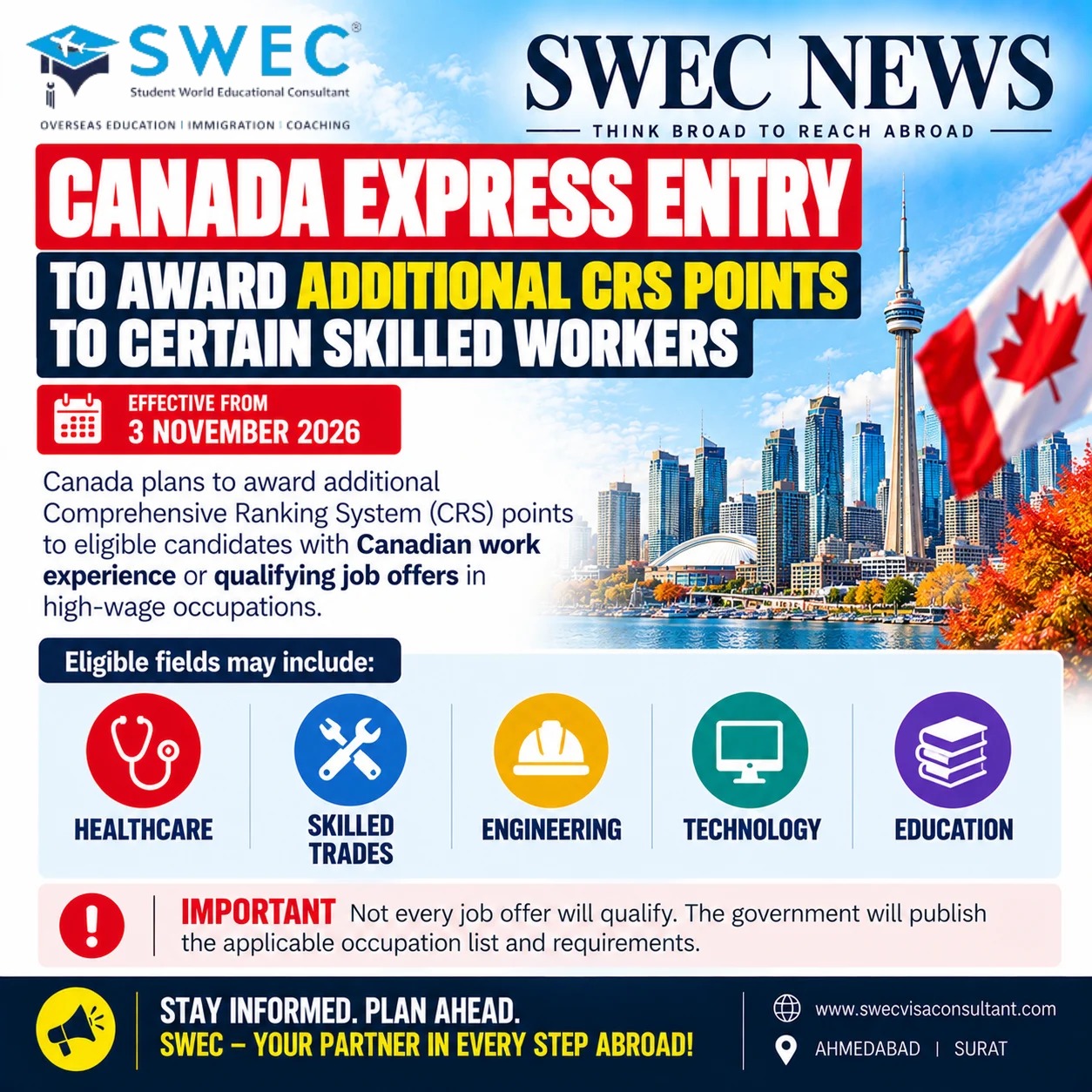
Canada is changing how it ranks Express Entry candidates. From 3 November 2026, skilled workers in certain high-wage occupations can earn extra Comprehensive Ranking System (CRS) points.
Job offer points are also coming back, and many job offers will no longer need a Labour Market Impact Assessment (LMIA).
Immigration Minister Lena Diab announced the changes on 16 October 2026. Here is what is changing, who gains and what to do next.
Key Changes at a Glance
| Change | What it means |
|---|---|
| New CRS factor | The Labour Market Integration factor, worth up to 150 points |
| High-wage work experience | Up to 70 extra points |
| Job offer points | Return for jobs in high-wage occupations, up to 100 points |
| LMIA | No longer needed for qualifying Express Entry job offers |
| Start date | 3 November 2026 |
| Invitation rounds | Paused for up to two weeks while scores are recalculated |
What Is the Labour Market Integration Factor?
It is a new part of the CRS. It gives points for one of these:
- Canadian work experience, with extra points if the experience is in an eligible high-wage occupation
- A qualifying job offer in an eligible high-wage occupation
You cannot get both. IRCC compares the two options and gives you whichever score is higher.
What Counts as a High-Wage Occupation?
This is the part many people will get wrong.
A job counts as high-wage if the median wage for that occupation across Canada is at least 1.3 times the average median wage of the whole Canadian workforce.
It depends on your National Occupational Classification (NOC) code, not your own salary. A high personal salary will not help if your NOC is not on the list. A lower salary will not hurt if your NOC is on it.
IRCC groups eligible jobs into three levels:
| Level | Median wage for the occupation |
|---|---|
| Level 1 | At least 2 times the average median wage |
| Level 2 | At least 1.5 times the average median wage |
| Level 3 | At least 1.3 times the average median wage |
CIC News reports 186 occupations on the list. They include financial auditors and accountants (NOC 11100), architects (NOC 21200), human resources professionals (NOC 11200), construction inspectors (NOC 22233) and industrial electricians (NOC 72201).
Check the full list on IRCC’s high-wage occupation page before you count on these points.
Points for Canadian Work Experience
Your Canadian work experience score has two parts.
1. Work-length points. These are the same points that already exist for skilled Canadian work experience in TEER 0 to 3 jobs. The rules for them are not changing.
| Canadian work experience | With spouse | Without spouse |
|---|---|---|
| 1 year | 35 | 40 |
| 2 years | 46 | 53 |
| 3 years | 56 | 64 |
| 4 years | 63 | 72 |
| 5 years or more | 70 | 80 |
2. High-wage occupation points (new). These are extra points on top of work-length points.
| Experience in high-wage occupations | Extra points |
|---|---|
| 12 months at the 2x level | 70 |
| 12 months at the 1.5x level | 40 |
| 12 months at the 1.3x level | 20 |
| Less than 12 months | 0 |
To qualify, you need at least 12 months (1,560 hours) of qualifying Canadian work experience in one or more eligible high-wage jobs. The experience can be:
- Continuous or not
- Full-time, or an equal amount of part-time
- Spread across more than one eligible high-wage job
If you worked two jobs at once, hours count only up to 30 hours a week.
Maximum: 150 points without a spouse (80 + 70) or 140 points with a spouse (70 + 70).
Points for a Qualifying Job Offer
Job offer points were removed in March 2025. Now they are back, but only for jobs in high-wage occupations.
According to CIC News, job offer points depend on the occupation’s level:
| Job offer occupation level | Points |
|---|---|
| 2x level | 100 |
| 1.5x level | 70 |
| 1.3x level | 50 |
IRCC’s official page confirms the 100-point maximum for a qualifying job offer.
How the Points Work: Three Examples
Example 1: Single, 2 years in a 2x-level occupation, no job offer Work-length 53 + high-wage 70 = 123 points
Example 2: Married, 1 year in a TEER 2 job that is not high-wage, job offer at the 1.5x level Work experience = 35. Job offer = 70. IRCC uses the higher score: 70 points
Example 3: Single, 1 year in a job that is not high-wage, job offer at the 2x level Work experience = 40. Job offer = 100. IRCC uses the higher score: 100 points
These cover only the new factor. Your total CRS score still includes age, education, language and other factors.
LMIA No Longer Needed for Qualifying Job Offers
Job offers for the Federal Skilled Worker Program and Federal Skilled Trades Program used to need an LMIA unless an exemption applied.
From 3 November 2026, IRCC will accept qualifying job offers without an LMIA. But:
- The offer must still be genuine
- It must meet program requirements
- IRCC will check whether the employer’s business is legitimate
- Separate work permit rules still apply
Employers should be ready to provide supporting documents.
How to Update Your Express Entry Profile
Canadian work experience: If it is already in your profile, IRCC will add the points automatically.
Job offers: You must update your profile yourself. Fragomen advises doing this before 3 November 2026.
According to CIC News, IRCC’s instructions say to select that you have a positive LMIA when adding the job offer, even though an LMIA is no longer required. Follow IRCC’s current instructions exactly when you update.
Pause in Express Entry Draws
IRCC will recalculate scores for everyone in the pool starting 3 November. This may take up to two weeks.
Invitation rounds will pause during that time and restart once the recalculation is complete. Expect the first draws after the pause to look different, because rankings across the pool may shift.
Who Gains the Most
- Workers in Canada in high-wage occupations, including many PGWP holders in fields like finance, engineering and skilled trades
- Candidates with job offers in high-wage occupations, especially those who could not get an LMIA
- Employers who want to keep skilled foreign workers
Candidates whose jobs are not on the high-wage list keep their existing work-length points but get no extra points. As others move up, they may drop in the rankings.
What This Means for Indian Applicants
Indian nationals are one of the largest groups in the Express Entry pool, so this change matters.
- Check your NOC code. It decides your eligibility, not your salary.
- Make sure your NOC is correct in your profile. A wrong code can cost you points or cause a refusal later.
- If you have a job offer, confirm it is in a listed occupation and update your profile before 3 November.
- If you are outside Canada, a qualifying job offer from a genuine employer may now help without an LMIA.
- Plan for the pause. No invitations are expected for up to two weeks from 3 November.
- Watch for more changes. Fragomen notes that in April 2026, IRCC proposed replacing the Federal Skilled Worker, Canadian Experience and Federal Skilled Trades classes with a single program.
To understand your full score, read our explainer on the Comprehensive Ranking System (CRS). For the full process, see our Canada Express Entry guide.
Get Your CRS Score Checked Before 3 November
These changes could move your rank up or down. The right NOC code and a properly updated profile matter more than ever.
SWEC Visa Consultant helps skilled workers from Ahmedabad, Surat and across Gujarat with:
- CRS score checks
- NOC code review
- Express Entry profile updates
- Job offer and document checks
- Full PR application support
Book a consultation with SWEC to see how the new rules affect your score.
Sources
- IRCC: 2026 changes to points for Canadian work experience and job offers
- IRCC: High-wage occupations eligible for Express Entry points
- CIC News: Canada boosts CRS points for Express Entry candidates with high-wage job offers, drops LMIA requirement
- Fragomen: Canada Express Entry Changes to Prioritize High-Wage Occupations