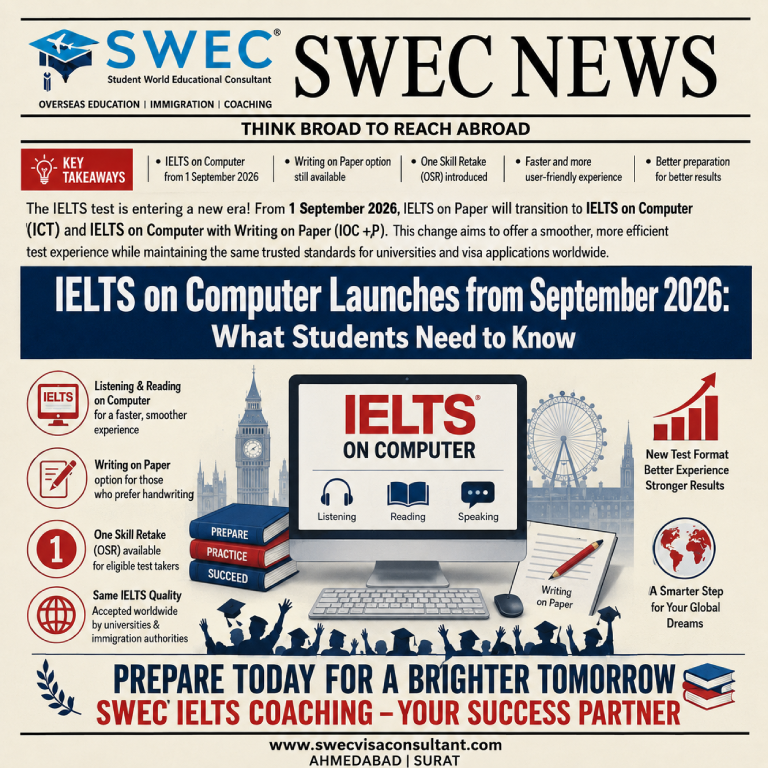
India’s IELTS format is changing, but the English skills being tested are not. From September 2026, IELTS on Computer will become the standard delivery format in India. Paper-based dates remain available only through August, subject to the official test schedule.
For students, parents, professionals, and visa applicants, the important change is how answers are entered. Test content, difficulty, band scoring, and the Speaking assessment remain the same. Candidates should confirm current dates during IELTS registration.
Key Takeaways
- India moves to computer-delivered IELTS from September 2026.
- Paper IELTS is available only for the remaining scheduled dates in August.
- Listening, Reading, and Writing move to a computer test center format.
- Writing on Paper may be available at selected locations.
- Eligible candidates may use One Skill Retake for one module.
- Screen practice and typing accuracy now need early attention.
- University and visa deadlines should guide the booking date.
What IELTS on Computer Changes from September 2026
IDP Education has confirmed that paper-based IELTS will no longer be available in India after August 22, 2026. Candidates can review the remaining dates through the official IDP IELTS India registration page.
The shift affects the test delivery method, not the test itself. In IELTS on Computer, candidates complete Listening, Reading, and Writing at a test center using a computer. Speaking continues face-to-face with a certified IELTS examiner.
This is part of a wider move toward computer delivery. However, IELTS test delivery updates confirm that timelines can differ by market. Indian candidates should not assume another country’s format or schedule applies locally.
Existing IELTS scores remain valid for their normal two-year period. A candidate who already holds an acceptable score does not need to retake the exam because the format has changed.
The Writing on Paper Option Explained
Some selected markets may offer IELTS on Computer (Writing on Paper). Where available in India, candidates complete Listening and Reading on a computer, handwrite the Writing test, and take Speaking face-to-face.
This option may suit candidates who plan essays better with pen and paper. However, they still need confidence with computer-based Listening and Reading.
Availability can vary by city, test center, and booking date. Candidates should check the official IELTS booking page before selecting this format.
What Stays the Same for Every IELTS Candidate
The core IELTS exam changes are limited. These parts remain unchanged:
- IELTS still tests Listening, Reading, Writing, and Speaking.
- Question types, time limits, and band scores remain the same.
- Marking standards and test difficulty do not change.
- Speaking remains an assessment with a certified examiner.
- IELTS continues to support university admission, professional registration, and immigration pathways.
Each university, country, and visa route sets its own score requirement. The computer format does not lower or raise those standards.
IELTS on Computer Compared With the Paper Test
The two formats assess the same English proficiency test skills, but the test-day experience feels different.
| Feature | IELTS on Computer | Paper IELTS |
| Answer method | Typed on screen | Written by hand |
| Listening experience | Headphones and on-screen questions | Audio played in the room |
| Editing answers | Easy to move, delete, and revise | Changes must be handwritten |
| Reading tools | Highlighting and question navigation | Underlining and notes on paper |
| Writing | Typed responses | Handwritten responses |
| Speaking | Face-to-face examiner | Face-to-face examiner |
| Result timing | Often 1 to 5 days | Usually longer |
| Candidate suitability | Good for confident typists | Good for candidates who prefer handwriting |
Computer delivery includes an on-screen timer, clear question navigation, text highlighting, and headphones for Listening. These features can reduce small test-day frustrations.
However, no format is easier for everyone. Slow typing, screen fatigue, and weak digital concentration can affect performance. Candidates should confirm current result timelines when booking, since processing times can change.
How One Skill Retake Can Help
One Skill Retake lets eligible computer-based candidates repeat one IELTS section instead of the full test. A candidate who misses a Reading target, for example, may not need to repeat Listening, Writing, and Speaking.
The permitted period is commonly up to 60 days after the original test. Eligibility, center availability, country rules, and acceptance by universities or immigration authorities must be checked before booking.
One Skill Retake can help with a single weak score, but it does not replace a full preparation plan.
It may reduce pressure and cost for some candidates. Still, a student should prepare for all four skills from the first attempt.
The Main Benefits and Possible Challenges
Benefits include:
- Faster results for many computer-based IELTS candidates.
- Easier editing during Writing and Reading tasks.
- Headphones that provide clear Listening audio.
- Screen tools for highlighting and moving between questions.
- Possible access to One Skill Retake.
Challenges may include:
- Typing full essays within the Writing time limit.
- Reading long passages on a screen.
- Staying focused around digital timers and navigation tools.
- Less comfort for candidates who think better through handwriting.
How Students Should Prepare for IELTS Computer Delivery
Preparation should start with an official practice test. This gives candidates a clear view of the screen layout, timer, question navigation, and answer boxes before test day.
Typing practice matters, especially for Writing Task 1 and Task 2. Candidates should build speed without losing control of spelling, grammar, punctuation, or paragraph structure. A fast answer full of errors will not improve a band score.
Timed Reading practice is equally important. Students should learn when to highlight keywords, skip difficult questions, and return later. During Listening practice, brief notes can help, but answers still need accurate spelling.
Regular mock tests reveal patterns that daily practice can hide. Students should track repeated mistakes, review useful vocabulary, and schedule weekly Speaking sessions with a partner or trainer.
Candidates choosing Writing on Paper should still practice computer-based Listening and Reading. The hybrid option does not remove the need for screen confidence.
Before registering, candidates should:
- Confirm the test date and available format.
- Check university application and visa deadlines.
- Review required IELTS scores for each course or pathway.
- Compare Writing on Paper availability where relevant.
- Register early, especially during peak intake periods.
What the Change Means for Indian Study Abroad Applicants
Students applying to Canada, the UK, Australia, or other destinations should build extra time into their plans. A retake, score reporting, university offer, and student visa documents can quickly compress a deadline.
Faster computer results may help, but institutions still set their own acceptance rules. First-time candidates often benefit from structured mock tests and focused feedback before booking.
SWEC Visa Consultant offers coaching support alongside application planning. Its study abroad consultants can help students connect IELTS timing with university and visa requirements. Candidates who need broader planning can also explore overseas education services for coaching and student visa guidance.
Final Guidance for September 2026
IELTS on Computer becomes the standard format in India from September 2026, while the test structure and scoring remain unchanged. Writing on Paper may still be available at selected centers, and One Skill Retake has separate eligibility rules.
Students should practice on screen, verify official registration details, and plan well before university and visa deadlines. To prepare with mock tests, expert feedback, and study abroad guidance, students can book IELTS coaching or contact SWEC Visa Consultant for a free consultation.