More than 1.2 million Indian students were studying abroad in 2025, even after tighter visa rules in some countries. That tells you something important. The dream is still alive, but the path needs sharper planning now.
When you choose to Study Abroad After 12th, you start your bachelor’s degree overseas right after school. It sounds exciting, but it can also feel heavy. You may worry about the right course, total cost, visa approval, and whether the degree will pay off.
That pressure is real in 2026 because demand is moving fast toward AI, cybersecurity, healthcare, and skill-based roles. Visa rules are also shifting in the US, UK, Canada, and Australia. So your choices matter more than before.
Key Takeaways
- Tech and healthcare lead on salary: Computer Science, AI, and Data Science start around $85K–$110K in the US. MBBS and nursing offer strong long-term security with growing global demand.
- Your country choice shapes cost and ROI: The US and UK offer high salaries but come with high costs ($40–70 lakhs/year). Canada, Australia, and Germany balance affordability with solid work visa options.
- Budget realistically: Expect ₹15–50 lakhs for annual tuition, plus ₹8–15 lakhs for living costs. Your total investment can vary widely by location and lifestyle.
- Scholarships are possible but competitive: Merit-based and country-specific scholarships can cover 25%–100% of costs, but most students combine partial scholarships with education loans.
- Start early: Begin your research and applications 12–18 months before your intended intake. Fall admission cycles usually open 10 months in advance.

Why Study Abroad After 12th Matters (And Why 2026 Is Your Year)
While the number of Indian students going abroad has dropped significantly—from over 9 lakh in 2023 to about 6.26 lakh in 2025—this actually creates more opportunity for those who plan smartly. Fewer applicants mean less competition for spots and scholarships at good universities. In 2026, you’re not just chasing a degree overseas; you’re making a strategic career move that could set you apart.
Global Exposure & Early Career Advantage
Starting college at an international university means you develop cross-cultural skills from day one. You learn to work with people from different backgrounds, adapt to new teaching styles, and build confidence in unfamiliar settings. Over 80% of employers specifically value this kind of international experience when hiring.
Higher Earning Potential
The salary gap remains significant for the right fields. While top Indian graduates might earn ₹8-15 LPA in good roles, international graduates in high-demand fields often start at ₹20-40 LPA equivalent. In the US, STEM graduates can earn $70,000-90,000 (approximately ₹58-75 lakhs) starting salaries. The key is that post-graduation work visas (like the 3-year OPT in the US or PGWP in Canada) let you earn in stronger currencies while gaining global experience.
Better Career Opportunities
Studying abroad gives you direct access to global job markets. Companies like Google, Microsoft, and Goldman Sachs recruit directly from international campuses. You also get exposure to startup ecosystems and specialization options that might not be available in India yet. This isn’t just about getting a job—it’s about accessing career paths that can accelerate your growth by 5-10 years.
Post-Study Work Visas
The visa landscape has tightened, but opportunities remain strong for qualified students:
- USA: OPT provides 3 years work authorization for STEM graduates
- UK: Graduate visa offers 2-3 years depending on your degree level
- Canada: PGWP gives up to 3 years work rights, with clear pathways to permanent residency
- Australia: Temporary Graduate visa provides 1.5-3 years based on your skills and degree
Personal Growth Beyond Academics
This journey transforms you beyond the classroom. You develop independence, maturity, and life skills that come from managing everything yourself in a new country. The diverse peer network you build becomes a professional asset for years to come. You learn different education systems and problem-solving approaches that make you more adaptable in any career.
2026 might seem uncertain with recent policy changes, but for students who plan carefully and choose the right course-country combination, the rewards have never been more valuable. The key is matching your strengths with opportunities that offer both growth and practical returns. If you’re just starting your research, this comprehensive 2026 guide to studying abroad after 12th can help you understand the full landscape.
Top 10 High-salary Courses To Study Abroad After 12th In 2026

Choosing the right course after 12th is one of the most important decisions for students planning to build an international career. In 2026, studying abroad is no longer only about earning a foreign degree — it is about selecting a program that offers strong career growth, global opportunities, and excellent salary potential. With industries like artificial intelligence, cybersecurity, healthcare, and finance expanding rapidly, students now have more profitable options than ever before.
Many students begin by researching the best courses to study abroad in 2026 and comparing them with industry-based salary insights for high-paying courses after 12th to understand which programs can deliver the highest return on investment. Resources such as best courses to study abroad in 2026 and high-salary courses after 12th for studying abroad can help students evaluate tuition costs, career demand, and future earning potential more effectively. The right degree can help students secure well-paying jobs shortly after graduation while opening doors to long-term career success.
1. B.Tech in Computer Science / Software Engineering
Duration: 4 years
Tuition Cost (per year):
- USA: $35,000–45,000 (₹29–37 lakhs)
- Canada: CAD $20,000–25,000 (₹12–15 lakhs)
- UK: £15,000–18,000 (₹15–18 lakhs)
- Australia: AUD $35,000–40,000 (₹21–24 lakhs)
Expected Starting Salary: $90,000–110,000 (₹75–90 lakhs)
Job Roles After Graduation:
- Software Engineer (most common)
- Full-Stack Developer
- Backend/Frontend Developer
- Cloud Architect
Top Countries to Study:
- USA – Highest salary, Silicon Valley opportunities
- Canada – Affordable, work-friendly, strong tech hubs (Toronto, Vancouver)
- UK – Strong tech scene, faster 3-year degree
Career Growth Potential:
- Year 5: $130K–150K
- Year 10: $180K–250K+
- Senior/Manager level: $250K–400K+
Why Choose This:
- Highest entry salary among undergraduates
- Maximum job opportunities globally
- Remote work possibilities (work from anywhere)
- Constant demand—never runs out of jobs
2. B.Tech in Artificial Intelligence & Machine Learning
Duration: 4 years
Tuition Cost (per year):
- USA: $40,000–50,000 (₹33–41 lakhs)
- Canada: CAD $22,000–28,000 (₹13–17 lakhs)
- UK: £16,000–20,000 (₹16–20 lakhs)
Expected Starting Salary: $110,000–140,000 (₹90–115 lakhs)
Job Roles:
- AI/ML Engineer
- Data Scientist
- Research Scientist
- AI Consultant
Top Countries:
- USA – Tech hubs: Silicon Valley, Seattle (Amazon, Microsoft, Tesla)
- Canada – Growing AI sector (Toronto, Vancouver)
- UK – Oxford, Cambridge have strong AI programs
Career Growth Potential:
- Year 5: $160K–200K
- Year 10: $250K–350K+
- Specialist/Researcher: $300K–500K+
Why Choose This:
- Fastest-growing field (40%+ year-on-year growth)
- Highest starting salary for undergraduates
- Rapid career progression
- Leads to highest-paying senior roles
3. MBBS / Medicine
Duration: 5–6 years
Tuition Cost (per year):
- USA: $50,000–80,000 (₹41–66 lakhs)
- Australia: AUD $35,000–50,000 (₹21–30 lakhs)
- UK: £25,000–35,000 (₹25–35 lakhs)
Expected Starting Salary: $70,000–90,000 as resident; $180,000+ as practicing physician
Job Roles:
- Medical Doctor / Physician
- Resident (first 3–5 years)
- Specialist (Cardiology, Neurology, etc.)
- Hospital Administrator
Top Countries:
- USA – Highest physician salaries globally ($200K–500K+)
- Australia – Critical nursing shortage, good work-life balance
- UK – NHS pathway, strong medical education
Career Growth Potential:
- Year 5–10: $150K–250K (as specialist)
- Year 15+: $300K–500K+ (established practice/specialist)
Why Choose This:
- Job security—doctors always needed
- Highest lifetime earnings (₹5–10 crore+)
- Respected globally
- Dual qualifications possible (study abroad + practice internationally)
Reality check: MBBS abroad is expensive and competitive. But the ROI is astronomical.
4. B.Tech in Cybersecurity
Duration: 4 years
Tuition Cost (per year):
- USA: $35,000–42,000 (₹29–35 lakhs)
- Canada: CAD $18,000–22,000 (₹11–13 lakhs)
- Australia: AUD $32,000–38,000 (₹19–23 lakhs)
Expected Starting Salary: $95,000–115,000 (₹80–95 lakhs)
Job Roles:
- Security Engineer
- Cybersecurity Analyst
- Penetration Tester
- Security Architect
Top Countries:
- USA – Highest demand, critical infrastructure needs
- Canada – Growing cybersecurity sector
- Australia – Tech-forward country
Career Growth Potential:
- Year 5: $140K–160K
- Year 10: $200K–280K+
Why Choose This:
- Every company needs security (high demand)
- Growing field (not saturated)
- Excellent salary growth
- Remote work opportunities
5. B.Sc Data Science / Data Analytics
Duration: 4 years (or 2-year Master’s)
Tuition Cost (per year):
- USA: $35,000–42,000 (₹29–35 lakhs)
- UK: £14,000–18,000 (₹14–18 lakhs)
- Canada: CAD $18,000–22,000 (₹11–13 lakhs)
Expected Starting Salary: $85,000–110,000 (₹70–90 lakhs)
Job Roles:
- Data Scientist
- Data Analyst
- Machine Learning Engineer
- Analytics Manager
Top Countries:
- USA – Tech companies (Google, Facebook, Amazon)
- UK – Financial sector (London)
- Canada – Accessible, growing tech
Career Growth Potential:
- Year 5: $130K–160K
- Year 10: $180K–250K+
Why Choose This:
- High demand across all industries
- Good salary without being AI-specialized
- Diverse roles (finance, healthcare, tech)
- Easier to learn than AI/ML
6. BBA / Bachelor of Business Administration
Duration: 3–4 years
Tuition Cost (per year):
- USA: $40,000–50,000 (₹33–41 lakhs)
- UK: £15,000–20,000 (₹15–20 lakhs)
- Canada: CAD $20,000–25,000 (₹12–15 lakhs)
Expected Starting Salary: $55,000–75,000 (₹45–60 lakhs); Higher with MBA
Job Roles:
- Business Analyst
- Management Consultant
- Product Manager
- Investment Analyst
- Entrepreneur
Top Countries:
- USA – Business schools (Wharton, Harvard, etc.)
- UK – MBA hub (London)
- Canada – MBA-friendly, accessible
Career Growth Potential:
- Year 5: $80K–120K
- With MBA (year 10+): $200K–400K+
Why Choose This:
- Gateway to MBA programs
- Opens consulting firm doors
- Diverse career paths (startups, finance, tech)
- Salary multiplies with MBA
7. Bachelor of Engineering – Civil Engineering
Duration: 4 years
Tuition Cost (per year):
- USA: $35,000–40,000 (₹29–33 lakhs)
- Canada: CAD $18,000–22,000 (₹11–13 lakhs)
- Australia: AUD $32,000–38,000 (₹19–23 lakhs)
Expected Starting Salary: $65,000–80,000 (₹55–65 lakhs)
Job Roles:
- Civil Engineer
- Project Manager
- Infrastructure Consultant
- Structural Engineer
- Construction Manager
Top Countries:
- Canada – Huge infrastructure projects (Subway, highways)
- Australia – Construction boom
- USA – Large-scale projects
Career Growth Potential:
- Year 5: $90K–120K
- Year 10: $130K–180K+
Why Choose This:
- Stable, always-needed profession
- Global infrastructure demand
- Good work-life balance
- Project-based satisfaction
8. Nursing / Bachelor of Science in Nursing
Duration: 3–4 years
Tuition Cost (per year):
- Australia: AUD $25,000–35,000 (₹15–21 lakhs)
- Canada: CAD $12,000–18,000 (₹7–11 lakhs)
- USA: $30,000–40,000 (₹25–33 lakhs)
Expected Starting Salary: $60,000–80,000 (₹50–65 lakhs); USA pays higher
Job Roles:
- Registered Nurse (RN)
- Nurse Manager
- Clinical Specialist
- Public Health Nurse
Top Countries:
- Australia – Critical nursing shortage (visa sponsorship easier)
- Canada – Accessible, good work-life balance
- USA – Highest salary
Career Growth Potential:
- Year 5: $75K–95K
- Year 10: $100K–150K+ (specialist/manager)
Why Choose This:
- Extreme job security (critical shortage globally)
- Growing demand year after year
- Good work-life balance
- Respect + purpose in the role
9. Psychology / Bachelor of Arts in Psychology
Duration: 4 years (or 2-year Master’s)
Tuition Cost (per year):
- USA: $30,000–38,000 (₹25–31 lakhs)
- UK: £12,000–15,000 (₹12–15 lakhs)
- Australia: AUD $28,000–35,000 (₹17–21 lakhs)
Expected Starting Salary: $45,000–65,000 (₹37–55 lakhs); Higher with Master’s
Job Roles:
- Clinical Psychologist
- Counselor / Therapist
- Industrial-Organizational Psychologist
- Research Psychologist
Top Countries:
- USA – Higher salaries, mental health focus
- Australia – Growing mental health awareness
- UK – Research opportunities
Career Growth Potential:
- Year 5: $65K–85K
- Year 10: $100K–150K+ (with specialization/private practice)
Why Choose This:
- Growing mental health awareness (more demand)
- Diverse specializations (clinical, counseling, research)
- Fulfilling career (helping people)
- Good salary + purpose alignment
10. Finance / Bachelor of Commerce (Honors) in Finance
Duration: 4 years
Tuition Cost (per year):
- USA: $40,000–48,000 (₹33–40 lakhs)
- UK: £15,000–18,000 (₹15–18 lakhs)
- Canada: CAD $20,000–24,000 (₹12–14 lakhs)
Expected Starting Salary: $60,000–85,000 (₹50–70 lakhs); Investment banking much higher ($100K+)
Job Roles:
- Financial Analyst
- Investment Banker
- Portfolio Manager
- Risk Analyst
- Trader
Top Countries:
- USA – Finance hubs (New York, Chicago)
- UK – London financial center
- Canada – Growing finance sector
Career Growth Potential:
- Year 5: $120K–180K
- Year 10: $200K–400K+
- Investment Banking: $300K–1M+ (with bonus)
Why Choose This:
- Highest earning potential (long-term)
- Access to finance hubs
- Diverse roles across sectors
- Rapid career acceleration
Comparison Table:
Course | Duration | Cost / Year | Top Countries to Study | Job Roles |
B.Tech Computer Science / Software Engineering | 4 years | $20,000–50,000 | USA, Canada, UK | Software Engineer, Full-Stack Developer, Cloud Architect |
B.Tech Artificial Intelligence & Machine Learning | 4 years | $22,000–50,000 | USA, Canada, UK | AI Engineer, Data Scientist, AI Consultant |
MBBS / Medicine | 5–6 years | $35,000–80,000 | USA, Australia, UK | Doctor, Specialist, Hospital Administrator |
B.Tech Cybersecurity | 4 years | $18,000–42,000 | USA, Canada, Australia | Security Analyst, Penetration Tester, Security Architect |
B.Sc Data Science / Analytics | 4 years | $18,000–42,000 | USA, UK, Canada | Data Analyst, Data Scientist, ML Engineer |
BBA / Business Administration | 3–4 years | $20,000–50,000 | USA, UK, Canada | Business Analyst, Product Manager, Consultant |
Civil Engineering | 4 years | $18,000–40,000 | Canada, Australia, USA | Civil Engineer, Project Manager, Structural Engineer |
Nursing (BSc Nursing) | 3–4 years | $12,000–40,000 | Australia, Canada, USA | Registered Nurse, Clinical Specialist |
Psychology | 4 years | $12,000–38,000 | USA, Australia, UK | Psychologist, Counselor, Researcher |
Finance / B.Com in Finance | 4 years | $20,000–48,000 | USA, UK, Canada | Financial Analyst, Investment Banker, Risk Analyst |
The best high-salary course for studying abroad after 12th depends on your interests, budget, and long-term goals. Courses like Computer Science, Artificial Intelligence, Cybersecurity, Medicine, and Finance continue to offer some of the strongest earning potential worldwide. Before making a final decision, reviewing expert resources can help you compare the most rewarding programs and choose a path that matches your career ambitions.
How To Choose The Right Course For You – 7 Critical Factors
Choosing what to study abroad isn’t just about picking the highest salary option. It’s about finding the right fit for your strengths, goals, and circumstances. Here are the seven factors that matter most when making this important decision.
Your Personal Interest & Passion
Start with what actually interests you. If you hate math but choose engineering because it pays well, you’ll struggle through four years of courses you dislike. Students who study what they’re passionate about tend to complete their degrees, earn better grades, and advance faster in their careers. Think back to your school days—which subjects did you genuinely enjoy? Which topics made you curious to learn more? That natural interest will fuel your motivation when studies get challenging.
Salary Potential & ROI
While passion matters, practical returns are equally important. Look beyond just starting salaries—consider the total investment versus long-term earning potential. A course that costs ₹60 lakhs but leads to ₹20 LPA starting salary has different math than one costing ₹25 lakhs with ₹15 LPA starting pay. Think about where you want to be in 5, 10, or 20 years. Can this field help you reach ₹50+ LPA eventually? Some careers have higher ceilings but longer paths to get there.
Job Market Demand in 2026
The world doesn’t need more graduates in saturated fields. Right now, AI and machine learning roles are growing about 40% year-on-year. Healthcare professions face critical shortages globally. Software engineering remains in high demand despite economic fluctuations. Before choosing a course, research which fields actually need more professionals. Look at job posting trends on platforms like LinkedIn and official labor statistics from countries you’re considering.
Post-Study Work Visa Availability
Some courses naturally lead to better visa options. STEM fields (engineering, technology, math) typically qualify for longer work visas—3 years in the US through OPT, similar durations in Canada and Australia. Other fields might have more restricted options. Certain countries prioritize work visas for specific industries where they have skill shortages. Always check current visa rules for your chosen field and country combination before committing.
Entry Requirements & Your Academics
Be honest about whether you can meet the requirements. If a course requires 85% in Physics and you scored 70%, it might not be the right fit. Some programs need specific subject backgrounds—engineering usually requires Math, medicine needs Biology. Also consider test score requirements like IELTS or SAT. There’s no point dreaming about a course if your academic profile doesn’t align with what universities require.
University Quality & Global Rankings
While the course matters more than the university brand, the institution’s reputation still impacts your career. Graduates from top 100 global universities typically get better placement opportunities and higher starting salaries. However, a good course at a decent university often beats a mediocre course at a prestigious one. Research which universities have strong programs in your chosen field rather than just looking at overall rankings.
Cost vs. Your Budget
This might be the most practical factor. Calculate the total cost over your entire course duration—not just tuition, but living expenses, books, insurance, and travel. Then look honestly at what your family can afford, what scholarship opportunities exist for that field, and whether you can realistically repay any education loans after graduation. Some fields have better scholarship availability than others. Always have a backup plan if funding falls through.
Here’s a simple way to evaluate your top choices: For each course you’re considering, rate it on these seven factors. Which one scores highest overall? Which factors matter most to you personally?
If you’re still unsure which course fits your unique situation, our counselors at SWEC can help you match your academic background, interests, and budget with the right options. Sometimes talking through these factors with someone who’s helped thousands of students can provide the clarity you need.
Best Countries To Study Abroad After 12th: 2026 Comparison Guide
Choosing where to study is as important as choosing what to study. Each country offers different advantages depending on your budget, career goals, and personal preferences. Here’s how the top destinations compare for Indian students in 2026.
United States – The Dream Destination (But It Costs)
Cost: $25,000–40,000/year (₹20–33 lakhs)
Average Post-Grad Salary: $80K–120K/year (₹66–99 lakhs)
Post-Study Work Visa: OPT (3 years for STEM, 1 year for others)
Best For: Engineering, AI/ML, Medicine, Business, Research-based courses
Pros:
- Longest work visa for STEM graduates (3 years)
- Strong job market in every field
- World-class universities
- High salaries after graduation
- Chance to transition to H-1B visa
Cons:
- Most expensive among English-speaking countries
- Visa timeline tightening in 2026
- Grace period reduced to 30 days after studies
- Need employer sponsorship for long-term stay
Top Universities:
- MIT, Stanford, Harvard, UC Berkeley, Carnegie Mellon, Caltech, Princeton
Real Talk: USA is the gold standard if you want the highest salaries and work at top tech companies. But it’s also the most expensive and risky visa-wise. Only go if your family can afford it comfortably or if you’re getting a strong scholarship.
United Kingdom – The Prestigious, Fast-Track Option
Cost: £12,000–18,000/year (₹13–19 lakhs)
Average Post-Grad Salary: £28,000–40,000/year (₹28–40 lakhs)
Post-Study Work Visa: Graduate Visa (2 years; recently extended from 1)
Best For: Business, Finance, Medicine, Law, Psychology, Humanities
Pros:
- No minimum salary requirement on Graduate Route
- Work anywhere, switch jobs freely
- Flexible visa (can work part-time or full-time)
- Fast path to UK permanent residency later
- Access to European job market
Cons:
- High tuition for top schools
- Lower entry salaries than USA or Canada
- Graduate Route ends—you need long-term sponsorship after
- London accommodation extremely expensive
Top Universities:
- Oxford, Cambridge, LSE (London School of Economics), UCL, Imperial, Durham, Warwick
Real Talk: UK is great if you want prestige without the USA price tag. Perfect if you’re into finance, business, or law. But if you’re chasing tech salaries, USA still wins. The 3-year degree is a bonus—you save money and graduate faster.
Canada – The Balanced, Practical Choice
Cost: CAD $18,000–25,000/year (₹11–15 lakhs)
Average Post-Grad Salary: CAD $50,000–70,000/year (₹30–42 lakhs)
Post-Study Work Visa: PGWP (up to 3 years) + Pathway to PR
Best For: Engineering, Business, IT, Nursing, all courses really
Pros:
- Longest work permit for graduates (up to 4 years in some cases)
- No minimum salary requirement
- Easiest pathway to permanent residency
- Great salary for entry-level
- Work rights are unrestricted
- Lower cost than USA or Australia
Cons:
- Expensive tuition, especially in Ontario
- Visa rules for international students are tightening
- Weather is harsh in many cities
- Job competition in saturated fields
Top Universities:
- University of Toronto, UBC (University of British Columbia), McGill, McMaster, Waterloo
Real Talk: Canada is the practical choice. If you want a realistic pathway to permanent residence abroad, Canada is your best bet. You get a decent work visa, good quality of life, and a real shot at staying long-term. Not the highest salaries, but solid and achievable.
Australia – The Lifestyle + Opportunity Combo
Cost: AUD $28,000–40,000/year (₹17–24 lakhs)
Average Post-Grad Salary: AUD $50,000–75,000/year (₹30–45 lakhs)
Post-Study Work Visa: Temporary Graduate Visa (1.5–3 years depending on field)
Best For: Engineering, IT, Nursing, Business, Science
Pros:
- Long post-study work visa (2–4 years)
- Strong job market in shortage fields
- Good balance of cost and earning potential
- Pathway to permanent residency
- High quality of life
- Extra visa time available for regional work
Cons:
- Expensive tuition (more than Canada, less than USA)
- Visa fees are high
- Age limit of 35 for some visas
- Cost of living is high in major cities
- Medical field degrees capped at AU$65,000/year
Top Universities:
- University of Melbourne, UNSW Sydney, University of Sydney, ANU (Australian National University), Monash
Real Talk: Australia is perfect if you want to balance studies with lifestyle. The work visa is generous, and there’s a real pathway to staying. But you’re far from home, and the job market is tighter than North America. Good for people who can afford it and want adventure + opportunity.
Germany – The Budget-Friendly Engineering Powerhouse
Cost: €0–10,000/year (₹0–8.5 lakhs; many universities FREE)
Average Post-Grad Salary: €35,000–50,000/year (₹29–42 lakhs)
Post-Study Work Visa: EU Blue Card / Residence Permit (2–3 years)
Best For: Engineering, IT, Automotive, Science, Mathematics
Pros:
- Public universities are free or near-free
- Living costs are very affordable
- Strong engineering and tech job market
- 18-month job search visa to find work
- EU work rights after graduation
- High salaries relative to cost of living
Cons:
- Low entry-level salaries compared to USA/Canada
- German language often required (especially outside tech)
- Smaller job market outside major cities
- Limited post-study visa compared to other countries
Top Universities:
- Technical University of Munich (TU Munich), Heidelberg, TU Berlin, TU Darmstadt
Real Talk: Germany is the underrated choice. If you can manage the language and want affordable education + strong engineering reputation, this is your move. The EU access is a bonus—work in any European country after graduation. Not the highest salaries, but the cost difference makes up for it.
Dubai – The Business Hub With No Income Tax
Cost: AED 80,000–120,000/year (₹18–28 lakhs)
Average Post-Grad Salary: AED 60,000–100,000/year (₹12–20 lakhs)
Post-Study Work Visa: Employment visa (2–3 years, employer-dependent)
Best For: Business, Finance, IT, Hospitality, Engineering
Pros:
- No income tax (keep more salary than Western countries)
- Business and finance hub for Middle East and Asia
- Fast-growing economy with constant opportunities
- Close to India (easy to visit family)
- Large Indian expat community (easier adjustment)
- High standard of living and safety
Cons:
- Expensive accommodation (especially Dubai city center)
- Extreme heat (45°C+ in summer)
- Visa dependent on employer (limited job flexibility)
- Salaries lower than Western countries
- Limited traditional university options
- Demanding work culture in some sectors
Top Universities: University of Dubai, American University in Dubai, Middlesex University Dubai, Heriot-Watt University Dubai
Real Talk: Dubai works if you want to build wealth fast with zero income tax. The job market is strong, and being close to India is a huge advantage. But extreme heat, employer-dependent visas, and fewer universities make it less ideal for traditional undergrad study. Better for business graduates or master’s students who want to earn and save aggressively. A tech salary in Dubai after taxes often matches Canada’s gross salary—you pocket significantly more money.
New Zealand – The Quality of Life Paradise
Cost: NZD 25,000–35,000/year (₹12–17 lakhs)
Average Post-Grad Salary: NZD 50,000–65,000/year (₹25–32 lakhs)
Post-Study Work Visa: Post-Study Work Visa (1–3 years depending on qualification)
Best For: Engineering, IT, Agriculture, Business, Environmental Science
Pros:
- Affordable tuition (lower than Australia, UK, USA)
- Post-study work visa (1–3 years)
- Clear pathway to permanent residency
- Stunning quality of life (safe, clean, friendly)
- Outdoor lifestyle (hiking, skiing, adventure)
- English-speaking (no language barrier)
- Small class sizes (personal professor attention)
- Strong job market for engineers and skilled trades
Cons:
- Far from India (24+ hour flight, expensive visits)
- Lower salary than Western countries
- Smaller job market overall
- Remote location (less global networking)
- Work visa dependent on employer sponsorship
- Weather can be unpredictable (rain, wind)
Top Universities: University of Auckland, University of Otago, Victoria University of Wellington, Massey University, University of Canterbury
Real Talk: New Zealand is ideal if quality of life matters more than maximum salary. You’ll earn less than USA or UK graduates, but living costs are manageable and work-life balance is excellent. Perfect for outdoor enthusiasts and adventure seekers. The 1–3 year work visa gives you real time to qualify for permanent residency. Just prepare for the distance from home—it’s a long journey back to India. But if you want a relaxed, beautiful place to build a career and eventually settle, New Zealand delivers.
Country | Cost/Year | Approx ₹/Year | Avg. Post-Grad Salary | Work Visa Length | Best For |
$25,000–40,000 | ₹20–33 lakhs | $80K–120K/year | 1–3 years | Engineering, AI/ML, Medicine, Business | |
£12,000–18,000 | ₹13–19 lakhs | £28K–40K/year | 2 years | Finance, Law, Business, Psychology | |
CAD $18,000–25,000 | ₹11–15 lakhs | CAD $50K–70K/year | Up to 3 years | IT, Nursing, Engineering, Business | |
AUD $28,000–40,000 | ₹17–24 lakhs | AUD $50K–75K/year | 1.5–3 years | Nursing, Science, IT, Engineering | |
€0–10,000 | ₹0–8.5 lakhs | €35K–50K/year | 2–3 years | Engineering, Automotive, Mathematics | |
AED 80,000–120,000 | 18–28 lakhs | AED 60,000–100,000/year | 2–3 years | Business, Finance, IT, Hospitality, Engineering | |
NZD 25,000–35,000 | ₹12–17 lakhs | NZD 50,000–65,000/year | 1–3 years | Engineering, IT, Agriculture, Business |
Quick Insight
- Best salary potential: United States
- Best PR opportunities: Canada and Australia
- Most affordable: Germany
- Best for tech careers: USA, Canada, Ireland
- Closest to India: Singapore
Complete Eligibility Checklist: Do You Qualify?
Academic Requirements:
- 12th Pass Certificate – Original needed for visa
- Minimum Percentage – Most universities: 60%, top universities: 75%
Course-Specific Requirements:
- Engineering/Science: Completed Physics, Chemistry, Math in 12th
- Medicine/MBBS: Science (Physics, Chemistry, Biology)
- Business/BBA: Any stream (Science, Commerce, Humanities)
- Psychology/Arts: Any stream
Question: Do I have the minimum grades?
Real talk: If you’re below 60%, some universities will still consider you if:
- Your entrance exams (SAT, IELTS) are strong
- Your extracurriculars are impressive
- Your personal statement is compelling
Don’t assume you’re ineligible. Many “average” students get admitted.
English Proficiency Tests:
IELTS (Academic) – Most popular
- Cost: ₹19,000
- Validity: 2 years
- Timing: Give yourself 3–4 months to prepare
- Target score: 6.5–7.0 (most universities)
TOEFL – Alternative to IELTS
- Cost: ₹10,000–12,000
- Valid: 2 years
- Target score: 90–100
Duolingo English Test – Easier, cheaper
- Cost: ₹3,000
- Accepted by many universities (not all)
- Takes 1 hour
PTE (Pearson Test) – Growing popularity
- Cost: ₹14,500
- Quick results (5 days)
Action: Most universities prefer IELTS. Give yourself 4 months. Aim for 6.5+.
Entrance Exams (by course)
SAT (for USA universities):
- Cost: ₹35,000 (+ test prep ₹30K–50K)
- Duration: 3 hours
- Sections: Math + Evidence-Based Reading
- Score: 1200–1400 target
- Preparation: 2–3 months
- Frequency: Multiple attempts per year
ACT (alternative to SAT):
- Cost: ₹35,000
- Different format (Science section instead of Reading-focused)
- Some universities accept either
GRE (for Master’s, some PhD programs):
- Cost: ₹18,400
- Sections: Quant, Verbal, Writing
- Takes 3.75 hours
GMAT (for MBA/Business Master’s):
- Cost: ₹17,500
- Sections: Quant, Verbal, Analytical Writing, Integrated Reasoning
- 3.5 hours
Important note: Increasingly, universities are making SAT/ACT optional. But having strong scores helps your application, especially for scholarships.
Action: Check if your target universities require SAT. If yes, prepare 3–4 months, start in May if aiming for September intake.
Document Checklist
Originals needed for university applications:
- 12th mark sheet (English medium)
- 12th passing certificate
- 10th pass certificate (some universities)
- Passport (valid 2+ years)
- 2–3 letters of recommendation (from teachers)
- Personal statement / SOP (500–800 words)
- Resume / CV
- IELTS/TOEFL result
- SAT/ACT result (if required)
- School leaving certificate
For visa applications:
- Acceptance letter from university
- Passport
- IELTS/TOEFL report
- Bank statements (6 months)
- Parents’ income proof (salary slips, IT returns)
- Affidavit of financial support
- Police clearance certificate
- Medical fitness certificate (chest X-ray, blood test)
- Travel insurance quote
Action: Get all documents ready 6 months before. Don’t rush at the last moment.
Financial Requirements
Proof of funds needed:
- Bank statements showing liquid cash for 1 year minimum
- Minimum amount: Tuition for year 1 + living costs for year 1
- Example: If Canada costs ₹15 lakhs/year total, show ₹15 lakhs in bank
Parents’ income documentation:
- Last 2 years salary slips (if salaried)
- Last 2 years IT returns (if self-employed)
- Original + certified copies
Visa officer wants to see:
- Funds are genuine (not borrowed)
- Funds are stable (not one-time luck)
- Parents can support if needed
Real talk: Many students use education loans. Visa officers understand. Show bank statements + loan approval letter.
Action: Open a bank account NOW. Deposit whatever amount your family can. Show consistent balance for 3–6 months. This proves funds are genuine.
Visa Eligibility
Basic requirements:
- Valid Indian passport (6+ months validity)
- No legal cases pending
- Clean police clearance
- Medically fit (chest X-ray, blood test)
- Financial proof (as above)
- Genuine intention to study (convincing SOP)
Processing timelines:
- USA (F-1 visa): 4–8 weeks after I-20 received
- UK (Student visa): 3–4 weeks (priority: faster)
- Canada (Study Permit): 2–4 weeks online
- Australia (Student visa): 2–3 weeks
Real talk: Most Indian students get visa approval. Rejections are rare if:
- Finances are clear
- SOP is genuine
- No suspicious connections
Action: Prepare honestly. Visa officers are experienced; they know when students are lying.
How To Study Abroad After 12th With Scholarship (Complete Funding Guide)
Paying for international education might seem overwhelming, but the right scholarship strategy can make it possible. Here’s how Indian students successfully fund their studies abroad every year.
Types of Scholarships Available
Merit-Based Scholarships These reward your academic achievements and test scores. They typically cover 25%, 50%, or sometimes even 100% of your tuition costs. You apply directly through the universities during your application process. The better your grades and test scores, the higher your chances. For instance, University of Toronto offers scholarships worth CAD $50,000 per year for outstanding international students.
Need-Based Scholarships These consider your family’s financial situation rather than just your academic performance. They require you to share detailed financial documents and usually cover 25-75% of your costs. In the US, you’ll complete the FAFSA form, while other countries have similar processes through their university applications. Being honest about your financial situation actually helps—universities want to support students who genuinely need assistance.
Country-Specific Programs Each study destination has unique opportunities:
- USA: Fulbright Program offers full funding for exceptional students, plus university-specific aid from places like Harvard, MIT, and Stanford
- UK: Chevening Scholarship covers all tuition and living costs (worth over ₹50 lakhs), along with British Council programs and merit awards from Oxford and Cambridge
- Canada: Lester B. Pearson Scholarship provides full funding, while Vanier Canada Graduate Scholarships offer CAD $50,000 per year
- Australia: Australian Development Scholarship supports select international students, and universities like Melbourne and UNSW offer generous funding
- Germany: DAAD Scholarships make education affordable with monthly stipends, and many public universities charge little to no tuition
Organization Scholarships Various groups offer additional support:
- Rotary International provides travel and education grants
- AIESEC offers internship scholarships
- Inlaks Scholarships specifically help Indian students
- Numerous foundation scholarships from different NGOs
How to Strengthen Your Application
Scholarship committees look for well-rounded candidates, not just academic achievers. Here’s what makes your application stand out:
Maintain strong academic performance throughout your studies. High IELTS or SAT scores can improve your chances by about 40%. Get involved in extracurricular activities like sports, debate, volunteering, or leadership roles—they show you’re more than just grades.
Your personal essay matters tremendously. Tell your unique story and explain why you deserve the scholarship. Get strong recommendation letters from teachers who really know you and can speak to your character. If you have genuine financial need, document it clearly—committees want to help students who need support. Show how your education will help your community or create positive change.
Application Strategy
Apply to 5-7 universities with a mix of ambitious, realistic, and safety options. Scholarship deadlines usually match admission deadlines, so check each university’s specific dates. Start your applications 10-12 months before you plan to begin studying. After you receive admission offers, don’t hesitate to follow up about additional scholarship opportunities—sometimes more funding becomes available later.
How To Go Abroad For Studies After 12th For Free [2026 Strategies]
Let’s be honest about “free” education abroad. While completely free options are rare, strategic planning can reduce your costs by 50-60%, making international education much more accessible. Here are realistic ways Indian students manage this.
Full Scholarship Route
Yes, full scholarships like Chevening, Fulbright, and DAAD do exist, but they’re highly competitive. You’ll need exceptional grades (usually 90%+), outstanding test scores, and compelling application essays. Only about 5-15% of applicants succeed with full funding. If you have this kind of academic record, start preparing 12 months in advance. These scholarships cover everything—tuition, living costs, and sometimes even travel expenses.
Partial Scholarship + Education Loan
This is how most students actually make it work. Secure a 50% scholarship through merit or need-based programs, then fund the remaining 50% with an education loan. Banks like State Bank of India, HDFC, and Axis offer loans up to ₹40 lakhs at 8-13% interest, with repayment starting after course completion. About 60% of our students use this combination successfully.
Work-Study Program
While studying, you can work part-time for 20 hours per week during semesters and full-time during breaks. This can earn you ₹3-5 lakhs annually, which covers most living expenses. The challenge is balancing work with studies, but good time management makes it achievable. This approach also gives you valuable work experience that helps with post-graduation employment.
Co-Op or Internship Programs
Some programs, especially in engineering and business, include paid co-op terms where you earn significant money. Engineering students in Canada can earn CAD $25,000-35,000 per semester (₹15-20 lakhs). We’ve had students earn ₹40 lakhs during two co-op terms—enough to cover their entire tuition. These programs integrate work experience directly into your degree.
Community-Specific Programs
Don’t overlook specialized scholarships for your community, religion, or background. Organizations like Rotary International offer education grants, and many foundations support students from specific regions or communities. While these might not cover everything, every bit helps reduce your overall costs.
Affordable Country Route
Germany offers nearly free tuition at public universities—you only pay minimal semester fees of €150-350. You’ll still need living costs of ₹7-8 lakhs annually, but part-time work can cover most of this. Ireland and Singapore also offer more affordable options compared to the US or UK, especially when combined with their scholarship programs.
The Reality Check: There’s no truly “free” education abroad except Germany’s tuition-free model. Most successful students use a combination: 30-50% from scholarships, 30-40% from education loans, and 10-30% from part-time work or family support. This brings total costs down to ₹25-40 lakhs over 4 years instead of ₹60-80 lakhs.
You don’t need ₹2 crore saved up. With the right strategy, you can reduce costs by 50-60% and make studying abroad financially feasible. The key is starting early, researching all options, and creating a personalized funding plan that works for your specific situation.
How To Go Abroad For Studies After 12th: Complete 6-step Process [2026]
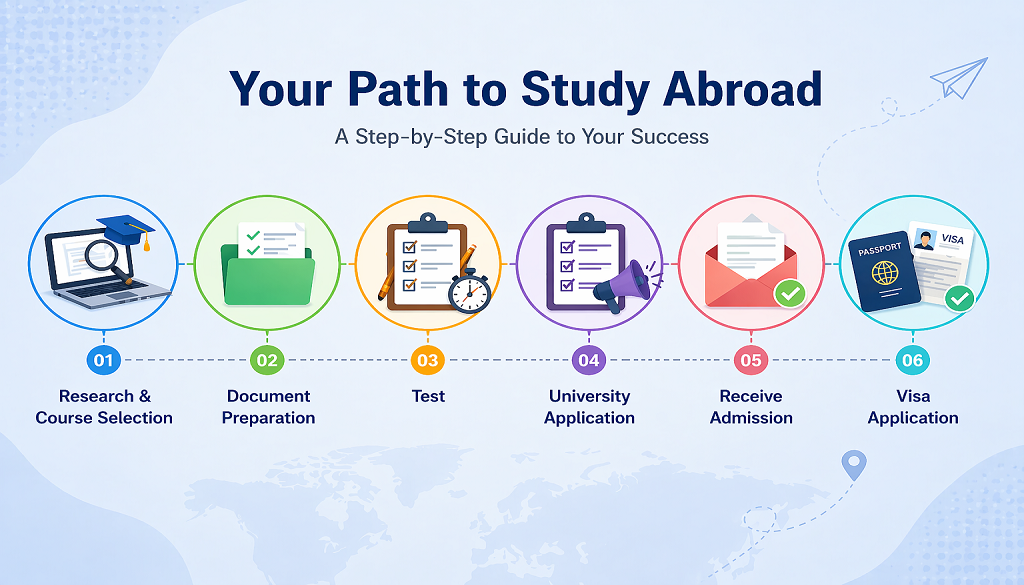
The journey to studying abroad might seem overwhelming, but breaking it into clear steps makes it manageable. Here’s your complete 12-month roadmap to make it happen successfully.
Step 1: Research & Course Selection (Months 1-3)
Start by exploring 3-5 courses that genuinely interest you. Research each option across different countries—look at salary prospects, job market demand, admission difficulty, costs, scholarship availability, and work visa options. Use resources like QS Rankings, Times Higher Education, and university websites to compare programs.
For example, if you’re interested in AI, research AI programs at the top 20 universities in your target countries. Spend about 5-6 hours each week on this research phase. By the end of month 3, you should have a shortlist of 10-15 universities, a clear course and country decision, and understanding of entry requirements.
Step 2: Document Preparation (Months 2-4)
While researching, start gathering your documents. Request official 12th transcripts from your school—these can take time to process. Approach 2-3 teachers who know you well for recommendation letters. Give them a proper request letter and at least 2 weeks to write strong recommendations.
Begin drafting your personal statement—this is your chance to explain why you want to study this course in this country, and what your career goals are. Write 500-800 words in your authentic voice, avoiding generic templates. Get feedback from mentors or consultants to strengthen your statement. Common mistake: Don’t leave SOP writing until the last minute.
Step 3: English Proficiency & Entrance Exams (Months 3-6)
Register for required tests 2-3 months in advance. For most countries, you’ll need IELTS Academic (target 6.5-7.0) or TOEFL. The IELTS costs about ₹19,000 and requires proper preparation. If applying to US universities, consider taking the SAT (target 1200-1400/1600), which costs around ₹35,000.
Schedule your exams for months 5-6 after adequate preparation. Don’t make the common mistake of taking tests too early without proper practice. By month 6, you should have your target scores and be ready to apply.
Step 4: University Applications (Months 5-8)
Create accounts on university portals and start filling application forms. Submit all required documents: transcripts, personal statement, recommendation letters, test scores, resume, and any portfolio items for creative courses.
Apply to 7-10 universities with a balanced strategy: 2-3 dream schools, 3-4 good matches, and 2-3 safety options. Budget ₹2,000-5,000 per application (total ₹15,000-50,000). Complete all submissions by month 8 and wait for responses. Common mistake: Applying to only 2-3 universities reduces your chances significantly.
Step 5: Receive Admission & Choose University (Months 9-10)
Admission offers start arriving in month 9. You might receive multiple acceptances—compare them carefully. Consider scholarship amounts, total costs (tuition + living), location, campus culture, course curriculum, and post-study work visa options.
Once you decide, accept the offer and pay the deposit (usually ₹1-3 lakhs). Don’t make the common mistake of accepting the first offer immediately—wait to compare all options.
Step 6: Visa Application & Pre-Departure (Months 10-12)
Gather visa documents: valid passport, acceptance letter, financial proof showing 1 year of funds, parents’ income documents, health insurance, and police clearance if required. Apply for your student visa based on country requirements—US F-1 visa after receiving I-20, UK student visa 3 months before intake, etc.
Prepare for possible visa interviews by practicing common questions about your course choice, country selection, and funding plans. Once a visa is approved (usually within 4-8 weeks), arrange accommodation (on-campus for safety, off-campus for savings), book flights 4-8 weeks in advance, get travel insurance, open a NRE/NRO bank account, and pack strategically.
Your 12-Month Timeline:
- Months 1-3: Research & course selection
- Months 2-4: Document preparation
- Months 3-6: Test preparation and exams
- Months 5-8: University applications
- Months 9-10: Admission decisions
- Months 10-12: Visa process and departure
Each phase builds on the previous one, with some overlap to keep you on track. Thousands of Indian students follow this process successfully each year. If any step feels confusing or overwhelming, remember that guidance is available. Our team at SWEC has helped students navigate this entire journey from research to departure, ensuring they make informed decisions at every stage.
Avoid These Common Mistakes When Going Abroad After 12th
After helping thousands of students through this journey, we’ve seen the same mistakes happen repeatedly. Learning from others’ experiences can save you time, money, and disappointment. Here are the most common pitfalls and how to avoid them.
Choosing Country Before Course
Many students start by saying “I want to study in the US” and then look for courses there. This backward approach often leads to poor career fit. Instead, first choose your course based on interest and salary potential, then find the country that offers the best combination of cost, work visa options, and job opportunities for that specific field.
Ignoring Post-Study Work Visa Rules
Some students get excited about admission offers without checking work visa options. They complete their degree only to discover they can’t work in that country afterward. Always research post-study work visa availability before applying. Countries like Canada and Australia offer clearer pathways than some European destinations.
Applying to Too Few Universities
Applying only to dream universities is a risky strategy. Even strong students face rejection from top-tier schools. Spread your applications across 7-10 universities with a mix of reach, target, and safety options. This ensures you have choices when decisions come in.
Weak Personal Statements
Admission committees read hundreds of applications. Generic, copied, or AI-generated personal statements get rejected immediately. Your story should be authentic and specific to you. Explain why you’re passionate about this field and how it aligns with your long-term goals.
Poor Recommendation Letters
Asking teachers who barely know you results in generic letters that don’t help your application. Choose teachers who can speak specifically about your strengths and potential. Give them enough time and information to write meaningful recommendations.
Incomplete Financial Documentation
Visa officers need clear proof of financial capacity. Vague bank statements or unclear income sources can lead to rejection. Maintain proper documentation showing consistent funds over time, legitimate income sources, and adequate coverage for at least one year of expenses.
Missing Deadlines
University applications have strict deadlines, often months before the intake semester. Many students assume they have more time than they actually do. Create a calendar with all important dates and work backward to ensure you meet every deadline comfortably.
Not Pursuing Scholarships
Assuming scholarships are only for top scorers causes students to miss out on significant funding opportunities. Many scholarships go unclaimed because students don’t apply. Research all available options and submit applications—even partial scholarships make a big difference.
These mistakes have real consequences: wasted years, lost opportunities, and unnecessary financial stress. The good news is that all are preventable with proper planning and guidance.
At SWEC, our counselors help students avoid these pitfalls by reviewing their entire plan before applications begin. We catch potential issues early and suggest alternatives that better match each student’s goals and circumstances. This proactive approach has helped thousands of students achieve their study abroad dreams without unnecessary setbacks.
If you want to ensure your journey goes smoothly, consider getting a second opinion on your plans. Sometimes an experienced perspective can identify risks you might have missed.
Your Questions Answered: Study Abroad After 12th FAQ
Can I Study Abroad After 12th Without IELTS?
Yes, in some cases you can study abroad without IELTS. If you scored 85% or above in 12th from an English-medium school, some universities may waive the English test requirement. Many universities now also accept the Duolingo English Test as a cheaper alternative. Still, most students need an English test, and a good score can improve your admission chances.
How Much Does It Cost to Study Abroad After 12th From India?
The total cost usually ranges between ₹25 lakhs and ₹80 lakhs depending on the country and course. Countries like Germany can be more affordable because of low or no tuition fees, while the United States can be more expensive. Scholarships can reduce the cost significantly, making study abroad more manageable for many families.
Is Studying Abroad After 12th Worth It?
For many students, yes. Graduates from countries like Canada or the United States often earn higher salaries after graduation. In the long run, better career opportunities and international exposure can make the investment worthwhile if you choose the right course and country.
Can My Parents Stay With Me While I Study Abroad?
Your parents can visit you on a tourist visa, usually for a few weeks or months. However, in most countries they cannot stay with you permanently while you study. Some students arrange short family visits after settling into university life.
Which Country is Best for Low Cost or High Salary?
If your focus is lower cost, Germany is a strong option. If you want higher earning potential, the United States is often considered the best. Canada offers a good balance between affordable education and strong career opportunities.
How Can SWEC Help in Your Study Abroad Journey?
SWEC can support you with course selection, university applications, visa guidance, scholarship search, and test preparation. The goal is to make the entire process simpler and help you choose the best path based on your budget and career plans.
Conclusion
Choosing to study abroad after 12th is one of the most important decisions you’ll make for your future. The right course in the right country can open doors to global opportunities, higher salaries, and personal growth that lasts a lifetime. But we understand it can also feel overwhelming—balancing course options, costs, visa requirements, and scholarship opportunities requires careful planning.
The key is matching your interests and strengths with practical opportunities that offer both growth and good returns. Whether you’re drawn to tech fields like AI and computer science, healthcare paths like medicine and nursing, or business and finance roles, the best choice depends on your unique situation.
Remember: you don’t need to have everything figured out immediately. The students who succeed start with good information, make thoughtful choices, and seek guidance when they need it.
If you’re feeling unsure about which path is right for you, or want help navigating the application and funding process, our team at SWEC is here to help. We’ve guided thousands of students through this exact journey and would be happy to discuss your options.
Ready to take the next step? Schedule your free consultation with our experts to get personalized advice based on your academic background, interests, and budget. There’s no obligation—just honest guidance to help you make the best decision for your future.