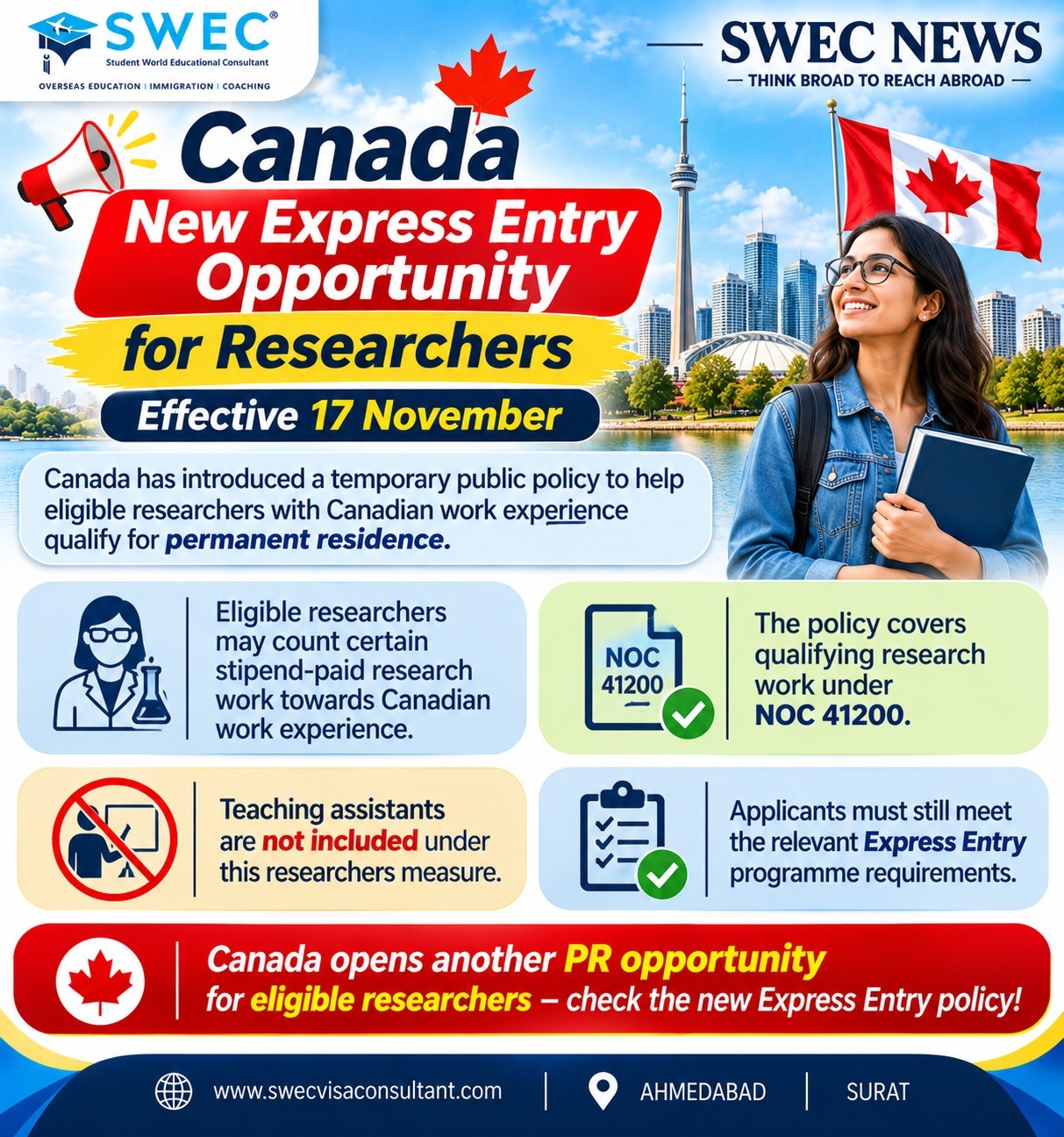
Canada has updated its Express Entry rules to recognize more types of paid Canadian work experience for certain researchers.
From 17 November 2026, eligible university professors and lecturers may be able to count research or teaching work paid through stipends, grants, bursaries or scholarships toward their Express Entry eligibility.
The change could help Indian researchers in Canada whose work is funded through academic arrangements rather than a regular salary.
However, this is not a new visa or a separate permanent residence program. It is a change to how certain work experience and job offers are assessed under Express Entry.
Canada Express Entry Researcher Update: Key Details
| Detail | What applicants should know |
|---|---|
| Effective date | 17 November 2026 |
| IRCC announcement | 18 November 2026 |
| Eligible occupation | University professors and lecturers, NOC 41200 |
| Funding covered | Qualifying stipends, grants, bursaries and scholarships paid by a Canadian entity |
| Programs affected | Canadian Experience Class and Federal Skilled Worker Program |
| Category change | NOC 41201 research and teaching assistant experience no longer qualifies for the researchers category |
What Has Changed for Researchers?
Some researchers are paid through university funding, grants or scholarships instead of a standard salary. Until this update, those payment arrangements could make it difficult to count their work experience under Express Entry.
Under a temporary public policy, eligible research and teaching work in NOC 41200 can now include certain non-wage compensation paid by a Canadian entity.
Immigration, Refugees and Citizenship Canada (IRCC) says qualifying experience paid in this way may count toward the requirements of the:
- Canadian Experience Class (CEC)
- Federal Skilled Worker Program (FSWP)
Qualifying work experience or job offers may also receive Comprehensive Ranking System (CRS) points.
The change does not mean every scholarship or grant automatically counts as work experience. Applicants must meet the policy conditions and the other requirements of their immigration program.
Who May Benefit From the New Rules?
The update focuses on university professors and lecturers under NOC 41200.
To benefit from the temporary public policy, an applicant must meet conditions that include:
- Receiving an Express Entry invitation to apply on or after 17 November 2026 and applying under the CEC or FSWP.
- Having at least one year of full-time Canadian work experience, or an equivalent amount of part-time experience, in NOC 41200.
- Gaining that experience within the three years before IRCC receives the permanent residence application.
- Showing that they performed the actions in the NOC lead statement and a substantial number of the occupation’s main duties.
A job title alone does not establish eligibility. IRCC looks at the work performed, the compensation arrangement and the applicable program rules.
Can Postdoctoral Researchers Qualify?
IRCC says the researchers category focuses on university-level academic and research roles, including professors, lecturers and postdoctoral researchers.
A postdoctoral researcher may benefit if their work meets the relevant NOC and policy requirements. However, the title “postdoctoral researcher” does not automatically confirm that a role falls under NOC 41200.
What Is the Researchers With Canadian Work Experience Category?
The Researchers with Canadian work experience category is part of Canada’s Express Entry category-based selection system. It was announced earlier in 2026.
The category allows IRCC to invite eligible candidates with qualifying Canadian research experience during category-based rounds.
Candidates must first qualify for an Express Entry program and enter the pool. They must then meet the researchers category requirements and the instructions for the relevant invitation round.
For an overview of the programs, eligibility and application process, visit SWEC’s Canada Express Entry immigration guide.
Meeting the category requirements does not guarantee an invitation. Eligible candidates are ranked, and IRCC issues invitations according to the rules of each round.
Research Assistants No Longer Qualify for This Category
The November update also changed the list of occupations eligible for the researchers category.
Work experience as a post-secondary teaching or research assistant, NOC 41201, is no longer eligible for the Researchers with Canadian work experience category.
| Occupation | NOC | Researchers category |
|---|---|---|
| University professors and lecturers | 41200 | May qualify if all requirements are met |
| Post-secondary teaching and research assistants | 41201 | No longer qualifies for this category |
This does not mean that someone with NOC 41201 experience cannot apply through Express Entry. They may still qualify under an immigration program or another category if they meet its requirements.
Can Researchers Get More CRS Points?
Qualifying Canadian work experience or a qualifying job offer may affect a researcher’s CRS score. The result depends on the candidate’s profile and whether the experience or offer meets IRCC’s rules.
NOC 41200 is included in the highest tier of IRCC’s high-wage occupations list. Under the current Labour Market Integration factor:
- A candidate with at least one year of qualifying Canadian experience in that tier may receive 70 additional high-wage experience points.
- A qualifying job offer in that tier may receive 100 points.
These points are not guaranteed. IRCC compares the points available for Canadian work experience with those for a qualifying job offer under this factor and uses the higher result. Candidates do not receive both scores together under the factor.
The high-wage classification is based on the occupation’s NOC and wage data, not the individual applicant’s salary alone.
What Indian Researchers Should Do Now
If you are an Indian researcher, lecturer or professor with Canadian work experience, take these steps before updating your profile:
- Check your NOC code. Compare your actual duties with NOC 41200.
- Review your work history. Check your dates, hours and the Canadian entity that paid you.
- Gather payment records. Keep funding agreements, stipend records, appointment letters and documents describing your duties.
- Update your Express Entry profile. IRCC advises candidates to add qualifying Canadian experience to their profiles.
- Check your program requirements. CEC and FSWP have different eligibility rules, including rules about work gained while studying.
- Review your job offer. A job offer must meet IRCC’s requirements before it can earn points.
Researchers whose experience was gained only in India should note that this particular policy and category require qualifying Canadian work experience.
Plan Your Canada PR Application With SWEC
The update may help eligible researchers whose academic funding arrangements previously made their Canadian experience difficult to count.
SWEC Visa Consultant can help you review your Express Entry options, understand your CRS score and plan your Canada PR application.
Sources
- IRCC: Express Entry updates for researchers
- IRCC: Temporary public policy for researchers with Canadian work experience
- IRCC: 2026 changes to Express Entry
- IRCC: Express Entry category-based selection
- BAL: Express Entry expands qualifying work experience for certain researchers
- CIC News: Canada broadens qualifying work experience for university professors and lecturers