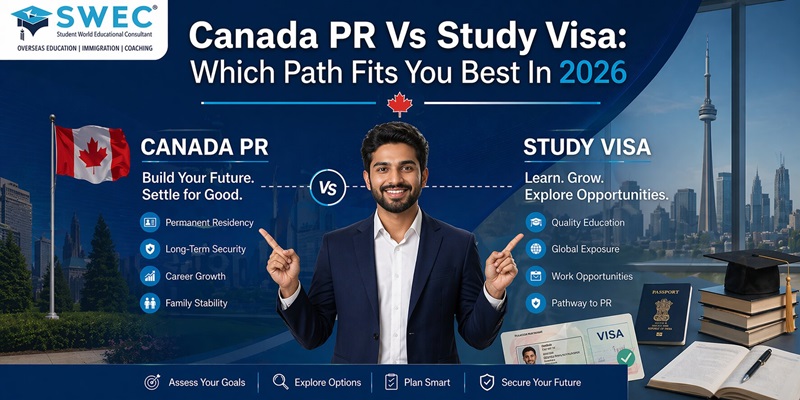
Should you study in Canada or apply for PR directly? You’re not alone in asking. Thousands of international applicants face this same choice every year, and picking the wrong path could cost you thousands of dollars and years of time.
Here’s what we see most often: many immigration consultants push you toward one option without really understanding your situation. They don’t know your budget, your work history, or when you need to settle. You deserve honest, clear information about both pathways so you can decide what actually fits your life.
That’s exactly what this guide does. We’ll compare Canada PR vs Study Visa side by side. You’ll see the real costs, how long each takes, what work rights you actually get, and which option matches your profile best. No sales pitch, no pressure—just the facts you need to move forward with confidence.
By the end, you’ll know exactly which path makes sense for you.
Key Takeaways
- Canada PR gives you permanent residency and unlimited work rights from day one. A study visa is a temporary pathway that usually lasts 2 to 4 years.
- You’ll spend $2,000 to $5,000 on a study visa route, while Canada PR typically costs $10,000 to $15,000 when you factor in all fees and tests.
- Study visa decisions often come in 4 to 24 weeks. Canada PR processing usually takes 6 to 12 months through Express Entry.
- On a study visa, you can work up to 20 hours per week on campus. PR gives you full work authorization with no restrictions.
- The most common path we see is study first, then apply for PR once you’ve built Canadian experience. Many of our clients follow this route successfully.
Canada PR Vs Study Visa, Quick Comparison At A Glance
A side-by-side view helps because you don’t need more information right now. You need a clearer decision. When you compare both options on cost, time, work freedom, and status, the trade-offs become much easier to see.
| Factor | Study Visa | Canada PR |
| Purpose | Study in Canada | Settle permanently |
| Immigration status | Temporary | Permanent resident |
| Average timeline | Often 4 to 12 weeks or longer for permit decision, but years to PR | Often about 6 to 8 months for Express Entry, longer for many PNP cases |
| Government fees | $150 permit + $85 biometrics | $990 processing + $600 right of permanent residence fee (from April 30, 2026) |
| Total estimated upfront cost | Often $16,000 to $42,000+ with tuition and living costs | Often $3,500 to $5,500+ with tests, medical, police checks, and documents |
| Work rights | Limited by permit conditions | Full work rights |
| Family benefits | Limited, depends on each family member’s status | Stronger long-term stability |
| Best fit | Students, career changers, weak direct PR profiles | Skilled workers with competitive profiles |
The one-line difference that matters most
A study visa lets you come to Canada to study for a limited period. Canada PR lets you live and work in Canada permanently.
That simple difference drives almost every other choice. If your main goal is education first, the study route may fit. If your goal is permanent settlement as soon as possible, PR is usually the cleaner option.
Fast snapshot of cost, timeline, and work rights
Study permits often move faster than PR files at the first decision stage. However, your full move timeline is usually longer because you still need to study, graduate, work, and then apply for PR.

PR costs more in direct filing fees, but it can save money over time because you skip tuition. It also gives you unrestricted work rights from day one, while student work depends on permit rules and enrollment status.
What You Really Get With A Study Visa In Canada
A study visa (also called a study permit) is temporary authorization to study at a Canadian educational institution. It’s not permanent residency, but it’s your gateway into Canada.
Here’s what it actually means: you’re allowed to live in Canada for the duration of your studies, typically 2 to 4 years depending on your program. A study visa is ideal if you want to gain a Canadian education, build local experience, or eventually transition to permanent residency. Many people also use it to work part-time while studying, which helps with costs.
Study Visa Requirements: You Need What
To get approved, you need to show IRCC that you’re a genuine student. Here’s what matters:
- Acceptance letter from a Designated Learning Institution (DLI) in Canada
- Proof of funds showing you can cover tuition plus at least $20,000–$30,000 CAD per year for living costs
- Valid passport that covers your entire stay in Canada
- Medical exam in some cases, depending on where you’re from
- Police certificate proving a clean criminal record
- Ties to your home country like family, a job waiting, or property that shows you’ll return after studies
Study Visa Processing Time and Cost Breakdown
Processing timelines vary by your country and current IRCC workload. Most cases take around 4 to 12 weeks or longer, so applying early matters. Peak season (July to August) can push timelines further out.
Here’s what you actually pay:
- Study permit application fee: $150 CAD
- Biometrics: $85 CAD
- Medical exam (if required): $100–$300 CAD
- Police certificate: $0–$100 CAD
- Document translation: $50–$200 CAD
- Travel to Canada: $500–$2,000 CAD

Your direct government fees add up to around $150 permit + $85 biometrics CAD. But here’s the real cost: tuition and living expenses. In 2026, you must show proof of funds including tuition plus at least $22,895 CAD in living costs outside Quebec. Once you factor in housing, food, insurance, and setup costs, your first-year total easily reaches $16,000 to $42,000 CAD or more.
Approval risk also matters. Study permit outcomes were much tougher in 2025. Overall approval rates fell to 35.7 percent, while first-time postsecondary applicants landed around 52 percent. University applicants performed better than many college applicants, as shown in this detailed breakdown of 2025 study permit approval rates. This means your school choice directly affects your approval chances.
“Since immigration and tuition fees or other fees are updated periodically, applicants should verify the latest costs on official government or university websites before applying.”
Who a study visa is best for
This route often fits you if you’re younger, changing careers, or still building your profile. It also makes sense if you want a Canadian credential and local work experience before aiming for PR.
If your current Canada PR eligibility looks weak, a study path can help you improve it. A good program choice can add education, language growth, and Canadian work history later.
Work Rights: How Much Can You Actually Work?
Yes, you can work while studying. But the rules matter.
On-campus work is usually allowed during school sessions. You can work up to 20 hours per week while classes are running, and full-time during scheduled breaks. Think library assistant, teaching assistant, or campus café.
Off-campus work becomes available after you’ve completed 50 percent of your program. Once you unlock this, you can work up to 20 hours per week during school and full-time during breaks. You can work any job in Canada at that point.
After graduation, you get a Post-Graduation Work Permit (PGWP). The length matches your program length, up to 3 years. This is when you can work full-time, and this work experience is crucial for building your Canada PR application later.
What Canada PR Gives You, And Why Many Skilled Workers Prefer It
Canada PR (Permanent Resident status) is the direct settlement route that gives you stronger rights from day one. Unlike a study visa, this isn’t temporary permission to study—it’s permanent permission to live and work in Canada indefinitely.
Here’s the simple difference that matters: a study visa gets you in the door for education. Canada PR gets you in the door for life. As a permanent resident, you get unlimited work rights anywhere in Canada, access to provincial healthcare, education benefits for your family, social security coverage, and a clear path to citizenship after three years. This is why many experienced professionals choose this route when they’re ready to settle permanently.
How to Get Canada PR: 4 Main Pathways in 2026
There are several ways to reach permanent residency, and the best one depends entirely on your situation. Here’s how they work:
Express Entry (Federal Skilled Worker) is for skilled workers with Canadian or foreign work experience. You need strong language scores (CLB 7+) and 1-2 years of experience in a skilled field. Processing usually takes about 6 months, making it the fastest option if you qualify.
Provincial Nominee Programs (PNP) match you with provinces that need your skills. You might need a job offer or specific work experience in a priority field. Processing takes 6-12 months, and it’s often less competitive than Express Entry.
Canadian Experience Class is perfect if you’re already working in Canada. You need 2 years of Canadian work experience, and processing takes 6-12 months. Many international students use this after their study visa and post-graduation work permit.
Family Sponsorship works if you have a Canadian citizen or PR sponsor who meets income requirements. There’s no education or experience requirement, but processing takes 12+ months.
You can also review common options in this 2026 guide to Canada PR pathways for more detailed comparisons. Most people we see follow this path: study visa first, then Canadian work experience, then PR through one of these routes.
Canada PR Eligibility: Do You Qualify Right Now?
To qualify for Canada PR, you typically need to meet these requirements:
You’ll need language proficiency at CLB 7 level (roughly IELTS 6.0) for most programs. The good news is you can improve this with study and practice if you’re not there yet.
Work experience matters—usually 1-2 years of skilled work in or outside Canada. Your experience needs to be in NOC Level 0, A, or B occupations (managerial, professional, or technical roles).
Education requirements include either a Canadian degree or a foreign credential that’s equivalent to Canadian education. You’ll need an Educational Credential Assessment to prove this.
There’s no strict age limit, but younger applicants score higher in points-based systems. Previous Canadian experience or a job offer also helps your adaptability score.
You’ll need to show financial proof that you can settle in Canada. This varies by family size but usually ranges from $15,000 to $25,000 CAD for a single applicant.
Finally, you must pass a medical exam and have a clean criminal record with proper security clearance.
The best part? If you don’t meet these Canada PR eligibility requirements right now, a study visa can help you build toward them over time.
Canada PR Processing Time and Cost: 2026 Update
Processing times vary by pathway. Express Entry typically takes about 6 months once you submit a complete application. Provincial Nominee Programs range from 6-12 months, and Canadian Experience Class falls in the 6-9 month range.
For costs, here’s the 2026 breakdown for a single adult:
- Express Entry application: $990 CAD (new fee from April 30, 2026)
- Right of Permanent Residence fee: $600 CAD
- Police certificates: $50–$100 CAD
- Medical exam: $300–$500 CAD
- Document translation: $100–$300 CAD
- Language tests and ECA: $500–$800 CAD
Your total application-related costs often land between $3,500 to $5,500 CAD before travel and settlement. If you hire professional help, consultant fees can add another $2,000 to $5,000 depending on your case complexity.
“Cost may vary, so check it or verify the latest cost on official government or university websites before applying”
Why Canada PR is Worth the Investment

Once you’re a permanent resident, you get benefits that change your entire Canadian experience:
Unlimited work rights mean you can work anywhere in Canada for any employer, with no restrictions or employer sponsorship needed.
Public healthcare access through provincial coverage means you don’t need private insurance (though many people still choose supplemental coverage).
Education benefits include children attending K-12 school for free, in-province university tuition rates instead of international fees, and access to RESP grants and student loan options.
Social benefits cover Canada Pension Plan eligibility, Employment Insurance access, and family allowance if you have children.
Citizenship path opens after 3 years of PR status. You can then apply for Canadian citizenship, travel with a Canadian passport (visa-free to 190+ countries), and sponsor family members to join you.
This is why Canada PR remains the ultimate goal for most immigrants—it’s worth the investment and wait time for the long-term stability it provides.
Canada PR Vs Study Visa: Complete Detailed Comparison
This is where most decisions become clear. You don’t need to ask which option looks easier on paper. You need to ask which one gets you to your real goal with the least waste of time and money.
Cost Comparison: Study Visa vs Canada PR
Let’s talk about real numbers because this often decides it for people. The Study Visa cost breakdown starts with $150 for the permit plus $85 for biometrics, then adds medical exams ($100–$300), police certificates ($50–$100), document translation ($50–$200), and travel ($500–$2,000). That’s $1,000–$2,900 before you even get to Canada.
Then comes the real expense: tuition. For a 2–3 year program at domestic rates, you’re looking at $5,000–$15,000 per year, totaling $10,000–$45,000. Your full Study Visa cost often lands between $11,000–$47,000+.
Now for Canada PR cost: $990 processing fee plus $600 right of permanent residence fee (from April 30, 2026), medical exam ($300–$500), police certificates ($50–$100), and document translation ($100–$300). That’s $2,040–$2,590. With professional help adding $2,000–$5,000, your total Canada PR cost is $3,775–$7,225.
The verdict? A study visa gives you education, experience plus a PR pathway later. Canada PR is faster, but it requires that you already have the credentials. Your Canada PR vs Study Visa decision depends on whether you need that education investment or can leverage existing qualifications.
Timeline Comparison: How Long Does Each Actually Take?
Time is money, and this is where people often miscalculate.
Study Visa processing time varies by your country. For Indian applicants, it’s typically 8–12 weeks. For Philippine applicants, 6–10 weeks. Overall, you’re looking at 4–24 weeks from application to approval.
But here’s the catch: that’s just to get your study permit. Your full journey to permanent status through study takes 2–4 years when you add program length and post-graduation work experience.
Canada PR processing time through Express Entry is often about 6–12 months from submission to final approval. However, you might need 1–2 years of work experience first to qualify. Recent April 2026 IRCC processing updates show that timelines can shift by program, with Federal Skilled Worker processing speeding up while Canadian Experience Class faces some backlog.
The real difference? A study visa gets you to Canada faster (1–2 months), but a Canada PR gets you to permanent status faster if you already qualify. Your total pathway time with Study Visa is 2.5 – 4 years versus 6–12 months with direct PR.
Work Rights: What You Can Actually Earn
This matters hugely for your income and career growth.
On a Study Visa, your work rights are limited. You can work on-campus up to 20 hours per week during school sessions, and full-time during breaks. After completing 50% of your program, you can work off-campus with the same limits. After graduation, you get a Post-Graduation Work Permit for up to 3 years with full-time work rights.
With Canada PR, you get unlimited work rights immediately. You can work full-time anywhere in Canada for any employer from day one.
The financial impact is dramatic. A student on a Study Visa might earn $500–$800 per week working 20 hours at $12–$16 per hour. A Canada PR holder can earn $1,500–$3,500+ per week in full-time professional work. That’s a difference of $2,000–$10,000+ per month in potential earnings.
Immigration Status: Temporary vs Permanent Security
This is the fundamental difference that changes everything.
Study Visa gives you temporary resident status that’s valid only for your study duration. You must maintain student status, and if you drop out or finish early, you must leave Canada. You have no permanent rights and initially no sponsorship rights for the family.
Canada PR gives you permanent resident status that’s valid indefinitely. You can stay in Canada forever, sponsor family members immediately, and apply for citizenship after 3 years. There are no employment requirements to maintain your status.
The key difference: PR is your permanent home; Study Visa is your temporary doorway. With PR, you have security and long-term planning ability. With a Study Visa, you’re always working toward the next step.
Education vs Experience: Which Builds Your Career Better?
Both paths help your career, but in completely different ways.
The Study Visa pathway gives you Canadian education recognized worldwide, skill development in your field, networking with Canadian classmates, and internship opportunities during studies. You get a credential advantage and Canadian work experience, but you start at entry level and spend $15,000–$45,000 on education. Your timeline to senior roles is typically 5–8 years after achieving PR.
The Canada PR pathway lets you leverage existing work experience immediately. You maintain your experience level, can jump into mid-level roles right away, and don’t need additional education credentials. You keep your professional network and career continuity. At $3,775–$7,225, it’s cheaper than school, and your timeline to senior roles is faster at 2–4 years.
Approval risk also differs between paths. Study permits faced tougher outcomes in 2025, with overall approval rates dropping to 35.7%. PR doesn’t have a reliable public approval rate for 2025–2026, so if you want official trend data, Canada’s operational processing updates provide better reference points than guesswork.
The verdict comes down to your situation: if you want to change careers or need Canadian credentials, a Study Visa makes sense. If you’re already skilled in your field and ready to settle, Canada PR is usually the better choice.
Can You Apply For Canada PR On A Study Visa? The Study-to-pr Pathway
Here’s what most people don’t realize: you don’t actually have to choose between a study visa and Canada PR. Most successful immigrants do both, and this hybrid approach is why the study-to-PR pathway remains the most popular route in 2026.
The Study-to-PR Pathway: How Most People Actually Succeed
This isn’t a secret workaround—it’s the standard path that thousands of international students follow every year. Here’s how it works:
You start with a study visa, complete your Canadian education, then use that credential and local work experience to build a stronger PR application. The process typically takes 3–5 years total, but it dramatically increases your approval chances because you’re building Canadian credentials the whole time.
Why does this work so well? It gives you Canadian education that employers recognize, local work experience that proves you can succeed in the Canadian job market, improved language skills from living here, and a network of references and connections. Most importantly, it shows IRCC that you’re genuinely committed to building a life in Canada, not just looking for a quick entry.
How to Transition from Study Visa to Canada PR: 7 Clear Steps
Here’s exactly how the journey unfolds, step by step:
Step 1: Get accepted to a Canadian university or college. This takes 2–4 months before your program starts. You’ll need to meet language requirements (usually IELTS 6.0+) and arrange your funds.
Step 2: Apply for your study visa. This takes 4–24 weeks depending on your country. You’ll submit your acceptance letter, proof of funds, and meet all eligibility requirements.
Step 3: Arrive in Canada and start your studies full-time. Your program will typically last 2–4 years for a diploma or degree.
Step 4: Work during your studies (optional but recommended). After completing 50% of your program, you can work off-campus up to 20 hours per week. This builds Canadian work experience and helps with income.
Step 5: Graduate and apply for your Post-Graduation Work Permit (PGWP). The length matches your program duration, up to 3 years.
Step 6: Work in Canada on your PGWP. You’ll need to secure a skilled job (NOC Level 0, A, or B) and accumulate 1–2 years of experience for your PR application.
Step 7: Apply for Canada PR through Canadian Experience Class. Submit your Express Entry profile and wait for an invitation. Success rates for this path are typically 80% or higher.
The total timeline is 3–5 years from study visa to PR, but you’re building value and security the entire way.
Why Study to PR is the Smart Choice for Most People
If you’re unsure which path to take, consider these advantages of the study-to-PR route:
It’s safer. Your PR approval rate jumps to 80%+ versus 50%+ for direct PR applicants because you build a stronger application with Canadian credentials.
You gain education benefits. A Canadian degree or diploma is recognized worldwide and gives you professional networking with Canadian peers that lasts throughout your career.
Your language improves naturally. Living in an English or French environment for 2–3 years dramatically improves your proficiency, which means higher test scores for your PR application.
You build Canadian work experience. Instead of trying to prove foreign experience counts, you have 2 years of local employment history that Canadian employers understand and value.
The risk is lower. If your PR application gets denied (which is rare on this path), you still have Canadian education and work experience. You’re not starting from scratch like direct PR applicants might be.
You get time to adapt. The 3–5 year timeline gives you space to adjust to Canadian lifestyle, build financial stability, and create community support—all things that make settlement easier long-term.

This pathway has the highest success rate and creates the smoothest transition to Canadian life. While it takes longer than direct PR, it builds the foundation for a successful long-term settlement that many direct applicants struggle to achieve quickly.
Who Should Choose A Study Visa? 4 Ideal Profiles
This section helps you self-identify where you fit. If you see yourself in one of these profiles, a study visa might be your smarter first move toward Canada.
Profile 1: Career Changers – Why Study Visa is Perfect for You
If you’re switching careers completely, a study visa makes more sense than trying to force your old experience into a new field. We see this often with people moving from sales, HR, or construction into IT, nursing, or accounting.
Here’s why it works: you gain Canadian education in your new field that employers actually recognize. You build credentials from scratch, network with professionals in your target industry, and get internship opportunities that help you transition smoothly. After graduation, job offers come easier because you have local training, and your PR approval chances jump significantly as a “Canadian educated professional.”
Profile 2: Young Professionals – Build Your Future with Study Visa
If you’re under 30 and early in your career, a study visa gives you time to build what you need for PR without the pressure. Many young professionals don’t have enough work experience yet to qualify directly, but they have the time to invest in education.
This path lets you buy time to gain more experience while Canadian education counts toward your PR requirements. Youth becomes your advantage in the points system, and you get 3+ years in Canada to build networks, savings, and flexibility to change paths if needed.
Profile 3: Budget-Conscious Applicants – Earn While You Study
If your budget is tight but you’re willing to work, a study visa can be more affordable than you think. This works well if you have $10,000–$20,000 saved but not the $25,000+ often needed for direct PR settlement.
Here’s the financial reality: you can work part-time while studying, earning $1,000–$2,000 per month. Your costs spread over 2–3 years instead of one lump sum. Some colleges offer cheaper tuition than universities, and scholarships are available for international students. After graduation, post-study work lets you save for your PR application without pressure.
Your out-of-pocket cost might look like: $8,000 year one (tuition + living minus part-time income), $6,000 year two, $4,000 year three. Total $18,000 spread over 3 years—much more manageable than upfront PR costs if you’re budget-conscious.
Profile 4: Education Seekers – Study Because You Want To
Sometimes, you genuinely want the education first, and PR becomes the bonus. If Canadian education matters for your career advancement or you’re passionate about a specific field, the study route honors that priority.
This path gives you world-class Canadian education recognized globally. You can focus on studies without PR pressure, build genuine professional networks, and know your education has value regardless of the immigration outcome. PR becomes the natural next step rather than the primary goal.

If you see yourself in any of these profiles, a study visa might be your ideal starting point. It’s not about choosing the fastest route—it’s about choosing the route that builds the strongest foundation for your Canadian future.
Who Should Choose Canada PR? 4 Ideal Profiles
If you see yourself in one of these profiles, direct Canada PR might be your smarter path than going through the study route first.
Profile 1: Experienced Professionals – Canada PR is Your Fast Track
If you have 5+ years of skilled work experience, Canada PR is usually faster and more direct. This path works best when you’re already established in your career and don’t want to go back to school.
Here’s why it makes sense: you use your existing experience instead of spending time and money on additional education. Express Entry can get you approved in 6–12 months, compared to 3–5 years through the study pathway. You maintain your career level, starting as a professional rather than a student, and you begin earning Canadian-level income immediately.
Profile 2: High Earners – Canada PR Saves Time and Money
If you’re already earning good money and time is your most valuable resource, Canada PR often makes more financial sense than the study route.
The math is straightforward: if you earn $100,000 per year, each year you spend in school costs you $100,000 in lost earnings plus $20,000 in tuition—that’s $120,000 per year. Over 3 years, that’s $360,000 in opportunity cost. Compared to a $7,000–$15,000 PR application fee, the direct route is dramatically cheaper for high earners.
This path lets you skip school completely, start earning immediately in Canada, leverage your existing expertise, and take the most direct route without detours. For people who value time over money, Canada PR is the clear choice.
Profile 3: Skilled Trades Workers – Canada Needs You Right Now
Electricians, plumbers, welders, carpenters—if you work in skilled trades, Canada is actively recruiting people like you through specialized pathways.
There’s a massive shortage of trades workers across Canada, and Provincial Nominee Programs actively recruit trades professionals. Some provinces even waive language requirements for certain trades, making the pathway faster than general skilled worker programs. Starting salaries range from $50,000–$70,000, and you can sponsor your family sooner through these dedicated streams.
Profile 4: Those Who Can’t Wait – Urgent Immigration Needs
Sometimes life circumstances require urgent action. If you need to immigrate within 12 months and can’t commit to 2–3 years of school, Canada PR is your only realistic option.
This path works when you’re already qualified or very close to meeting PR requirements. Express Entry can deliver results in 6–12 months, there’s no waiting for school completion, and the process is direct and straightforward. Success rates are high if you already meet the criteria.

If you see yourself in any of these profiles—experienced professional, high earner, skilled trades worker, or someone with urgent timeline needs—Canada PR is likely your best path. It’s about leveraging what you already have rather than building from scratch through the education system.
Which Option Is Better For You? Decision Matrix
By now, you understand the key differences between both paths. But which option actually fits your specific situation? Use this simple decision matrix to find your profile and see which path makes more sense for your circumstances.
| Your Profile | Best Option | Why This Works |
| Early career, less than 3 years experience | Study Visa | Build Canadian credentials and work experience first |
| Experienced professional with 5+ years work | Canada PR | Leverage your existing background directly |
| Career changer switching fields | Study Visa | Need new credentials for your target industry |
| Urgent timeline (need PR within 12 months) | Canada PR | Fastest legal pathway if you qualify |
| Limited budget (under $20,000 saved) | Study Visa | Spread costs over time and work during studies |
| High earner (over $80,000 per year) | Canada PR | Time value matters more than tuition costs |
| Education as primary goal | Study Visa | Get Canadian degree plus PR as bonus |
| Don’t want to go back to school | Canada PR | Direct path without education requirement |
| Skilled trades worker with experience | Canada PR | High demand, faster provincial pathways |
| Recent graduate with limited experience | Study Visa | Build Canadian work history first |
| Young professional under 30 | Study Visa | Maximize opportunities with time advantage |
| Weak work experience history | Study Visa | Build stronger Canadian profile from scratch |
Here’s what matters most: about 75% of international students eventually become permanent residents through the study visa pathway. It’s the most successful and reliable long-term route for building a Canadian life.
Canada PR is faster only if you already meet all the requirements right now. If you’re not sure which applies to your situation, that’s exactly what our team at SWEC helps you figure out during a free assessment.
Common Questions About Canada PR And Study Visa Choices
How much does Canada PR cost vs Study Visa?
A study visa costs less in filing fees, $235 including biometrics. But the full study route often costs much more once tuition and living funds are added. Canada PR fees are higher at the application stage, and the full case often reaches $3,500 to $5,500 with tests and documents. So, the cheaper form is not always the cheaper path.
Can I apply for PR while on a Study Visa?
Yes, in many cases you can. A common route is study, then a post-graduation work permit, then Canadian work experience, and later PR through Express Entry or a provincial stream. That path is popular because it helps you gain Canadian points and employer value. Still, no step guarantees the next one, so your program choice and job outcome matter.
How long does Canada Study Visa approval take?
Study visa processing time often falls around 4 to 12 weeks or longer, depending on your country and IRCC workload. Express Entry is often about 6 to 8 months once you submit a full PR application, while many PNP routes take longer. The bigger point is your total journey time. A quicker permit decision can still lead to a slower route to permanent residence.
Is SWEC Visa Consultant’s service covered by success guarantee?
You should never assume any consultant, firm, or lawyer can guarantee approval. Immigration decisions belong to IRCC, not to an agent. If you’re comparing study visa consultation, PR application help, or immigration lawyer cost, ask for the written service agreement, refund terms, and what happens if your case is refused. Clear paperwork matters more than bold claims.
Which pathway is better, PR or Study Visa, for my profile?
PR is usually better if you already meet Canada PR requirements and want to settle sooner. A study visa is often better if your direct PR profile is weak, you want Canadian education, or you’re changing careers. Compare your age, education, work history, budget, and long-term goal. The best path is the one that matches your current profile, not the one that sounds most popular.
Canada PR Vs Study Visa: Final Decision – Which Path Is Right For You?
You’ve now seen both paths clearly. Here’s what matters most:
Study Visa works best if you’re building your profile. It costs $2,000–5,000 plus education, takes 4–24 weeks to process, gives temporary status with limited work rights initially, but builds Canadian education and experience that leads to 80% PR approval rates through Canadian Experience Class. Perfect for career changers, young professionals, and those who don’t yet meet PR criteria.
Canada PR fits best if you’re already qualified. It costs $3,775–7,225, takes 6–12 months to process, gives permanent status immediately with unlimited work rights, but requires existing qualifications. Works well for experienced professionals, high earners, and those with urgent timelines.
The honest truth? Most successful immigrants don’t choose one over the other—they use both. They start with Study Visa Canada, build credentials and local experience, then transition to PR through Canadian Experience Class. This pathway delivers 80%+ success rates because it proves you can succeed in Canada.
Your best choice depends on your current experience, timeline, budget, and goals. There’s no one-size-fits-all answer, which is why professional guidance matters.
Ready to stop guessing and start with the right path? Schedule Your FREE Canada Immigration Assessment with SWEC today. We’ll analyze your specific profile and show you exactly which option fits your Canadian dream.