
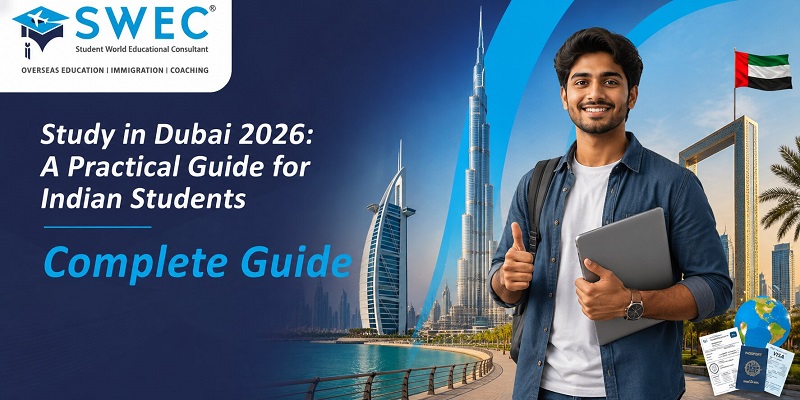
If you’ve been exploring study abroad options lately, chances are Dubai has come up more than once.
And honestly, there’s a reason for that.
Over the last few years, Dubai has quietly become one of the most practical international study destinations for Indian students. You get globally recognized universities, English-speaking campuses, strong safety, and a lifestyle that feels modern without being completely unfamiliar.
For many families, that balance matters a lot. It feels international, but not too far from home. And once students actually sit down and calculate the real costs and logistics, many discover that Dubai makes more sense than they initially expected.
This guide walks you through what study in Dubai actually looks like in 2026 – university options, popular courses, realistic costs, the visa process, and day-to-day life once you arrive. Whether you’re planning after 12th grade, after graduation, or as a working professional, this should give you a clear enough picture to move forward with confidence.

Key Takeaways
- Dubai has more than 70 accredited universities, including branch campuses of well-known UK and Australian institutions
- Annual tuition fees typically fall between AED 30,000 and AED 80,000, roughly ₹7 lakh to ₹20 lakh
- With the right documents, a student visa can be processed in about 3 to 6 weeks
- Dubai is only about 3 hours from most major Indian cities, closer than most people realize
- Part-time work is allowed for students who meet specific visa and university requirements
- Many universities offer merit scholarships covering up to 50% of tuition
- SWEC Visa Consultant offers free counseling to help you plan your academic journey in Dubai
Why Indian Students Are Choosing Dubai Over Other Countries In 2026
A few years ago, the default shortlist was Canada, UK, or Australia. Those countries are still popular, and for good reason. But more Indian students are now looking seriously at UAE campuses, not as a backup plan, but as a deliberate choice.
Here’s why that’s happening.
The distance from home matters more than most people admit
When you study in the UK or Australia, even a quick trip home becomes an expensive, exhausting event. Dubai is different. You can be back in India in under 3 hours from most major cities, with dozens of weekly flight options.
For families, that is a meaningful shift. Students feel less cut off. Parents feel more comfortable with the decision. A recent UAE guide for international students also points out how close and accessible the UAE feels for Indian families, and that comfort factor often ends up being the deciding one.
English is used almost everywhere
Arabic is the official language, but you’d hardly notice that in a university setting. English is the working language across campuses, offices, and most daily situations. On top of that, Dubai has one of the largest Indian communities in the world, you’ll regularly hear Hindi, Gujarati, Malayalam, and Telugu too.
For students going abroad for the first time, that familiarity takes the edge off. The city is also widely recognized for its safety, which matters quite a bit when you’re moving to a new country alone.
You can earn a globally respected degree without the full price tag
This is where things get genuinely interesting.
Many universities in Dubai are branch campuses of respected institutions in the UK, Australia, and the US. That means you could be earning a degree from a well-recognized university without paying the full cost of studying in that country.
It’s a strong deal when you think about it. You get the international exposure and the credential, but the overall financial burden stays more manageable. For families carefully comparing their options, that combination is hard to argue with.
Is It Actually A Good Idea To Study In Dubai In 2026?
Short answer: yes, for the right student. But let’s break that down properly.
A quick look at how the education system works
Before you apply anywhere, the first thing to check is accreditation. In the UAE, two bodies oversee higher education:
- KHDA regulates private education within Dubai
- MOHESR is the federal authority that handles university recognition across the entire UAE
If a university holds proper recognition from either body, your degree carries weight both within the UAE and internationally. When you’re comparing universities for Indian students, verifying this should be step one on your checklist.
What student life actually feels like
Here’s the reality: student life in Dubai is easier to navigate than most people expect before they arrive.
The city is genuinely safe, that’s not just a marketing line. Public transport is reliable, healthcare is well-organized, and everyday logistics are smooth. For newcomers, that infrastructure removes a lot of the friction that makes moving abroad stressful.
For Indian students specifically, there’s another layer of comfort. You’ll find Indian restaurants on most streets, cultural communities spread across the city, and a general sense of familiarity that makes settling in feel far less isolating. If your budget is planned well, student life in Dubai can be both affordable and genuinely rewarding.
Top Universities In Dubai For Indian Students

The UAE has more than 70 higher education institutions, but a handful of names keep coming up for good reasons. Here’s a practical breakdown.
Government universities
- United Arab Emirates University (UAEU), based in Al Ain – one of the UAE’s top public institutions
- Higher Colleges of Technology (HCT), known for applied sciences and technology programs
- Zayed University, with solid programs in business, communication, and arts
Private universities
- University of Dubai
- Amity University Dubai
- BITS Pilani Dubai Campus – especially well-known among Indian students
- Manipal Academy of Higher Education Dubai
- SP Jain School of Global Management
International branch campuses
This is where Dubai really stands out. Several respected overseas universities have full campuses here, offering the same qualifications as their home institutions.
- Heriot-Watt University Dubai (UK degrees)
- Middlesex University Dubai (UK degrees)
- University of Birmingham Dubai (UK degrees)
- Murdoch University Dubai (Australian degrees)
- Rochester Institute of Technology Dubai (US degrees)
Quick university comparison
| University | Top Program | Annual Tuition (AED) | Approx. INR |
| BITS Pilani Dubai | Engineering | 70,000 – 85,000 | ₹15.5L – ₹19L |
| Heriot-Watt Dubai | Business, Engineering | 55,000 – 75,000 | ₹12L – ₹16.5L |
| Manipal Dubai | Medicine, Nursing | 50,000 – 90,000 | ₹11L – ₹20L |
| Amity Dubai | MBA, IT | 40,000 – 65,000 | ₹9L – ₹14.5L |
| Middlesex Dubai | Media, Law, Business | 45,000 – 60,000 | ₹10L – ₹13L |
Fees are estimates only. Always confirm current figures on the official university website before applying.
Popular Courses Indian Students Choose In Dubai
Not every course makes sense for every student. Some open more doors, others suit specific interests. Here’s a realistic look at what Indian students most commonly pursue, and why.
Engineering and Technology
Computer Science, IT, Data Science, Civil Engineering, and Electrical Engineering remain among the top choices. These programs focus on applied skills and lead to competitive roles in tech and infrastructure.
BITS Pilani Dubai and Heriot-Watt University Dubai are two names that frequently come up for students building a strong technical foundation overseas.
Business and Management
One of the most consistently popular areas, especially for students who want flexibility in their career path. Whether you’re after a bachelor’s degree or an MBA, Dubai is a global business hub where these programs feel immediately relevant. SP Jain’s MBA is widely respected, and Amity and Middlesex also offer strong options here.
Media and Design
If you’re drawn to creative work, this is worth exploring seriously. Middlesex University Dubai has comprehensive programs in media, journalism, and design, and the city’s growing content and advertising industry means there are real internship opportunities while you study.
Hospitality and Tourism
This field fits Dubai almost perfectly. Tourism is a core pillar of the local economy, which means hospitality courses here carry real industry weight. The Emirates Academy of Hospitality Management is one of the most prominent institutions in this space. A master’s degree in this area can open direct placement opportunities in one of the world’s most dynamic tourism sectors.
Healthcare and Nursing
A strong, stable choice. Manipal Dubai has a well-established medical and nursing program, and demand for qualified healthcare professionals in the UAE continues to grow. For students planning long-term careers in healthcare, this remains one of the most future-proof options available.
Media Production and Digital Communication
Dubai’s digital and media industry has expanded significantly in recent years. If you’re interested in content creation, branding, digital storytelling, or production, this field is now genuinely worth a look, not just as a passion project, but as a viable career path.
Hospitality Management and Event Management
These two areas deserve individual attention because Dubai genuinely excels at both. The city hosts major international conferences, exhibitions, and events throughout the year, which creates consistent demand for trained professionals. Students in these programs tend to find real internship opportunities relatively easily.
Cost Of Studying In Dubai For Indian Students

Let’s be direct about this, cost is usually the first real question. Here’s a clear picture of what tuition fees and monthly expenses actually look like.
Tuition fees
The range depends heavily on the institution and program:
- Budget range: AED 30,000 – 45,000 per year (roughly ₹6.7L – ₹10L)
- Mid-range: AED 50,000 – 70,000 per year (roughly ₹11L – ₹15.5L)
- Premium range: AED 75,000 – 1,00,000 per year (roughly ₹16.5L – ₹22L)
These are broad planning figures. Confirm exact fees through the official university website or the UAE Immigration Authority before committing.
Monthly living expenses
Your actual monthly outgoing depends a lot on your choices. If you share a flat and cook most meals at home, the numbers stay quite manageable.
| Category | Monthly Cost (AED) | Approx. INR |
| Shared accommodation | 1,500 – 2,500 | ₹33,000 – ₹55,000 |
| Food (cooking at home) | 600 – 900 | ₹13,000 – ₹20,000 |
| Transport (Metro/bus) | 200 – 350 | ₹4,400 – ₹7,700 |
| Internet and phone | 150 – 200 | ₹3,300 – ₹4,400 |
| Miscellaneous | 300 – 500 | ₹6,600 – ₹11,000 |
| Total estimate | 2,750 – 4,450 | ₹60,000 – ₹1,00,000 |
By keeping things simple, many students manage on around ₹60,000 to ₹75,000 a month. That often surprises people who compare it to living costs in Indian cities like Pune or Bangalore. A recent Dubai student guide for 2026 also breaks down universities, visas, and career options in a way that is worth reading if you are still early in the research stage.
Scholarships: More Available Than You’d Think
The good news is that scholarships are available for students planning to study in Dubai, even though people do not talk about them as much as they do for places like Canada or Australia.
University-based scholarships
Most Dubai universities offer merit scholarships covering anywhere from 10% to 50% of tuition. BITS Pilani Dubai, Heriot-Watt University Dubai, and Middlesex University Dubai are particularly known for supporting international students.
The things universities typically look for:
- Academic scores of 80% or above in 12th or graduation
- Strong entrance test scores – SAT or IELTS depending on the course
- Early applications – round one applicants often get better consideration
If you’re applying for university admission in Dubai, submitting early genuinely matters.
Government scholarships
The UAE government does run scholarship programs from time to time, though not every year. It’s worth monitoring the Ministry of Education website and individual university pages for official announcements.
How to apply for scholarships
The process is usually straightforward, but the details matter. Here’s how it typically works:
- Apply through the university’s official portal — most institutions have a dedicated scholarship section during the application process
- Indicate that you want scholarship consideration — don’t assume it’s automatic; flag it explicitly in your application
- Write a strong statement of purpose — this carries more weight than most students expect, so don’t rush it
- Submit clean, complete academic transcripts — gaps or discrepancies in documents can quietly hurt your chances
- Apply in the first round if possible — early applicants tend to get better scholarship consideration at most Dubai universities
If you want support putting a strong application together, working with a trusted counsellor who knows the local education landscape, like the team at SWEC Visa Consultant, can help you avoid small but costly mistakes before you hit submit.
Dubai Student Visa Process From India, Step By Step
Visa paperwork is usually the part that stresses students out the most. Understandably so, but once you know what is actually involved, it is not as complicated as it looks.
If you would rather not navigate it alone, the SWEC Visa Consultant team can walk you through the entire process, from documents to submission.
Step 1: Get your admission letter first
Nothing else moves until this is done. You need a conditional or unconditional offer letter from your chosen university before anything visa-related can begin. Sort your admission first — everything else follows from there.
Step 2: Apply for the student visa
Here’s something that surprises many students: in the UAE, your university sponsors your student visa. You’re not applying directly to a government office the way you would in the UK or Canada. The university’s international office handles most of it, usually through the GDRFA or their own internal visa team.
It’s a smoother process than most people expect, especially if you’re working with a consultant who’s done this before.
Step 3: Get the medical test done
Once your file is moving, you’ll need a medical fitness check in the UAE, a standard blood test and chest X-ray. It’s quick and routine for most students, but you can’t skip it. It’s a mandatory part of getting your residency approved.
Step 4: Register for your Emirates ID
Think of this as your UAE identity card, you’ll use it for banking, healthcare, transport, and pretty much any official interaction. Once your visa comes through, get this sorted early. It makes everything else easier.
A note on what happens after you graduate
If you want to stay in the UAE and look for work after completing your degree, the country offers a Job Seeker Visa that lets graduates remain while actively job hunting. That’s a meaningful option for students who want to hit the ground running rather than flying home first.
Documents to keep ready
- Valid Indian passport (at least 6 months’ validity)
- University offer or admission letter
- 12th marksheets or graduation certificates (attested if required)
- Birth certificate
- Passport-size photographs
- Medical fitness certificate
- Health insurance (if your university doesn’t provide it)
- IELTS or English proficiency certificate (if required by your university)
Applying for a master’s? Some institutions will also ask for a CV, work experience proof, or additional academic records.
Visa fees and processing time
| Item | Approximate Cost |
| Student visa fee | AED 1,100 – 1,500 (roughly ₹24,000 – ₹33,000) |
| Emirates ID | AED 100 – 370 (varies by visa duration) |
| Medical test | AED 200 – 400 |
| Processing time | Usually 3 to 6 weeks |
Confirm all figures through your university or the UAE Immigration Authority before proceeding.
Can Indian Students Work While Studying In Dubai?
A lot of students ask this very early on. The simple answer is yes, but it depends on the rules set by your university and visa.
Many students in the UAE can work part-time during term, typically up to 20 hours a week, with full-time hours allowed during official semester breaks. That said, these permissions aren’t automatic for everyone. Check the specific rules attached to your student visa and your university’s own policies before making any financial assumptions.
When it does work out, part-time income helps. It probably won’t cover your rent, but it can take care of groceries, transport, and the occasional expense that comes out of nowhere. And beyond the money, it’s also a way to start building professional experience in an international environment, which matters once you’re job hunting.
Common roles students take on:
- Retail and hospitality positions in hotels and malls
- Private tutoring or academic support work
- Freelance digital tasks and remote projects
- Internships tied directly to their field of study
Most of these roles bring in somewhere between AED 1,500 and 3,500 a month. It varies a lot depending on the role and your skills, but it’s a useful buffer for day-to-day costs.
What Life In Dubai Actually Feels Like For An Indian Student
A lot of students arrive expecting it to feel more foreign than it does. For most Indian students, the adjustment is smoother than they anticipated.
The community makes a big difference
Dubai has one of the largest Indian communities in the world. Within a week of arriving, most students have already encountered familiar languages, found a restaurant that serves food from their region, and connected with others from similar backgrounds. That sense of familiarity doesn’t make Dubai feel small, it just makes it easier to settle in without feeling completely cut off from home.
The city is genuinely easy to live in
The Metro is clean, punctual, and affordable. The RTA bus network fills in the gaps. Healthcare is organized and accessible. And safety is one of Dubai’s most consistent realities, not just a selling point. For families back home, knowing their child is in a city that consistently ranks among the world’s safest makes the decision easier to sit with.
Affordable Indian food? Not a problem. Between restaurants and grocery options, home-cooked flavors are never far away.
Where most students end up living
- On-campus housing – convenient and well-managed, usually AED 1,500 – 2,500 per month
- Shared apartments – the most popular choice, typically AED 1,200 – 2,000 per person
- University-affiliated hostels – organized residential tie-ups near campus that many institutions offer
Dubai vs Canada vs Australia: Which One Actually Makes Sense In 2026?
Most students who end up choosing Dubai didn’t start out with it as their first option. They were looking at Canada or Australia, ran the actual numbers, and the picture shifted. That happens more often than you’d think.
| Factor | Dubai | Canada | Australia |
| Distance from India | ~3 hours | ~14–16 hours | ~11–13 hours |
| Tuition fees | More moderate | High | Very high |
| PR / immigration path | Limited (Golden Visa for top talent) | Strong | Strong |
| Part-time work | Allowed | Allowed | Allowed |
| Safety | Very high | High | High |
| Indian community | Very large | Large | Moderate |
| Post-study work | Emerging | Strong PGWP options | Usually 2–4 years |
| Language barrier | None | None | None |
Here’s an honest way to think about it: if permanent residency is the main goal, Canada and Australia are the better bet. The pathways are clearer, more established, and more predictable.
But if what you’re really after is a globally respected degree, a manageable budget, and a city that’s a three-hour flight from home, Dubai holds up extremely well. The UAE doesn’t run a traditional PR system, but strong graduates can qualify for the Golden Visa, which provides real long-term stability. And as Dubai’s job market keeps maturing, post-study work is becoming a genuinely viable path for international graduates who want to stay and build something there.
The point? There’s no single “right” choice. It depends on what matters most to you.
Are you chasing permanent residency? Canada or Australia wins. Are you after a respected degree, reasonable costs, and flexibility? Dubai deserves a serious look. Know what matters most to you, then pick the country that delivers it.
How SWEC Visa Consultant Helps Indian Students Study In Dubai
There is a point in this process where most students hit a wall, too many university options, unclear visa steps, scholarship deadlines they did not know existed. It is not that the information is hard to find. There is just a lot of it, and even small mistakes in documents or timing can set you back by weeks.
That is usually where the right guidance starts to matter.
The SWEC team specializes in helping Indian students navigate overseas education, not by handing out a generic list of colleges, but by looking at your profile, your budget, and your goals before suggesting anything. If you are trying to understand the Dubai student visa process from India, a Dubai Student Visa Consultant can walk you through the next steps in a more practical way.
What they help with:
- Free counselling session – your academic background, budget, and goals get reviewed before any recommendation is made
- University shortlisting – matched to your profile and the specific course you’re targeting
- Application support – SOP writing, document review, and admission guidance
- Scholarship guidance – identifying what you actually qualify for, not just what exists
- Visa documentation – complete, error-free file before submission
- Pre-departure support – accommodation, banking, travel prep
- Post-arrival check-in – so the first few weeks don’t feel like you’re figuring it out alone
For students whose plans extend beyond one destination, you can also connect with Study Abroad & Immigration Experts for broader international education guidance.
Frequently Asked Questions
What IELTS score do I need to study in Dubai?
Most universities ask for 6.0 to 6.5 for undergraduate programs and 6.5 to 7.0 for postgraduate ones. TOEFL is accepted at many institutions too, and some run their own internal English tests. If your previous studies were entirely in English, certain universities may waive the requirement, but confirm that directly with the admissions office before assuming.
Can I study in Dubai after 12th from India?
Yes. Most universities accept Indian students straight after Class 12, typically with a minimum of 60% to 75% in boards. Some courses additionally require SAT scores or an internal entrance test, check the specific requirements for the program you’re applying to.
How much does SWEC charge for counselling?
The first session is free. After that, fees depend on how much support you need, basic application help or full visa assistance. Get in touch with them directly for a clear breakdown. No hidden costs.
Is a Dubai university degree valid in India?
Yes, as long as the university is accredited by the KHDA or MOHESR. Degrees from campuses like BITS Pilani Dubai and Manipal Dubai are well-regarded by Indian employers, so your qualification holds up whether you stay in the UAE or come back home.
Can I work part-time while studying in Dubai?
Many students do, but it depends on your specific visa type and what your university permits. Before you factor part-time income into your monthly budget, verify the rules that apply to your situation. It can help cover expenses, but it’s not something you should count on before confirming you’re eligible.
What are the best courses to study in Dubai after 12th?
Engineering, business, IT, hospitality, media, design, and healthcare are all consistently popular. The right answer depends on your career direction, budget, and which university has a strong reputation in that area.
Final Thoughts: Is Studying In Dubai Worth It In 2026?
For the right student, genuinely yes.
You get a respected international degree, a city that is safe and well-run, English-medium classes, and a community that makes the first few months feel far less overwhelming than most study abroad experiences. The fact that you can be home in three hours is not a small thing either. It changes how families feel about the decision, and that comfort matters.
Costs are real, but they are not impossible to manage. Scholarships, shared accommodation, and part-time work can take a decent chunk off the total if your planning is sensible.
If permanent residency abroad is the main goal, Canada or Australia are usually the first places to look. They are more straightforward for that path. But if you want quality education, real international exposure, and a plan that does not ask your family to stretch beyond what feels reasonable, Dubai in 2026 is a strong, practical choice.
If you are at the stage of comparing universities, sorting out visa requirements, or simply trying to figure out where to begin, getting early guidance from the right people can save time and help you avoid costly mistakes. You can contact SWEC through their website whenever you are ready. Their team can assist with everything from university shortlisting to arrival support.
The earlier you start, the more options you have.