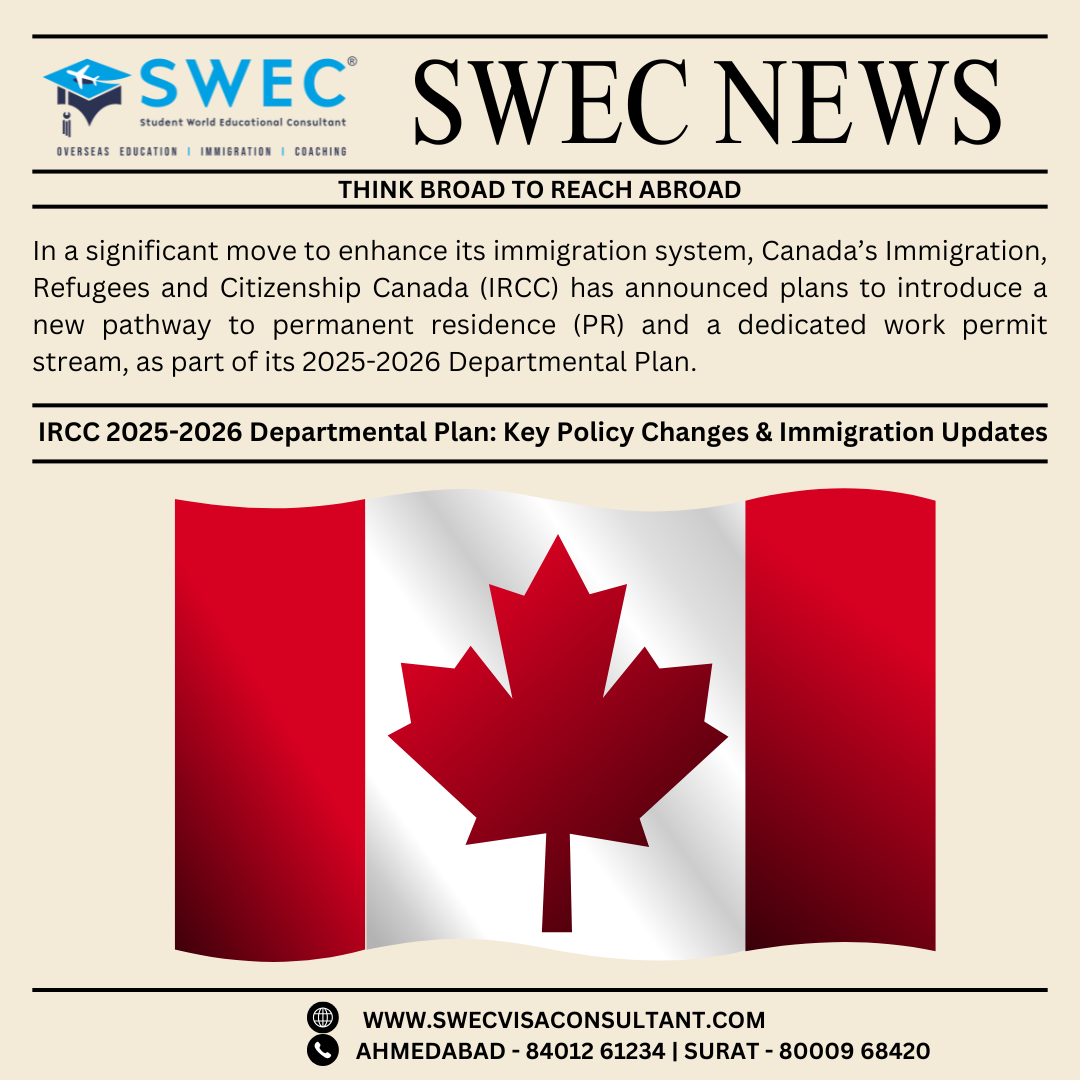
Canada’s immigration landscape is set for significant changes as Immigration, Refugees and Citizenship Canada (IRCC) unveiled its much-anticipated 2025-2026 Departmental Plan. Released on June 20, 2025, the plan outlines several policy updates, new permanent residence (PR) pathways, and work permit streams that will directly impact Canada’s immigration system in the coming year.
If you’re planning to immigrate to Canada in 2025 or 2026, here’s a detailed overview of what’s changing.
Key Highlights of IRCC’s 2025-2026 Departmental Plan
IRCC announced several new initiatives and reforms aimed at improving Canada’s immigration programs and services:
- A New Permanent Residence Pathway:
The Economic Mobility Pathways Pilot (EMPP) will become a permanent program by the end of 2025, offering new opportunities for skilled refugees to secure Canadian PR. - New Foreign Labour Stream for Agriculture and Fish Processing:
A specialized work permit stream is being developed for foreign workers in the agriculture and fish processing sectors, addressing labor shortages in these critical industries. - Updates to Post-Graduation Work Permit (PGWP) Requirements:
IRCC plans to revise the field of study eligibility criteria for PGWPs, impacting international students applying for work permits after graduation. - Changes to Spousal Open Work Permits (SOWPs):
New eligibility requirements will be introduced for spouses of foreign workers and international students seeking open work permits. - New Free Trade Agreements (FTAs):
Canada will implement new trade agreements with Indonesia and Ecuador, and work on expanding FTA-based work permits with countries in the Comprehensive and Progressive Agreement for Trans-Pacific Partnership (CPTPP) and the Association of Southeast Asian Nations (ASEAN). - Modernized Online Client Account:
Throughout 2025-2026, IRCC will launch a new digital client account for all immigration applicants, improving application tracking and processing. - Welcoming Francophone Communities Initiative (WFCs):
Full operational rollout of the Welcoming Francophone Communities Initiative is planned over the next fiscal year, supporting French-speaking newcomers. - Potential New PR Pathway for Refugee Students:
IRCC is exploring a new permanent residence pathway for refugee students, offering them long-term settlement opportunities.
Express Entry and Immigration Priorities for 2025-2026
The Departmental Plan reaffirms several existing commitments for Canada’s immigration priorities:
- Focus on healthcare workers, trade professionals, educators, and French-speaking applicants in category-based Express Entry draws.
- Prioritize temporary residents already in Canada for PR admissions, targeting at least 40% of new PRs from within the country.
- Speed up family sponsorship applications for relatives living outside Canada.
- Issue 80,000–84,000 Labour Market Impact Assessment (LMIA)-based work permits per year under the Temporary Foreign Worker Program (TFWP) — a notable drop from 184,000 permits in 2023.
- Reduce temporary resident levels to 5% of Canada’s population.
- Cap annual permanent resident admissions to no more than 1% of Canada’s population.
- Maintain limits on study permit applications while aiming to boost French-speaking PR admissions outside Quebec to 8.5%.
- Continue expanding settlement services and integration support for new immigrants.
- Roll out an online passport renewal system to simplify services for Canadian residents.
Canada’s Immigration Targets and Service Goals
IRCC aims to:
- Process 80% of all application types within standard service times.
- Achieve a 90% client satisfaction rate across immigration services.
- Maintain at least 65% public support for immigration levels by the end of each fiscal year (up from 50% in 2023-2024).
- Ensure international students and visitors contribute over $36 billion annually to Canada’s economy.
Canada’s Recent Immigration Policy Direction (2024-2025)
Throughout 2024, Canada’s federal government introduced policy changes to manage pressure on housing and public services, including:
- Capping study permit applications.
- Tightening eligibility for PGWPs and SOWPs.
- Imposing a moratorium on low-wage LMIA applications in high-unemployment metropolitan areas.
The 2025-2027 Immigration Levels Plan reflected this direction by:
- Reducing overall permanent resident admissions by 20%.
- Setting specific targets for net new temporary resident admissions.
- Mandating that 75% of PNP nominations go to candidates already inside Canada.
Express Entry Draws in 2025 (So Far)
As of this writing, Canada has conducted several Express Entry draws in 2025, aligned with its new category-based selection priorities.
Final Thoughts: What This Means for Aspiring Immigrants
These upcoming changes highlight Canada’s focus on streamlining immigration pathways, addressing labor market needs, and supporting economic growth through targeted immigration policies. For those planning to immigrate to Canada in 2025 or 2026, it’s essential to stay updated with these developments, adjust eligibility plans, and consult licensed immigration professionals where needed. Looking for expert guidance to navigate these upcoming changes in Canada’s immigration programs? SWEC is here to help. As one of the Best Canada immigration consultants in Ahmedabad and Surat, SWEC offers reliable, up-to-date advice and end-to-end support for your Canada PR, work permit, and study visa applications. Whether you’re applying through Express Entry, PNP, or student pathways, trust SWEC’s experienced team to guide you through every step of the process. Contact us today to turn your Canadian dream into reality.