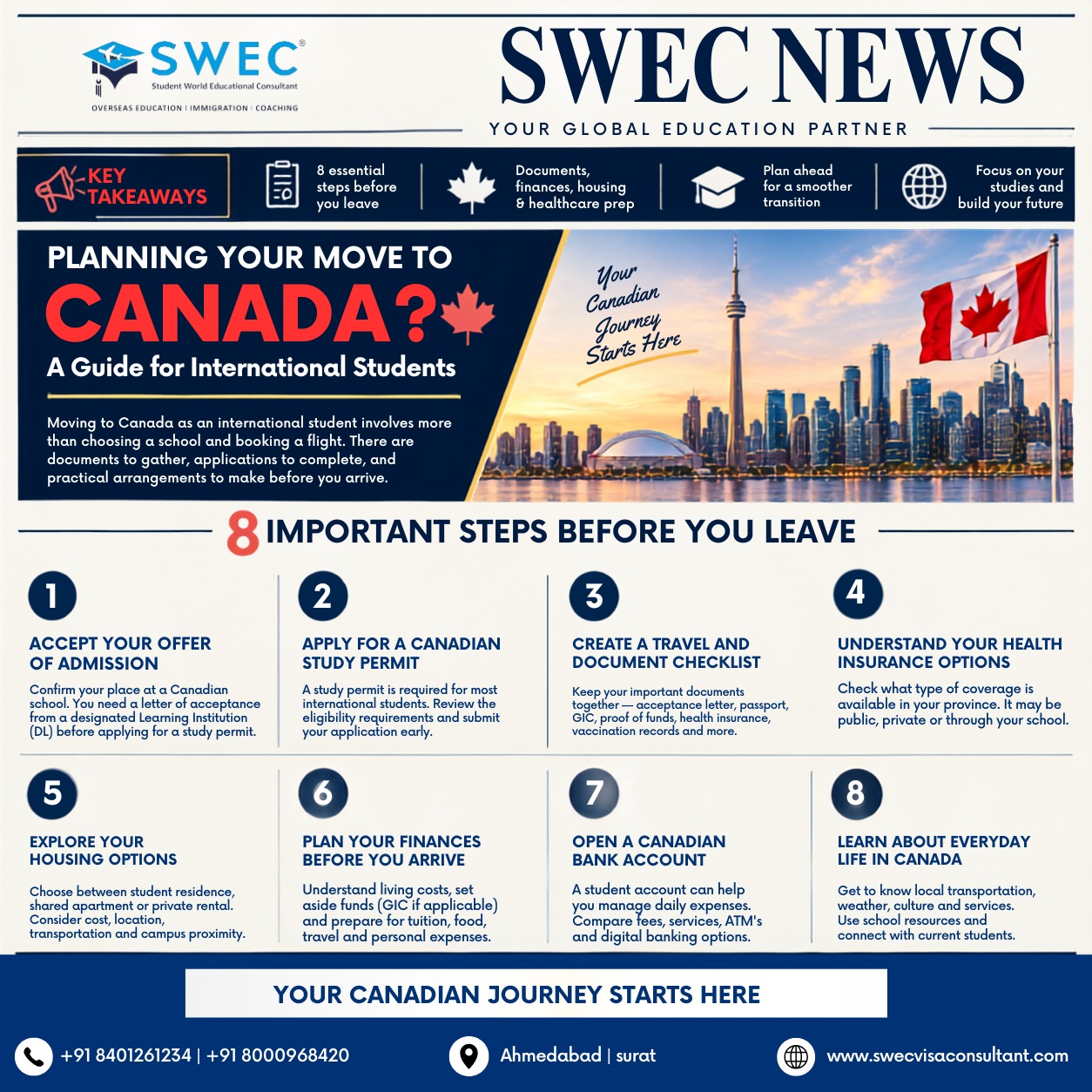
Moving to Canada as an international student takes more than receiving an offer letter and booking a flight. You need to prepare your documents, arrange funds, find a safe place to live, understand your health coverage, and plan for life after you arrive.
For students from India, good preparation can make the Canada study permit process less stressful and help you settle into your new city with confidence.
This guide explains what you should do before moving to Canada in 2026.
1. Accept Your Offer From a Designated Learning Institution
Your Canada journey begins when you receive and accept an offer from a Designated Learning Institution (DLI).
A DLI is a school approved by a provincial or territorial government to host international students. Most students need a Letter of Acceptance, also called an LOA, from a DLI before applying for a study permit.
Before accepting your offer, check these details carefully:
- Your course name and duration
- Campus location
- Tuition fee and payment deadlines
- Refund policy
- Whether the institution is on the official DLI list
- Whether your chosen program may support your post-study goals
- Any conditions mentioned in your offer letter
Do not choose a college based only on low tuition fees or an agent’s promise. Your course should match your education, work background, and future career plans.
If you are unsure about your options, read our guide on Canada student visa rules, PGWP updates, and key changes for 2026.
2. Understand Your Study Permit Requirements
Most students planning to study in Canada for more than six months need a study permit.
A study permit allows you to study at a Canadian institution. It is not the same as a travel visa. Depending on your nationality and approval process, you may also need a Temporary Resident Visa (TRV) or an electronic Travel Authorization (eTA) to travel to Canada.
You can review the official Canada study permit requirements on the IRCC website before you apply.
Your study permit application may require:
- Valid passport
- Letter of Acceptance from a DLI
- Provincial or Territorial Attestation Letter, if required
- Proof of tuition payment
- Proof of financial support
- Academic documents
- IELTS, PTE, TOEFL, or other language results, if relevant to your case
- Statement of Purpose
- Biometrics
- Medical exam results, if requested
- Police clearance certificate, if requested
Important PAL/TAL update for 2026
Many study permit applicants need a Provincial Attestation Letter or Territorial Attestation Letter, known as a PAL or TAL.
However, from January 1, 2026, students applying for a degree-granting master’s or doctoral program at a public institution are generally exempt from the PAL/TAL requirement.
Rules can change, so always confirm the latest requirement before submitting your application.
3. Build a Realistic Financial Plan
Canada wants to see that you can pay for your education and living costs without depending on work in Canada.
Your financial documents should show that you can cover:
- First-year tuition fees
- Living expenses
- Travel costs
- Funds for accompanying family members, if applicable
- A reasonable plan to fund the rest of your program
For one student applying outside Quebec, IRCC currently lists CAD 22,895 for yearly living expenses. This amount is separate from tuition fees and travel costs. It may be updated periodically, so check the official proof of financial support guidance before filing your application.
You may use documents such as:
- Recent bank statements
- Education loan approval letter
- Tuition fee payment receipts
- GIC confirmation, where applicable
- Scholarship letter
- Sponsor’s financial documents and support letter
- Proof of income or business income of parents or sponsors
Avoid showing large unexplained deposits in your account shortly before applying. Your funds should be clear, traceable, and supported by proper documents.
For a deeper breakdown, see our guide on the Canada student visa, GIC, and application process for Indian students.
4. Prepare Your Documents Before Booking Your Flight
Once your study permit is approved, create a travel folder with both original documents and digital copies.
Keep your key documents in your cabin baggage, not in your checked luggage.
Your travel folder should include:
- Valid passport
- Letter of Introduction or study permit approval letter
- Letter of Acceptance
- Tuition fee receipts
- Proof of funds
- GIC documents, if applicable
- Accommodation confirmation
- Travel insurance or health insurance details
- College address and contact details
- Emergency contact numbers
- Academic transcripts and certificates
- Vaccination records or medical documents, if needed
- Prescription and medical records, if you take regular medication
Save digital copies securely in your email, cloud storage, and phone. This can help if a document is lost during travel.
5. Arrange Accommodation Before You Arrive
Finding safe and affordable housing can be difficult in major Canadian cities. Start looking as early as possible after receiving your visa approval.
Your options may include:
- On-campus residence
- Homestay accommodation
- Shared rental apartment
- Private student housing
- Temporary hotel or hostel stay while you search for long-term housing
Before paying a deposit, verify that the listing is genuine. Rental scams are common, especially when students are searching from outside Canada.
Do not send money to someone you have not verified. Ask for a video call, written rental agreement, property details, and proof that the person is authorized to rent the property.
When comparing options, consider:
- Distance from campus
- Public transport access
- Monthly rent and utility bills
- Lease duration
- Safety of the area
- Furnishing and internet availability
- Rules for guests, cooking, and shared spaces
6. Learn About Health Insurance
Health coverage for international students differs by province, territory, and institution.
Some provinces may allow international students to access public health coverage after meeting local conditions. In other provinces, students need private insurance through their college, university, or an independent provider.
Before departure, ask your institution:
- Is health insurance included in my tuition fees?
- When does coverage begin?
- Does it cover emergency treatment?
- Does it cover prescriptions and dental care?
- Do I need temporary private insurance for my first few weeks?
Do not assume every medical expense will be free in Canada. Healthcare can be costly without proper insurance.
7. Plan Your First Month in Canada
The first few weeks can be busy. A simple arrival plan will help you stay organized.
Your first-week checklist
- Complete any college orientation process
- Collect your study permit at the airport, if applicable
- Move into your accommodation
- Get a Canadian SIM card
- Open a bank account
- Apply for a Social Insurance Number, if eligible
- Get a public transit card
- Attend your campus orientation
- Learn how to access student health services
- Find nearby grocery stores, pharmacies, and emergency services
You should also create a monthly budget for rent, food, transport, phone bills, books, and personal expenses.
International students may have permission to work under certain conditions, but part-time income should not be your main financial plan. Your focus should remain on studies and maintaining compliance with your study permit conditions.
8. Understand Your Study Permit Conditions
After arriving in Canada, you must follow the conditions attached to your study permit.
In most cases, this means you must:
- Remain enrolled at your approved DLI
- Make reasonable progress in your program
- Study according to your permit conditions
- Keep your passport and study permit valid
- Apply for an extension before your permit expires, if needed
- Follow work rules if you work during your studies
If you plan to change schools or programs, check the rules before making the change. Some transfers may require you to apply for a new study permit or study permit extension.
Our detailed guide on understanding the Canada study permit explains the permit conditions, documents, and important compliance steps.
9. Think Beyond Your Arrival, But Do Not Assume PR Is Guaranteed
Many Indian students choose Canada because they want global education, work experience, and possible long-term immigration options.
However, studying in Canada does not automatically guarantee permanent residence.
Your future options may depend on factors such as:
- Your program and institution
- Post-Graduation Work Permit eligibility
- Canadian work experience
- Language scores
- Occupation
- CRS score under Express Entry
- Provincial Nominee Program requirements
- Immigration rules in force at that time
Choose your course because it supports your career, not only because you hope it will lead to PR. Immigration policies can change, so your study plan should make sense on its own.
Get Ready for Canada With SWEC Visa Consultant
A well-prepared application and pre-arrival plan can help you begin your Canadian student journey with fewer surprises.
At SWEC Visa Consultant, we help students from Ahmedabad, Surat, and across Gujarat with:
- Profile assessment
- University and course selection
- Canada study permit documentation
- Statement of Purpose guidance
- Financial document planning
- Visa application support
- Pre-departure guidance
Planning to study in Canada in 2026? Speak with SWEC Visa Consultant for a clear assessment of your student profile and next steps.