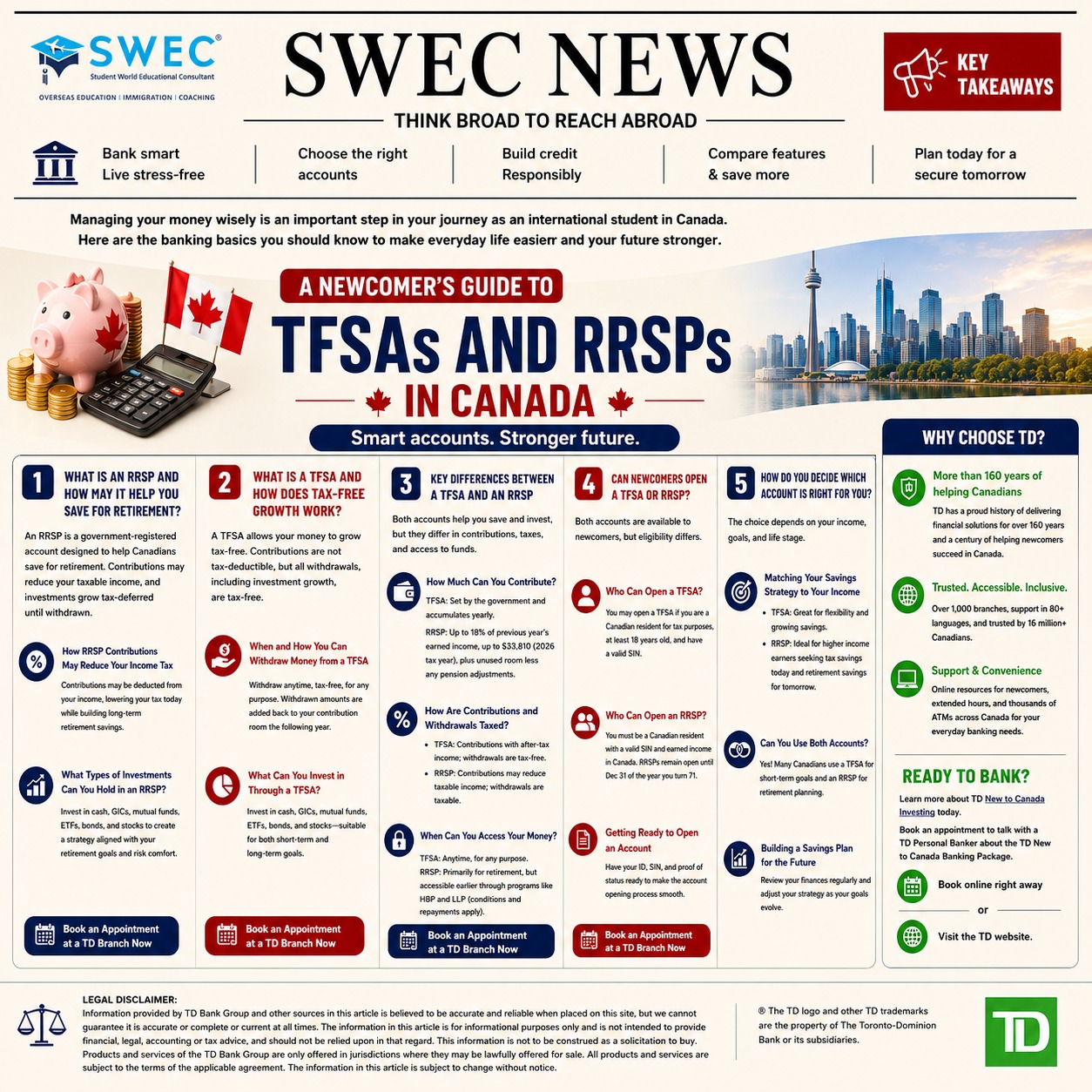
Canada is set to welcome around 385,000 newcomers in 2026 under the federal government’s 2026–2028 Immigration Levels Plan, and hundreds of thousands of them will open their first Canadian savings account this year. The Canada Revenue Agency (CRA) has confirmed the two numbers that matter most: the 2026 TFSA limit stays at $7,000, and the 2026 RRSP contribution cap is $33,810.
But financial advisors and settlement agencies continue to flag the same problem: newcomers keep applying rules meant for long-time residents, and it is costing them penalty taxes of 1% per month.
Here is what has been confirmed for 2026, and what new permanent residents, workers, and students need to know before contributing a single dollar.
TFSA Limit Holds at $7,000, but Newcomers Do Not Get Back-Years
According to the CRA’s TFSA contribution rules, the 2026 TFSA dollar limit is $7,000, added to accounts on January 1, 2026.
For newcomers, two details in the CRA guidance stand out:
- Room starts on the day you become a Canadian tax resident, provided you are 18 or older. It is not tied to citizenship or immigration status, and it is not prorated. Arrive in November and you still get the full $7,000.
- There is no retroactive room. Long-time residents have accumulated over $100,000 in TFSA room since 2009. Newcomers only earn room for years they were tax residents. Someone who became a resident in 2024 has $21,000 of room in 2026. Someone arriving this year has $7,000.
A Tax-Free Savings Account lets money grow tax-free. Contributions are made with after-tax income, and withdrawals, including all investment gains, are never taxed. It can hold cash, GICs, mutual funds, ETFs, and stocks. Temporary residents qualify too: work and study permit holders with a valid SIN (including SINs starting with 9) can open one, which matters for students navigating the Canada student visa and PGWP rule changes for 2026.
The penalty for getting it wrong is steep. Over-contributions, and any contribution made while a non-resident, are taxed at 1% per month until withdrawn.
RRSP Cap Rises to $33,810, but Most 2026 Arrivals Have Zero Room
The CRA’s registered plan limits for 2026 set the RRSP maximum at $33,810, or 18% of 2025 earned income, whichever is lower.
The catch for newcomers: RRSP room is created only by Canadian earned income reported on a Canadian tax return. Foreign income earned before arrival does not count. That means most people landing in 2026 have $0 RRSP room this year.
A Registered Retirement Savings Plan works on a “pay tax later” model. Contributions reduce taxable income now, often producing a refund, and withdrawals are taxed as income later. Room appears only after a newcomer files their first Canadian tax return and receives a Notice of Assessment (NOA) from the CRA, typically in spring of the following year.
There is one piece of good news: unused RRSP room carries forward indefinitely. A newcomer earning $60,000 in 2026 will see roughly $10,800 in room on their 2027 NOA, and waiting costs nothing.
Withdrawal Rules: Where the Two Accounts Split
TFSA withdrawals are tax-free and do not count as income, so they do not reduce benefits like the Canada Child Benefit. Withdrawn amounts are restored to contribution room, but only on January 1 of the following year.
RRSP withdrawals are taxable. Under CRA withholding rates, banks withhold 10% on amounts up to $5,000, 20% up to $15,000, and 30% above that (outside Quebec), with the full amount added to taxable income at filing. Non-residents face a flat 25% withholding. Exceptions exist for first-home purchases (Home Buyers’ Plan, up to $60,000) and education (Lifelong Learning Plan).
What This Means for 2026 Arrivals
With record numbers arriving through economic streams, including the 105,000 immigrants Canada plans to welcome through the Provincial Nominee Program, the practical takeaway for the 2026 cohort is a sequence, not a choice:
- Year one: Get a SIN, confirm tax residency, and start with the TFSA ($7,000 room). RRSP room is likely zero.
- Year two: File the first Canadian tax return and check the NOA for RRSP room.
- Year three onward: Add RRSP contributions as income rises, especially where an employer matches contributions.
The same logic applies to families. Spouses arriving on a Canada dependent visa each build their own TFSA room from their own residency date, and each needs their own SIN.
Quick Facts: TFSA vs RRSP in 2026
| TFSA | RRSP | |
| 2026 limit | $7,000 | $33,810 or 18% of 2025 income |
| Newcomer year-one room | Full $7,000 | Usually $0 |
| Tax deduction | No | Yes |
| Withdrawals | Tax-free | Taxed as income |
| Penalty risk | 1%/month on excess or non-resident contributions | Withholding tax on early withdrawals |
FAQs
Can newcomers open a TFSA in 2026?
Yes. Anyone 18 or older who is a Canadian tax resident with a valid SIN can open one, including work and study permit holders.
How much TFSA room does a 2026 arrival have?
$7,000, regardless of arrival month. No room accrues for years before tax residency began.
Can a newcomer contribute to an RRSP in their first year?
Usually not. Room requires prior-year Canadian earned income, confirmed on a Notice of Assessment.
Is a TFSA or RRSP better for a newcomer?
Most start with a TFSA while income is lower, then add an RRSP as income and tax savings grow. It depends on individual circumstances.
What happens if I contribute after leaving Canada?
TFSA contributions made as a non-resident are taxed at 1% per month; non-resident RRSP withdrawals face 25% withholding.
Planning your move to Canada in 2026? Speak with a SWEC visa consultant about PR, work, study, and dependent visa options.
Sources:
- Canada Revenue Agency – TFSA Contribution Rules and Limits: https://www.canada.ca/en/revenue-agency/services/tax/individuals/topics/tax-free-savings-account/contributing.html
- Canada Revenue Agency – Registered Plans: 2026 Contribution Limits (What’s New): https://www.canada.ca/en/revenue-agency/services/tax/registered-plans-administrators/whats-new.html
- Canada Revenue Agency – Tax Rates on RRSP Withdrawals: https://www.canada.ca/en/revenue-agency/services/tax/individuals/topics/rrsps-related-plans/making-withdrawals/tax-rates-on-withdrawals.html
- Immigration, Refugees and Citizenship Canada – 2026–2028 Immigration Levels Plan: https://www.canada.ca/en/immigration-refugees-citizenship/news/notices/supplementary-immigration-levels-2026-2028.html